MINSK, 9 April (BelTA) – The use of wood pellets by the population has grown fourfold since 2021, BelTA learned from Vitaly Kretsky, Deputy Chairman of the State Standardization Committee, Director of the Energy Efficiency Department, at a press conference.
The deputy chairman noted that the situation in the world is unstable, and many states are thinking about the rational use of energy resources. This topic is relevant on the global agenda. “Our country began addressing energy efficiency issues from the moment it gained independence, about 35 years ago. A legislative framework has been built along with the entire logical chain across the power vertical together with relevant regulatory and program documents. Work in this direction is carried out according to two key approaches,” noted Vitaly Kretsky.
The first approach is to increase the country’s energy self-sufficiency. “We are not so rich in energy resources, this is why the main task is to strengthen energy security and independence. Last year the sixth state program in the field of energy saving (implemented in five-year increments) was successfully completed. All targets were hit. The key indicator is the integration of domestic energy resources into the fuel and energy balance. This direction aligns with the National Security Concept. In 2025 the country’s energy self-sufficiency exceeded 30%. We have set a similar task for the current five-year period: we plan to increase this indicator to 33% by 2030,” he said.
The main contribution to the self-sufficiency indicator, apart from the nuclear power plant, comes from the use of domestic energy resources – primarily wood fuel. “The annual use of local fuels is about 3.5 million tonnes of fuel equivalent, which is equivalent to replacing about 3 billion m3 of natural gas. There are good examples: in Vitebsk Oblast and Mogilev Oblast the share of local energy resources used by public utility organizations is already close to 50%. The heads of these regions can be confident that even in the event of supply disruptions they will provide the required volumes of heating and hot water supply to populated locations. If we go down to the district level: out of 118 districts 66 already have a share of domestic energy resources exceeding 50%, and in some it is close to 90%,” emphasized Vitaly Kretsky.
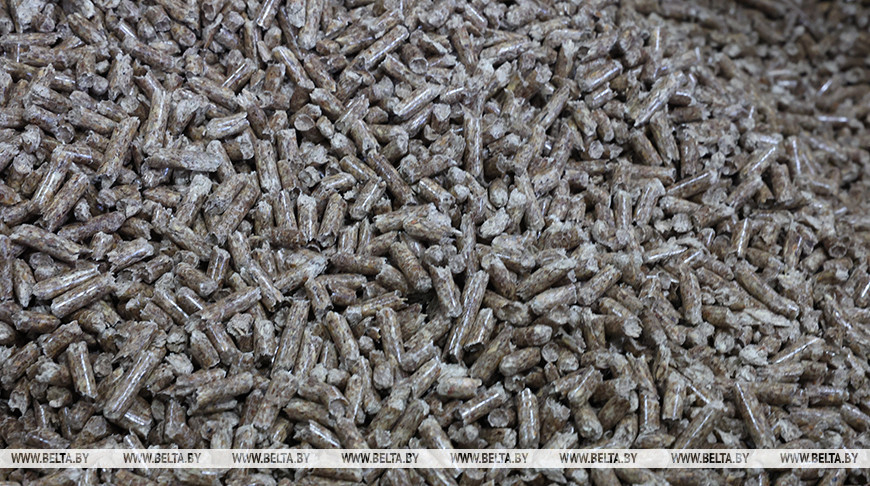
During the past five-year period as many as 71 energy sources with the total capacity of over 350MW were commissioned, making it possible to replace imported fuels by switching to local energy resources. It is equivalent to the annual replacement of about 80 million m3 of natural gas. “Literally a couple of years ago we actively began introducing wood pellets as fuel. Several large installations with the capacity of 10MW using this type of fuel have already been built. The population is also being actively engaged: compared to 2021, the use of wood pellets by the population has grown fourfold. This is facilitated by the state policy: a unified price for this type of fuel has been set regardless of the chosen heating method (firewood, peat briquettes, or wood pellets) while wood pellets are a more modern type of fuel that allows fully automating the heating process in a residential home. Apart from that, the state compensates 40% of the cost of boiler equipment,” noted the deputy chairman.
The second approach is work to improve the energy efficiency of the economy as a whole. Targets for improving the efficiency of energy use are set annually. “We do not force enterprises to reduce consumption. There are enough resources in the country. Our requirement is to use resources efficiently, with the lowest costs for the production of heat and electric energy, products, and the performance of work,” Vitaly Kretsky pointed out.
During the previous five-year period about 3.1 million tonnes of fuel equivalent were saved, thus exceeding the target of 2.5 million. The result of all this work is a reduction in the energy intensity of the gross domestic product. “Over five years we reduced it by 1.8% while the target was 1.2%. When compared to other post-Soviet countries or within the framework of the EAEU, the rate of energy intensity reduction in our country is among the best. And if we compare results with 2000: our GDP has grown by 36% while energy consumption has increased by only 12%. This is the result of the work of the entire country, all organizations, ministries, and government agencies,” he cited figures.
For a specific enterprise the effect is manifested primarily in the reduction of cost per unit. After analyzing more than 2,000 product items last year, it was determined that the reduction in cost per unit in the course of making certain types of products ranged from 0.3% to 38%. For example, Minsk Margarine Plant achieved the effect due to the introduction of modern boiler equipment. “Today efficiency is increased mainly by modernizing existing production facilities. We implemented quick-payback, low-cost measures such as the replacement of light bulbs, windows back in the 2000s. Today we focus on modernizing the production, and it is in this area that we achieve the greatest effect,” summarized Vitaly Kretsky.