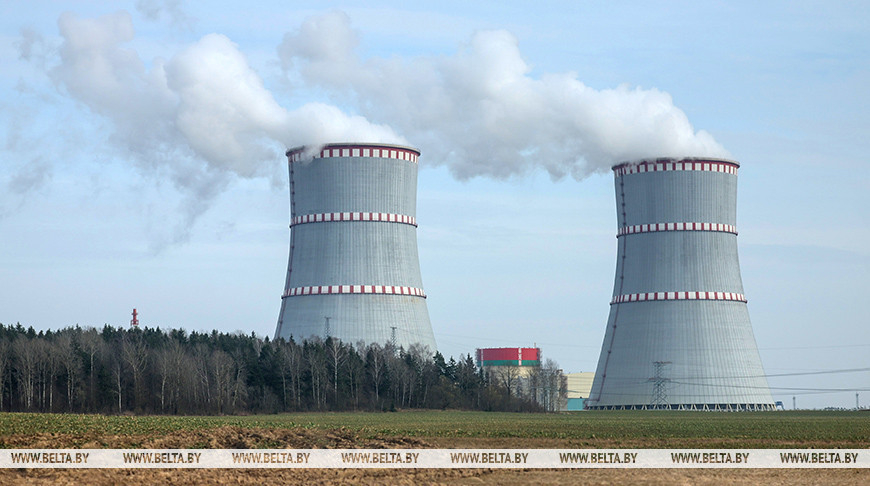
MINSK, 29 April (BelTA) – Aleksandr Rakavchuk, head of the radiation safety workshop at the Belarusian Nuclear Power Plant (BelNPP), explained how safety is ensured at the plant in a new episode of BelTA’s Nation Speaks project.
The BelNPP design fully aligns with the current state of scientific and technological development, Aleksandr Rakavchuk said. “It is technologically advanced and meets all international and national safety requirements. All aspects have been considered during the design phase: the monitoring network has been expanded, a multi-level protection system has been installed, and automated systems for radiation control and radiation environment monitoring have been implemented. Operational monitoring tools are also used, including radiometric vehicles equipped with the necessary instrumentation for conducting radiation monitoring in the sanitary protection zone and the observation zone,” he said.

The project has been implemented using the principle of deep, multi-layered protection. This involves establishing physical barriers to prevent the release of radioactive substances and ionizing radiation into the environment, as well as organizational and technical measures to ensure reliable protection and functioning of these barriers. The entire radiation monitoring system at the BelNPP allows for continuous monitoring of the condition of all barriers, the workshop head said.
Automated radiation environment monitoring systems operate at industrial sites, in controlled access areas, in buildings and on the grounds of the sanitary protection zone, as well as outside the facility. “In addition, automated systems for individual dosimetric monitoring and for preventing the spread of radioactive contamination are in operation. Together, all these systems allow the plant’s condition to be assessed in real time. The radiation monitoring system itself can be called an ‘all-seeing eye’. We observe all processes and promptly register any deviations from the technological process. This enables us, upon identifying trends in changes to radiation parameters, to quickly implement measures to prevent the development of abnormal situations,” Aleksandr Rakavchuk explained.
“Our plant meets the highest safety standards. In 2019, before the first power unit was put into commercial operation, an IAEA Operational Safety Review Team (OSART) mission took place. Based on its findings, a positive assessment was given, after which we proceeded with the acceptance of the first power unit, and subsequently the second in 2023,” he emphasized.

With regard to emergency situations, the BelNPP is in a state of constant readiness: drills are conducted annually. “As the operating organization of a nuclear energy facility, we prioritize this. Together with safety regulatory bodies, we conduct planned annual inspections and practice response actions for hypothetical nuclear or radiation accidents,” Aleksandr Rakavchuk said.
Data exchange takes place at the level of crisis centers. “Gosatomnadzor is represented by an information and analytical center. We also interact with the Healthcare Ministry, the Natural Resources and Environmental Protection Ministry, the National Academy of Sciences, as well as with foreign partners, including the Kurchatov Institute (Russian Federation),” the workshop head said. “A department for nuclear and radiation safety supervision operates at the BelNPP site, which routinely conducts ongoing safety assessments. In this format, we also continuously interact with regulatory bodies."