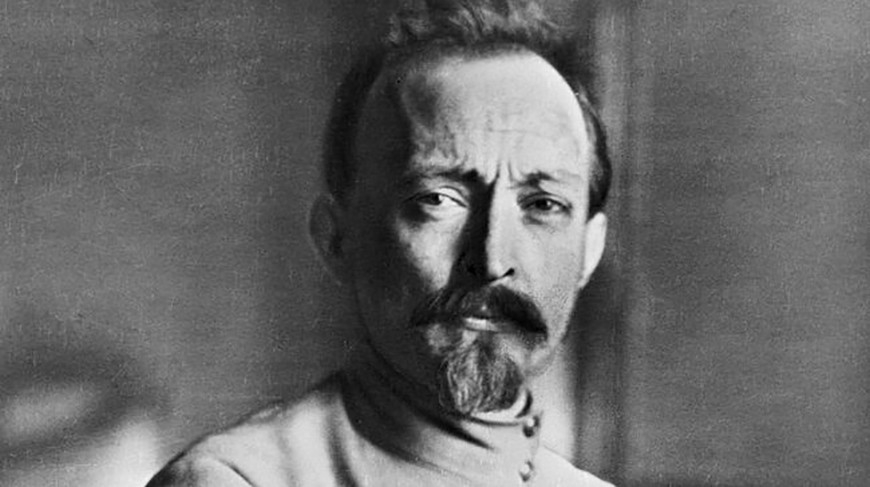
An archive photo courtesy of RIA Novosti
News of the story
"On Point"
Felix Dzerzhinsky is one of the most famous Soviet political figures. He went down in history primarily as the head of the All-Russian Extraordinary Commission for Combating Counter-Revolution and Sabotage (VChK or Cheka for short). This state body is considered the predecessor of organizations such as the GPU, NKVD, KGB, and other ones. However, Felix Dzerzhinsky’s efforts were not limited to his work at the VChK. What was the revolutionary’s childhood like? How many times was he arrested? How did he fight homelessness and why did he get the nickname “Iron Felix”? All the questions are answered by the latest episode of BelTA’s project On Point. History by Candidate of Historical Sciences Sergei Aleksandrovich, Associate Professor of the Department of History of Southern and Western Slavs at Belarusian State University.
Where was Felix Dzerzhinsky born?
Felix Dzerzhinsky was born in the family estate of Dzerzhinovo in 1877. At the time of the Russian Empire it was Oshmyany Uyezd, Vilna Governorate. Nowadays it is Stolbtsy District, Minsk Oblast. Originally, the estate was called Ozemblovo, but it was renamed by the father of the future revolutionary and founder of the VChK. Edmund-Rufin Dzerzhinsky received it as a dowry from the family of his future wife. Over time a house was built in the estate. It was designed by architects who were relatives of the Dzerzhinskys.
“It was a large family: parents and nine children. The first child died literally right after birth, and the rest lived lives of varying lengths – some were longer, some were shorter. There were also long-livers among them. For example, the eldest sister Aldona died in Lodz in 1966 at the age of 96,” the historian says.
Felix Dzerzhinsky was the sixth child in the family. It is known that shortly before giving birth, his mother tripped and fell into a cellar, but the child was unharmed and was born healthy. According to one version, it was after this incident that the child was named Felix, which translates as “lucky.”
What was the childhood of the VChK founder like?
According to the memoirs of Felix Dzerzhinsky himself, his childhood was unusual. On the one hand, the family was large and sometimes in need of money, but on the other hand, it was very close-knit and was raised in Catholic traditions. The mother played a big role in raising the children. Together with the children she often sang songs of the rebels from the uprisings of 1830-1831 and 1863-1864.
“The family spoke only Polish. Everyone was baptized into the Catholic faith and were churchgoing people. Up to a point little Felix even dreamed of becoming a Catholic priest,” notes Sergei Aleksandrovich.
Initially, Felix Dzerzhinsky was educated at home thanks to assistance of both his father’s relatives and his mother’s relatives. Apart from that, his older sister, who was a student in Vilna, also came home and helped little Felix with his studies.
At the age of ten, he entered the First Vilna Men’s Gymnasium to continue his education. By this time, Felix Dzerzhinsky’s father had died of tuberculosis, and the child was forced to live with relatives in Vilna.
What is known about Dzerzhinsky’s school years?
“He was better at exact sciences than at humanities. Especially in the first years of study, Felix Dzerzhinsky excelled in the study of the Scripture. Russian was the hardest subject for him. Apparently, there were some reasons related to his upbringing: before moving to the provincial capital, Felix Dzerzhinsky had almost never heard or spoken Russian,” the historian emphasizes. “Apart from that, he had difficulty with the classical language that was compulsory in Russian Empire gymnasiums – Ancient Greek.”
As Sergei Aleksandrovich notes, in Russian Empire gymnasiums, behavior and diligence of students were as important indicators as academic performance. A special journal was even kept to record the misdemeanors or achievements of the gymnasium students. For instance, young Felix had certain behavioral problems and conflicts with classmates. The future revolutionary himself in those years was an explosive and energetic, but at the same time reserved, young man.
Around that time Felix Dzerzhinsky’s interest in religious topics spiked. At some point he even seriously thought about becoming a Catholic priest. Nevertheless, the religious education teachers dissuaded him from this idea.
What sparked Dzerzhinsky’s interest in studying Marxism?
In 1896 Felix Dzerzhinsky was forced to stop studying due to the deteriorating financial situation of the family. By this time, he had already been participating in revolutionary activities for two years. According to the historian, Felix Dzerzhinsky’s interest in studying the ideas of Marxism was caused, among other things, by his upbringing.
“Apparently, this was facilitated by his personal convictions that were shaped primarily by his mother. These include echoes of the suppression of the 1863-1864 uprising and the Russian Empire policy in Vilna itself where Catholic churches were closed. Cossacks would sometimes disperse parishioners who tried to preserve these Catholic churches,” notes Sergei Aleksandrovich.
Felix Dzerzhinsky joined a Marxist study group in 1894. At the same time, his first underground pseudonyms appeared – Jakub and Jacek. Although he did not graduate from the gymnasium, the future founder of the VChK was a highly educated man. Felix Dzerzhinsky began writing revolutionary leaflets and proclamations, in which he called for overthrowing the autocracy, for expanding the workers’ rights, and for fighting for economic and political rights. He personally reproduced these materials using the copying technology of the time, earning him another pseudonym – the Bookbinder. Around that time Felix Dzerzhinsky was arrested for the first time.
How many times was Dzerzhinsky arrested?
“Historians count six arrests, two of which ended in exile to Siberia. From both exiles Felix Dzerzhinsky escaped, demonstrating extraordinary proclivity for conspiracy and willpower even despite his rather poor health. The fact is that by the time of his second exile, he was already ill with tuberculosis,” says Sergei Aleksandrovich. “There is an opinion that he contracted tuberculosis in prison while caring for a comrade in revolutionary struggle who was suffering from this disease.”
As the historian notes, the Russian Empire authorities had a fairly humane attitude towards revolutionaries. If they were exiled to remote regions of the Russian Empire, it was considered kind of a guarantee that revolutionary activity would not affect the situation in large cities. For example, in the Alexandrovsky Central Prison outside Irkutsk, Felix Dzerzhinsky was kept practically without guards, which allowed him to freely leave his cell and regularly enjoy the outdoors.
The VChK’s future founder did not lose contact with political organizations of various countries and maintained correspondence. We are primarily talking about the Kingdom of Poland, which was part of the Russian Empire. Warsaw was the third most politically and economically significant city of the empire at that time after Moscow and St. Petersburg.
What was Lenin’s attitude towards Dzerzhinsky?
Felix Dzerzhinsky’s active revolutionary efforts were also connected with Warsaw. He wrote many articles that were published in the periodical press and was engaged in party building. Sergei Aleksandrovich believes that it was precisely Felix Dzerzhinsky’s active revolutionary work that attracted the attention of the All-Russian Communist Party to him. Over time, in the eyes of Vladimir Lenin, he became a man who could always be relied upon.
“At the same time, it was believed that Dzerzhinsky could allow some deviations or excesses. There was his personal understanding of the problem and there was the party line, but he, by and large, never massively deviated from it. There were things that Dzerzhinsky disagreed with (for example, the Brest Peace), but in the end he overcame his beliefs and did the right things,” the historian notes.
Over time Vladimir Lenin’s trust in Felix Dzerzhinsky became so high that the Bolshevik leader personally insisted that in December 1917 Dzerzhinsky should head the All-Russian Extraordinary Commission for Combating Counter-Revolution and Sabotage.
Why was the All-Russian Extraordinary Commission created?
“The reason for the establishment of this organization was the threat of an all-Russian strike by specialists who had been hired by the Soviet authorities. It was a problem both in the army and in civilian life. This is why the question arose: who is loyal to the Soviet authorities then?” the historian explains. “Lenin’s famous thesis was very relevant: a revolution is only worth something if it knows how to defend itself. Therefore, a control and supervisory body was needed to monitor the situation.”
It was for this reason that the VChK was created. At the same time, the goal was not to carry out terror, which began in September 1918, after the murder of Moisei Uritsky and the assassination attempt on Vladimir Lenin.
“Subsequently, Dzerzhinsky would hold positions such as People’s Commissar of Transportation, i.e., he took care of the railway. I have even come across claims that he managed to make passenger transport almost self-sustaining for some time,” emphasizes Sergei Aleksandrovich. “Apart from that, until his death, he headed the Supreme Council of the National Economy. It was kind a of prototype of the Council of Ministers.”
How did Dzerzhinsky fight homelessness?
After World War One and the Civil War, a large number of children in all regions of the former Russian Empire lost their parents and were forced to obtain food by not exactly legal means. These methods included primarily theft and robbery, which often required ingenuity and physical effort. Such children interested Felix Dzerzhinsky. He said that they lacked basic education and upbringing, but they would never betray each other. And in this regard, Dzerzhinsky believed, they could be learned from.
“According to various estimates, there were from 5 to 7 million children like these across all territories of the former Russian Empire. And it was the VChK that dealt with the issue of removing them from the streets. There was also another aspect of fighting homelessness. About a quarter of all these children came from families that were considered enemies of the Soviet government. And if these children were not removed from the streets in time, the Soviet government would eventually get crime and banditry on a scale that would be difficult to deal with,” Sergei Aleksandrovich believes.
As the VChK chairman Felix Dzerzhinsky organized a system of children’s institutions where thousands of destitute children received medical care, education, food, and an opportunity for further self-realization. One of the communes, which was named after Felix Dzerzhinsky, was headed by Anton Makarenko. A commercial enterprise was even created over there that back then produced some of the most technologically advanced cameras – FED, named after the initials of Felix Edmundovich Dzerzhinsky. Later Anton Makarenko wrote his famous book The Pedagogical Poem about his work in the commune.
Why was Dzerzhinsky called Iron Felix?
According to the historian, there are many versions of the origin of Dzerzhinsky’s famous nickname – Iron Felix. In Soviet times, the most popular version was that this nickname was associated with the political figure’s character. Felix Dzerzhinsky exercised iron steadfastness and firmness in his decisions. This is quite explainable by the position of head of the VChK that he held.
“The next version is related to his work as People’s Commissar of Transportation. Iron railways and Iron Felix,” notes Sergei Aleksandrovich.
Apart from that, despite his poor health Felix Dzerzhinsky worked himself to the bone as if he was made of iron. The historian believes that in this sense, a parallel can be drawn with Joseph Dzhugashvili, who adopted Stalin [made of steel] as the last name, which also characterized his character.
What did Dzerzhinsky die of?
The historian drew attention to the fact that just like his nickname the death of Felix Dzerzhinsky has multiple theories. Nevertheless, Sergei Aleksandrovich believes that the head of the VChK died of natural causes. Felix Dzerzhinsky not only suffered from tuberculosis for a long time but also often worked without good sleep or rest. He underwent treatment in Switzerland several times, but the effect was short-lived.
“On the last day of his life, at a session of the Supreme Council of the National Economy Felix Dzerzhinsky was presenting a report, but he felt unwell and went home. Bending over the bed in order to make it, he passed out and died,” says Sergei Aleksandrovich.
According to the historian, there is no need to look for any conspiracy theories in Felix Dzerzhinsky’s death. There were no people in the country’s leadership in whose way he stood, and the party itself ultimately lost a very important and active person.