Photo courtesy of the Permanent Mission of Belaurs to the OSCE in Vienna
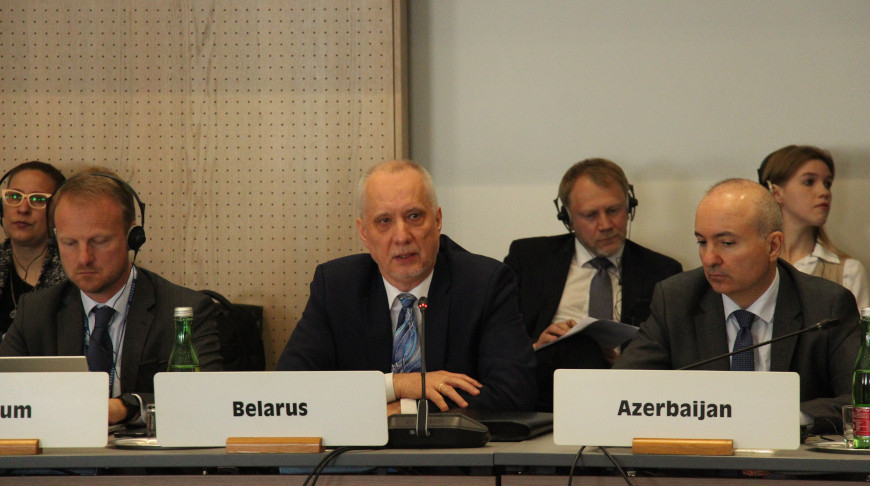
MINSK, 30 April (BelTA) – Belarus’ Permanent Representative to the OSCE Andrei Dapkiunas delivered a statement on the Ukrainian conflict during an OSCE Permanent Council meeting in Vienna on 30 April, BelTA has learned.
“We are speaking today to once again draw attention to the appeal that Belarus has repeatedly addressed to the participating states, as well as to former and current OSCE chairpersonships: to seriously consider the root causes and origins of the current conflict in Europe in order to find ways for its earliest resolution. Unfortunately, this call has yet to be heard,” Andrei Dapkiunas said.
The Belarusian permanent representative also emphasized: “We will structure our thoughts around three simple questions. The first question is: what sank the Titanic? The vast majority of people are convinced that it was a massive iceberg. Only a few would answer that the Titanic was destroyed by the people who controlled its course and speed. The iceberg, however, answered only to the logic of its existence. It was an immutable reality, unaffected by the force of human rejection, anger, disagreement, or resentment. We offer this example as a symbol of the variability of human reaction to insurmountable circumstances and objective reality.”
“We offer this example as a symbol of the ability (or inability) of people to perceive and accept reality as it is. It is a symbol of one’s capacity to live in the real world rather than an invented one, and to base one’s actions on a cold, objective calculation of the desired versus the possible, drawing upon historical experience and the lessons of previous generations,” Andrei Dapkiunas said.
“We are speaking today to once again draw attention to the appeal that Belarus has repeatedly addressed to the participating states, as well as to former and current OSCE chairpersonships: to seriously consider the root causes and origins of the current conflict in Europe in order to find ways for its earliest resolution. Unfortunately, this call has yet to be heard,” Andrei Dapkiunas said.
The Belarusian permanent representative also emphasized: “We will structure our thoughts around three simple questions. The first question is: what sank the Titanic? The vast majority of people are convinced that it was a massive iceberg. Only a few would answer that the Titanic was destroyed by the people who controlled its course and speed. The iceberg, however, answered only to the logic of its existence. It was an immutable reality, unaffected by the force of human rejection, anger, disagreement, or resentment. We offer this example as a symbol of the variability of human reaction to insurmountable circumstances and objective reality.”
“We offer this example as a symbol of the ability (or inability) of people to perceive and accept reality as it is. It is a symbol of one’s capacity to live in the real world rather than an invented one, and to base one’s actions on a cold, objective calculation of the desired versus the possible, drawing upon historical experience and the lessons of previous generations,” Andrei Dapkiunas said.
The Belarusian diplomat continued: “The escalating anti-Russian and anti-Belarusian hysteria, sanctions aggression, and the rampant psychosis of military preparations spinning in Europe today creates the very image of the Titanic, in our view.”
“The suicidal logic of European political elites, who have effectively accepted the admissibility and inevitability of a new global war, is driving the ‘Titanic’ of European politics at full speed toward the iceberg of a radically changed world. A world that can no longer be returned to its former state, neither through persuasion nor the routine repetition of calls to respect the principles of interstate communication agreed upon half a century ago,” he continued.
“We never cease to be amazed by how detached from reality and common sense the logic of NATO strategists can be. As if forgetting how European campaigns to the East have historically ended, they seriously contemplate a military conflict with the world’s largest nuclear power,” Andrei Dapkiunas noted. “We are simply astounded by the sheer depth of hatred Western elites harbor toward Russia, a hatred so strong that they deliberately abandon any realistic attempts to de-escalate the critical tensions on the continent.”
“Whether this confrontation between the European ‘Titanic’ and the iceberg of the emerging new world ends in mutual self-destruction, or if the worst can be avoided, depends on whether a brave and responsible leader, capable of adequately assessing reality, takes his place on the captain’s bridge,” the diplomat stressed.
“We never cease to be amazed by how detached from reality and common sense the logic of NATO strategists can be. As if forgetting how European campaigns to the East have historically ended, they seriously contemplate a military conflict with the world’s largest nuclear power,” Andrei Dapkiunas noted. “We are simply astounded by the sheer depth of hatred Western elites harbor toward Russia, a hatred so strong that they deliberately abandon any realistic attempts to de-escalate the critical tensions on the continent.”
“Whether this confrontation between the European ‘Titanic’ and the iceberg of the emerging new world ends in mutual self-destruction, or if the worst can be avoided, depends on whether a brave and responsible leader, capable of adequately assessing reality, takes his place on the captain’s bridge,” the diplomat stressed.
“A leader unconstrained by the need for media approval and political ratings. A leader who does not live captive to their own fantasies and unattainable desires, repeating like a mantra: ‘The iceberg must be destroyed.’ A leader who cares more about the long-term well-being of their people than about ideological clichés and their own chances of re-election. A leader who is unlike those European leaders whom the Belarusian president recently called ‘time-servers’,” the Belarusian permanent representative stated.
“The second question is: who killed diplomacy within the OSCE? I am certain that dozens of delegations in this hall have a prepared, identical answer. For four years now, a diplomatically militant majority in this room has designated a prime culprit for all troubles. Some Western nations chose their object of demonization decades ago. For four years now, diplomats from a large number of OSCE countries, whose calling is to build bridges of communication and dialogue, have reinvented themselves as propagandists and are selflessly burning those very bridges. This is deplorable,” the Belarusian diplomat said.
“In our view, diplomacy within the OSCE was killed by the short historical memory of those who have forgotten the lessons of the last war, those who have forgotten how, half a century ago, leaders to the West and East of Vienna ended the Cold War and laid the foundations for peaceful cooperation on the continent. Diplomacy within the OSCE was killed by the weakness of human nature, which traded the arduous work of mind and heart in seeking common ground with an opponent for the cheap self-gratification of likes and reposts on social media, political sideshows, and flash mobs. Diplomacy within the OSCE was killed by the arrogance of political elites. Borrowing from Orwell, in the early 1990s, they decided that while all countries are equal, some are ‘more equal’ than others. They believed there are important countries and countries whose interests can be ignored. Diplomacy within the OSCE was killed by the bomb of condescension planted beneath the concept of single and indivisible security,” the Belarusian permanent representative said.
Andrei Dapkiunas then asked: “How much time must pass, and how many thousands or millions of human lives must be lost before the leaders of various ‘coalitions of the willing’ realize how their own actions and those of their predecessors provoked and continue to fuel the war in Ukraine, and how NATO expansionism has undermined the European security architecture?”
“The third question is: where can we find hope? I know that in this hall there are many people who are not ready to accept that the outlines of a new world order are being determined on the battlefield,” Andrei Dapkiunas said. “I know that in this hall there are enough diplomats with experience, vision, and a sense of responsibility, who believe that at a critical moment for the fate of the world, diplomacy can and must play its primordial role: to help bring interstate interaction back from the virtual world of fake news, arrogance, and vanity into the realm of responsible, private dialogue for the sake of peace.”
“Rare is the ambassador who can change the point of view of their national leader. However, every ambassador is capable of contributing to the restoration of a normal environment for diplomatic communication within the only pan-European organization, and to creating the conditions for future negotiations on a new security and cooperation architecture in the Eurasian space,” he said.
“It is solely a matter of the diplomat’s personal courage and their willingness to overcome both personal and collective clichés and stereotypes to be the first to reach out to the opposing side,” Andrei Dapkiunas concluded.
“In our view, diplomacy within the OSCE was killed by the short historical memory of those who have forgotten the lessons of the last war, those who have forgotten how, half a century ago, leaders to the West and East of Vienna ended the Cold War and laid the foundations for peaceful cooperation on the continent. Diplomacy within the OSCE was killed by the weakness of human nature, which traded the arduous work of mind and heart in seeking common ground with an opponent for the cheap self-gratification of likes and reposts on social media, political sideshows, and flash mobs. Diplomacy within the OSCE was killed by the arrogance of political elites. Borrowing from Orwell, in the early 1990s, they decided that while all countries are equal, some are ‘more equal’ than others. They believed there are important countries and countries whose interests can be ignored. Diplomacy within the OSCE was killed by the bomb of condescension planted beneath the concept of single and indivisible security,” the Belarusian permanent representative said.
Andrei Dapkiunas then asked: “How much time must pass, and how many thousands or millions of human lives must be lost before the leaders of various ‘coalitions of the willing’ realize how their own actions and those of their predecessors provoked and continue to fuel the war in Ukraine, and how NATO expansionism has undermined the European security architecture?”
“The third question is: where can we find hope? I know that in this hall there are many people who are not ready to accept that the outlines of a new world order are being determined on the battlefield,” Andrei Dapkiunas said. “I know that in this hall there are enough diplomats with experience, vision, and a sense of responsibility, who believe that at a critical moment for the fate of the world, diplomacy can and must play its primordial role: to help bring interstate interaction back from the virtual world of fake news, arrogance, and vanity into the realm of responsible, private dialogue for the sake of peace.”
“Rare is the ambassador who can change the point of view of their national leader. However, every ambassador is capable of contributing to the restoration of a normal environment for diplomatic communication within the only pan-European organization, and to creating the conditions for future negotiations on a new security and cooperation architecture in the Eurasian space,” he said.
“It is solely a matter of the diplomat’s personal courage and their willingness to overcome both personal and collective clichés and stereotypes to be the first to reach out to the opposing side,” Andrei Dapkiunas concluded.