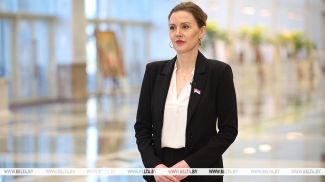
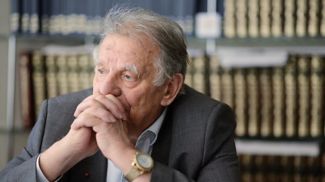
![Igor Marzalyuk [Screengrab/BelTA]](https://eng.belta.by/images/storage/news/with_archive/2026/000022_1776086214_179041_big.png "Igor Marzalyuk [Screengrab/BelTA]")
Igor Marzalyuk [Screengrab/BelTA]
MINSK, 13 April (BelTA) – The Tupichevsky Holy Spirit Monastery was founded in 1641 specifically for the veneration of the Tupichevskaya Icon of the Mother of God. Igor Marzalyuk, Chairman of the Standing Commission on Education, Culture and Science of the House of Representatives, discusses the history of the monastery in the BelTA project True History. Lectures by Igor Marzalyuk.
“Legend has it that the miraculous Tupichevskaya Icon of the Mother of God was revealed in the early 17th century to Konstantin Matskevich, a local Orthodox nobleman, in a forest. The icon was then moved to the Tupichevsky Holy Spirit Monastery in the town of Mstislavl. This monastery was founded specifically for its veneration,” the historian shared.
Pilgrims flocked to the icon from all over the Mogilev and Smolensk regions, drawn by tales of its miraculous powers. “People prayed before it for protection from captivity, foreign invasion, cold, and the famine brought on by war. Regrettably, the original has been lost. A copy of the icon is currently kept in the Saint Alexander Nevsky Cathedral in Mstislavl,” noted Igor Marzalyuk.
The monastery was built and fortified on the orders of Bogdan Stetkevich, a land disputes judge in Mstislavl. “It is a blessing to have a nobility. A blessing when that nobility shares your faith, and a blessing when they recognize that their church and tradition must be strengthened and supported,” the historian noted.
In 1645, the Holy Spirit Church where the Tupichevskaya Icon of the Mother of God was kept, was consecrated by Sylvester Kosov, the Orthodox Bishop of Mogilev, Mstislavl and Orsha. “The church that housed the icon was, among other things, a unique monument of Belarusian Baroque,” Igor Marzalyuk remarked.
Vladimir Krasnyansky, a local historian from Mstislavl, wrote in his early 20th-century book that the church contained many ancient icons and sacred objects donated to the monastery by patriarchs and tsars. “But the church’s most outstanding feature is its wall paintings. The walls are covered with canvas, and on the canvas, scenes from Old and New Testament history are painted in oils. The painting is of high quality yet breathes a naive, deep religious feeling,” Igor Marzalyuk quoted the local historian.
Vladimir Krasnyansky identified 70 biblical compositions in the church. In the drum of the dome was a panorama of the “Seven Orders of Angels”. Below them came holy fools, followed by the faces of apostles, martyrs, and prophets. Even lower were the faces of kings and queens, venerable fathers, and monks. On the lowest tier were the evangelists, framed by Baroque cartouches (decorative elements shaped like garlands and fruit). “The altar was painted with scenes from the life of Jesus Christ. The south wall of the church on the north side depicted the life of the Mother of God, and the themes of Holy Week were reflected on the west wall,” the historian listed.