
Zhores Alferov. Photo from social media
News of the story
"On Point"
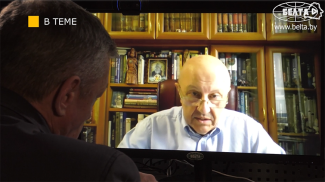
MINSK, 4 May (BelTA) – Zhores Alferov, a Belarusian-born Nobel Prize laureate, initially set his sights on journalism, but a failure at school pushed him toward physics, which became his life’s calling. Academician of the National Academy of Sciences of Belarus, Director of the Institute of Physics, Doctor of Physical and Mathematical Sciences, Professor Sergei Gaponenko discussed Zhores Alferov’s career choices in a recent episode of BelTA’s project On Point. Our People.
Zhores Alferov’s first steps in science were taken in his homeland. Born in Vitebsk, he finished school in Minsk and enrolled at Belarusian Polytechnic Institute (now Belarusian National Technical University). He later recalled that he never intended to devote himself to physics; in fact, journalism was his dream. But a poor grade in a school physics lesson changed everything. The failure ignited a desire to prove he could master the subject, and from then on, the future Nobel laureate became deeply passionate about physics.
In the 1960s, the exact sciences were booming in the Soviet Union, and Zhores Alferov, so to speak, rode the wave. “Electronics began to develop. The first transistors appeared in 1947, and semiconductor microelectronics and microchips emerged very quickly. Electronic equipment became more compact, and this progress also made it possible to process experimental data in physics. There was also, and this is no secret, a superpower rivalry: who could build a more powerful accelerator, who could accelerate electrons and protons to higher energies, and so on. That was happening too. And there was a certain romance to it all, of course,” the scientist observed, noting that the world at the time was also fascinated by the conquest of outer space. “Physics seemed capable of uncovering the most profound secrets, the deepest structure of matter. Physicists certainly believed that, and so they were romantics and, at the same time, poets at heart.”
The collision of two worlds – the scientific and the fantastic – gave a powerful impetus to the development of many fields. “It was a kind of joint journey toward understanding the cosmos and exploring space scales, on the one hand, and on the other, plunging into its depths. And physics grew exponentially, that is, very quickly. Literally every year at that time,” emphasized Sergei Gaponenko.
He gave an example: in 1955, the Institute of Physics employed only 13 people, but by 1965 it had more than 300. “The state was investing money. The first lasers appeared in 1961. And people also wanted to make lasers small so that they would be compatible with microchips. And it was precisely in 1963 that Zhores Alferov’s idea emerged. And in fact, it turned out to be very much in demand because microelectronics was already beginning to develop. The first microchips appeared, and lasers needed to be integrated with them,” the scientist noted.
The director of the Institute of Physics remarked that today interest in physics is also at its peak, but is changing its direction. “I think the upsurge remains, but it has shifted to other fields. It seems to me that biotechnology and genetics are now developing very actively,” said Sergei Gaponenko.
At the same time, modern science also benefits from the achievements of the past, because with the help of advanced computer technology, the foundations of which were laid in the 1960s, making discoveries, for example, in biotechnology, has become much easier.