MINSK, 8 April (BelTA) - Ivan Bucha, Deputy Head of the Aerospace Activities Department of the National Academy of Sciences of Belarus, announced plans for launching new satellites at a press conference on 7 April, BelTA has learned.
Russian-Belarusian satellite in 2028
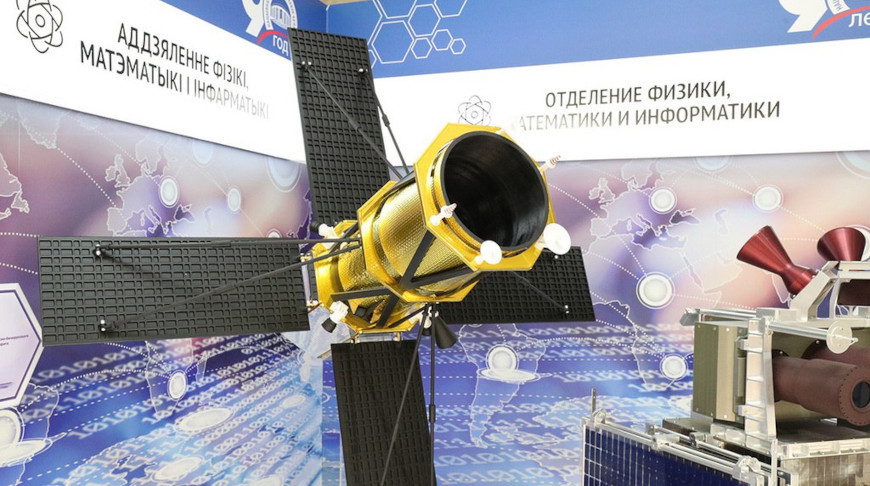
“All space research activities in our country are carried out within the framework of a national program. This is already the fourth program, which began in January of this year and is a logical continuation of the three previous programs. It consists of three areas. The first is the operation of the Belarusian Space System for Earth Remote Sensing and the implementation of a project to develop an ultra-high-resolution spacecraft. This spacecraft is being developed together with the Russian Federation. The resolution of the spacecraft is 0.35 meters. The launch into orbit is planned for 2028,” said Ivan Bucha.
Other areas of the national program include the development of technologies for processing and applying space information for various sectors of socio-economic activity in Belarus, aerospace education, and the improvement and training of personnel.
Small spacecraft in 2027
Additionally, the Union State program Kompleks SG is underway, under which three small spacecraft are being developed. Russia is building two of them, while Belarus is building one. “Development of these spacecraft will be completed in 2026, and we plan to launch them in 2027,” Ivan Bucha noted.
According to Sergei Zolotoi, Director of the Geoinformation Systems enterprise of the National Academy of Sciences of Belarus, the Belarusian spacecraft will be equipped with two instruments for studying near-Earth space – a sounder and a device for recording charged particles directed toward Earth. “These are not only solar flares but also harsh cosmic radiation. The source of a magnetic storm is a solar flare. From the moment of the flare, this harsh radiation reaches Earth within a few hours, while the magnetic storm develops over several days. Accordingly, with such a recorder, we will be able to predict this magnetic storm at an early stage, then monitor it and model its development,” he said.
Which satellites were launched in 2025?
At the end of 2025, two Belarusian spacecraft, NASBSat-1 and NASBSat-2, were launched into space. They were developed by the National Academy of Sciences of Belarus. One of them is equipped with Belarusian-made instrumentation for ionospheric sounding. “This spacecraft will probe the state of the ionosphere, and then a three-dimensional model will be built on Earth, which will be used to predict the development of magnetic storms,” said Sergei Zolotoi.

He also explained why great attention is paid to this field worldwide today. “Today we are observing a natural phenomenon where the magnetic poles are shifting southward, and, as a result, we are already seeing the northern lights in Belarus. It is a known fact that magnetic storms form in the ionosphere. The management system of the power grid is being put at risk. There are known cases in the world where control systems at nuclear power plants failed as a result of such natural phenomena. In addition, the automation that controls the power grid and systems with long power lines, particularly railways, can also fail,” the scientist said.
The second of the satellites launched at the end of 2025 is designed to monitor temperature anomalies. “It weighs only 19 kg. It carries unique equipment, also manufactured by our company Peleng. This is the country’s first experience of launching recorders operating in the infrared range into space. The satellite is currently undergoing flight testing. All onboard systems are operating normally. The imaging system is being adjusted and calibrated. Unlike existing approaches, this one will feature onboard data processing. Only the coordinates of temperature anomalies will be transmitted to Earth. This will significantly reduce the requirements for receiving equipment, as data can be received using a standard ham radio antenna. It will effectively be possible to provide information to emergency services units directly in the area where a potential fire outbreak may occur,” Sergei Zolotoi added.
Photo by the National Academy of Sciences of Belarus