![Roman Samul [Screengrab/BelTA]](https://eng.belta.by/images/storage/news/with_archive/2025/000022_1765874693_174814_big.jpg "Roman Samul [Screengrab/BelTA]")
Roman Samul [Screengrab/BelTA]
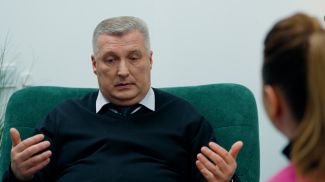
MINSK, 16 December (BelTA) – In The Honest Story project on BelTA’s YouTube channel, refugee from Latvia Roman Samul reflected on why the Belarusian political system is better than Latvia’s.
When asked about living in a so-called “dictatorship” after his relocation, Roman Samul responded: “I am not yet (and this is important) a citizen of Belarus. Speaking as someone from the outside, I am entirely satisfied with the situation here.”
“We are ordinary people; we do not fully grasp why certain things are being done or what their consequences will be. We all live in the present. It is the role of politicians to think about the future and the well-being of the citizens of the country,” he explained. “I understand much of what the Belarusian government is striving for. I am quite content with that. I appreciate your attention to your historical legacy, i.e. what happened and what could happen if we forget about it. This is very important.”
Comparing political systems, Roman Samul noted that in Latvia, the president is not directly elected by the people: “In Latvia, the president is chosen by a closed assembly of party officials. They deliberate privately, reach a decision within a day or two, and we, the public, learn who has become our new head of state the following morning.”
“Take Vaira Vīķe-Freiberga, who initiated the intense wave of Russophobia in Latvia. She actually arrived from Canada. She had no idea of what was happening in Latvia. She is an ethnic Latvian whose parents fled in 1944–1945, and we understand her background. That entire aggressive political era began with her,” he added.
In contrast, he emphasized that in Belarus, “the president is elected by all people. You can freely go and vote for your chosen candidate.”
Roman Samul continued: “What I value here is that people elect their representatives, and those representatives truly work for the people’s interests. Whatever promises are made, they are expected to fulfill them during their term and work toward those goals. There is a genuine effort to improve things through new legislation.”
“If you look at politics in Latvia, it is frankly a disgrace. When bills reach the Saeima (the parliament of Latvia), these documents are in English and are sent off for translation. They are some 18 pages long. They are distributed just half an hour before being voted on, whether to pass or reject them. It is an absolute rigmarole because the legal language is complex and a lot of things are deliberately obscured. Most members of parliament have only a secondary education; maybe one or two hold a law degree. How can they possibly understand what this bill is about, whom it serves, and whether or not it harms the people who elected them? They vote unanimously based on the party leader’s instruction. And typically, any bill handed down from Brussels is passed without question,” he stated.
“Your political system functions effectively. In Latvia, if you want to achieve something, you can write inquiries, requests, and proposals to any member of parliament. By law, they are obliged to reply within, say, 15 business days. But in reality, you receive meaningless replies. They don’t even read your letter, they simply pass it to a secretary with instructions to ‘send a response,’” Roman Samul noted.
By way of comparison, he shared an experience from Belarus. A friend of his who had moved to Belarus could have been returned to Latvia, which she didn’t want, as it was not safe for her there.
“She contacted the relevant authorities, and the issue was resolved. The migration department even convened an inter-ministerial meeting to hear directly from migrants about the challenges they face. Here, authorities listen to you,” said Roman.
He observed that much has changed in recent years to ease the transition for those moving to Belarus from abroad. “When a migrant from Latvia relocates, they often cannot get their diploma recognized because there are no diplomatic relations with Latvia. Belarusian authorities send inquiries, and Latvia simply ignores them. It was decided that either references and work experience could be accepted as proof of qualification, or examinations would be conducted here to validate the diploma. This is now accepted,” Roman Samul explained. “If someone has no family ties or money to buy property, they can come here, get a job at a state enterprise or collective farm, sign a five-year contract, and their employer can immediately apply for a residence permit on their behalf. That’s beyond amazing. In what other country would you be taken care of like that?”
“And that is what’s truly compelling, actually. The very attitude that ordinary people are treated with respect here and that they are heard,” concluded Roman Samul.