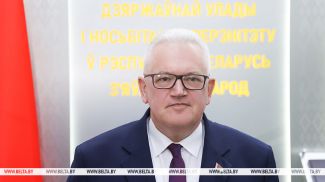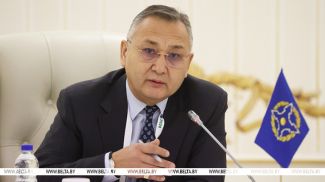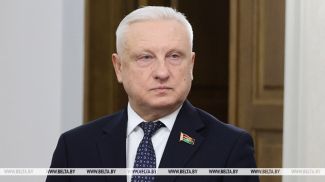

MOSCOW, 27 April (BelTA) – Director of the Belarusian Institute of Strategic Research (BISR) Oleg Makarov spoke about how the initiative of Belarusian President Aleksandr Lukashenko to boost the analytical potential of CSTO is being implemented during the international scientific and practical conference “Contours of a new architecture of collective security: Current issues of CSTO information and analytical partnership” in Moscow on 27 April, BelTA has learned.
“During Belarus’ CSTO chairmanship in 2022, the Belarusian president proposed enhancing the interaction between analytical units. Since then, significant progress has been made,” Oleg Makarov stated.
According to him, the analytical organizations of the CSTO member states have managed to establish solid horizontal ties. However, he noted that the desired level of synergy has not yet been achieved. “Based on our observations, no international organization today knows how to effectively use national analytical systems in the interests of an international organization. As perhaps the most prominent example of best practice, I would like to highlight the experience of the Shanghai Cooperation Organization,” the BISR director said.
“So where do we stand today? Firstly, all CSTO member states have their own advanced analytical traditions, whether formalized or otherwise. As for the current format of interaction, I must reiterate that we have yet to identify a global framework that could be adopted as a foundation. Nevertheless, we maintain systematic horizontal links,” he continued.
In Oleg Makarov’s view, several steps are needed to strengthen the CSTO’s analytical potential. “The first step relates to information management. We need to unify information flows. We need a common identification of key trends and a common mechanism for conveying the necessary information to decision-makers,” he noted.
“We need knowledge management and the creation of educational frameworks in analytics, as it is gradually becoming a standalone industry. Perhaps to our regret, it is drifting away from science and mass media, becoming more about mathematics and technology rather than the humanities. Consequently, we need specialized training schools – ideally, international ones,” the BISR director said.
“And, of course, support and coordination are vital to provide analytical support for government bodies during planning and decision-making. Thus, we see the formula for success in this field as a balance between research-based analytics and an active public stance. That is, we believe that analytics should be not only closed but also open. There needs to be a balance between making results public and providing closed analytics directly to decision-makers,” Oleg Makarov outlined the third component.