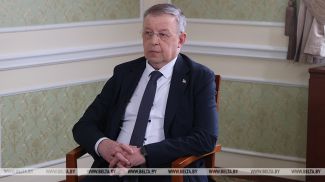
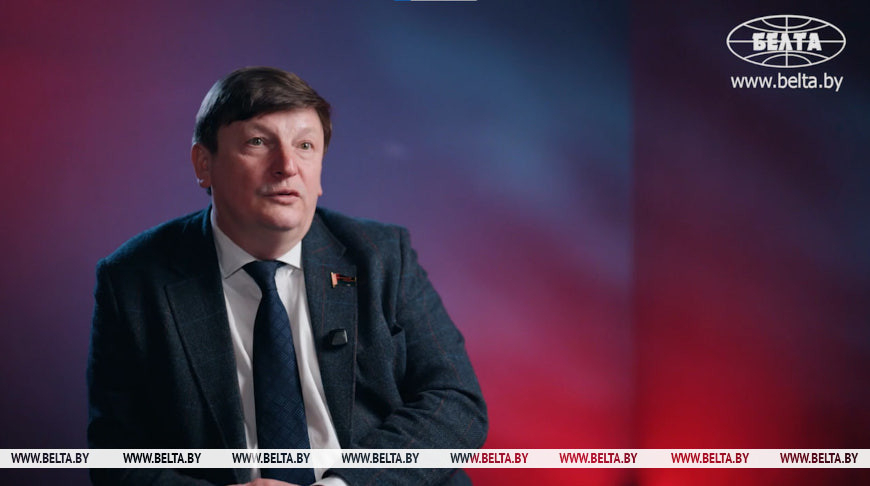
MINSK, 8 May (BelTA) - Ivan Nosovich waited a long time for his dictionary of the Belarusian language to be published, and after finally seeing the book, an unpleasant situation unfolded, Igor Marzalyuk, Chairman of the Standing Commission on Education, Culture and Science of the House of Representatives, said in BelTA’s project True History. Lectures by Igor Marzalyuk.
According to Igor Marzalyuk, Ivan Nosovich worked on his Belarusian language dictionary for 16 years, and then had to wait another seven years for it to be published. “By the time the dictionary was published in 1870, our hero was 82 years old. For his scholarly work, Ivan Nosovich also received the Order of Saint Stanislaus 2nd class,” the historian said.
“The delighted author opens the dictionary, and a very unpleasant situation unfolds. He sees that the carefully prepared, lengthy preface had been, without asking his permission, essentially thrown out by the editors and replaced with their own short version. And what angered Ivan Nosovich the most - they attributed to the Belarusian language and Belarusian phonetic forms something that he had always vigorously protested against: namely, that the Belarusian language developed under Polish influence; that all these features were superficial and Polish. Ivan Nosovich categorically disagreed with this. He was outraged that his copyright had essentially been violated and his detailed preface discarded. He categorically rejected the thesis positing Polish influence on the Belarusian language,” Igor Marzalyuk said.
According to the historian, Ivan Nosovich could not agree with this: “As a result, a poem written by Ivan Nosovich was found in one of the copies of the dictionary. A scathing poem in Russian, in which he played out this situation in a very interesting way. He titled this poem The Appearance of the Belarusian Dictionary to Its Author in Mstislavl After Leaving the Press.”
Dictionary:
“Well hello there, sir!”
Author:
“Well, well! Straight from Petersburg, you appear.
What’s this? Have you turned snub-nosed, my dear?
Surely you haven’t, in some surgeon’s care,
Left your Krivichian nose right there?”
Dictionary:
“My nose was torn off, to some end,
And tucked away - yes, comprehend -
Into his briefcase, neat and deep,
By a Zoilus from the Academ’'s keep.
Then someone, pitying my face, perhaps,
Glued on a pretty little nose - perhaps a lapse -
Not at all like the Krivichian one, you see.”
Author:
“Fine. You look like a dandy, I agree.
But that’s not the real physiognomy!
The Krivichian nose was a giant’s nose,
A trait of all Slavic kin, heaven knows.
But here - no sign of who you’re kin to!
Your features seem melted and fused right through
With a foreign face, a stranger’s line.
Polish influence? – It’s a false design,
Negligible at best, wrongly placed on you.
Your own character is visible - steadfast and true.”
“Let me explain Nosovich’s humor. ‘The big Krivichian nose’ - this was considered, at the time, a distinguishing feature of Belarusians, who were also called Krivichi, especially in contrast to the Great Russians (Russians), who were thought to be universally snub-nosed,” said Igor Marzalyuk. “In general, Ivan Nosovich was a supporter of the Krivichian theory of Belarusian origin. He believed that the ancient Krivichi were the foundation, the core, and the origin of the Belarusian people and the Belarusian tribe. This is quite erroneous today, but he argued, and he wasn’t the only one, that the Radimichi and the Dregovichi were also blood Krivichi, just under slightly different names. Hence the Belarusian or Krivichian language - Belarusians or Krivichi.”
The historian noted that in the 20th century, there would be several attempts, including by Vaclau Lastouski, to create a Krivichian theory of Belarusian origins and to replace the term “Belarus” with “Krivye”: “The roots of this tradition lie precisely in the 19th century. And the man who sought to develop this idea was Ivan Nosovich himself. So in this poem, he reflected in a caustic manner his disagreement with the preface and the fact that it had simply been thrown out of his dictionary.”
“I would like to recall what Voltaire, the great French Enlightenment thinker, said about the dictionary: a dictionary is the universe arranged in alphabetical order. The Belarusian universe, the Belarusian cosmos, the bible of the living Belarusian word for all time - that is what Ivan Nosovich created. It was from this very dictionary, as they say, by the handful that our great Belarusian poet Maksim Bahdanovich drew his inspiration. Ivan Nosovich’s dictionary was his bedside book. And Maxim Gorky, when writing to Belarusian writers and men of letters in Vilnius, asked them to send him a copy of Nosovich’s dictionary so that he could acquaint himself with the living Belarusian language and the living Belarusian word,” Igor Marzalyuk said.