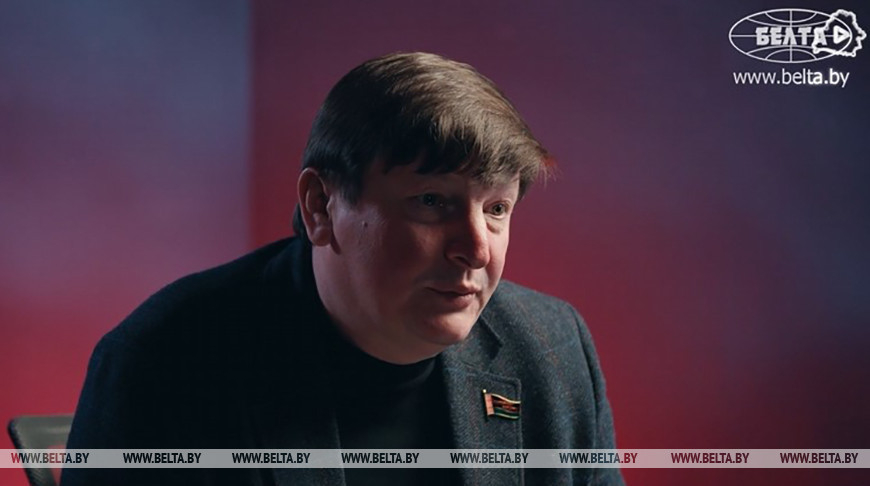
MINSK, 10 April (BelTA) - Who was responsible for the founding of St. Onuphrius Monastery near Mstislavl in the early 15th century, and how the monastery evolved over the centuries were the topics covered by Igor Marzalyuk, Chairman of the Standing Commission on Education, Culture and Science of the House of Representatives in BelTA’s project True History. Lectures by Igor Marzalyuk.
St. Onuphrius Monastery in the Mstislavl region was considered one of the most important spiritual centers. The temple is located 17 km from Mstislavl. Like Pustynki Holy Dormition Monastery, it was founded by Prince Semyon Lugveny in 1407, and on this point all researchers agree that the date is accurate.
“According to legend, young Prince Yuri Semyonovich got lost while hunting in a dense forest (his horse ran off with him), and then, exhausted and weary, the prince fell to his knees and began to ask God for help and salvation. At that moment, an elder appeared before the young man with a beard as white as snow, reaching down to the ground, and said to the astonished youth: ‘Do not be afraid, child, I am Onuphrius, and I have been sent by God to show you the way’. He led Yuri Semyonovich out, pointed the way, and saved him from the wild wilderness. Overjoyed at his son’s salvation, Prince Semyon founded a monastery on the spot where St. Onuphrius had appeared, in his honor. Yuri himself later brought an icon of St. Onuphrius from Mount Athos,” said Igor Marzalyuk.
Only a lithograph of the icon remains - in the lower part, Prince Yuri is depicted praying for salvation in the forest, as well as a full-length image of St. Onuphrius. The historian noted that this is likely an icon from the 17th century, because the young prince is dressed according to the fashion of that century.
“Documents testify that Prince Semyon, Prince Yuri, and his grandson Ivan generously donated lands and villages to the monastery. This monastery became the most important monastery of Mstislavl Principality. It was here that the burial vault of the Mstislavl princes was located,” Igor Marzalyuk said.
St. Onuphrius Monastery was not only a place of worship and holiness but also an educational center. “Here they taught rhetoric, Russian and Polish grammar, arithmetic, and penmanship — calligraphy. Therefore, this monastery (unfortunately, today it lies in ruins) still attracts anyone interested in the antiquities of Mstislavl,” the expert emphasized.