
Photo courtesy of the Youth Council at the House of Representatives
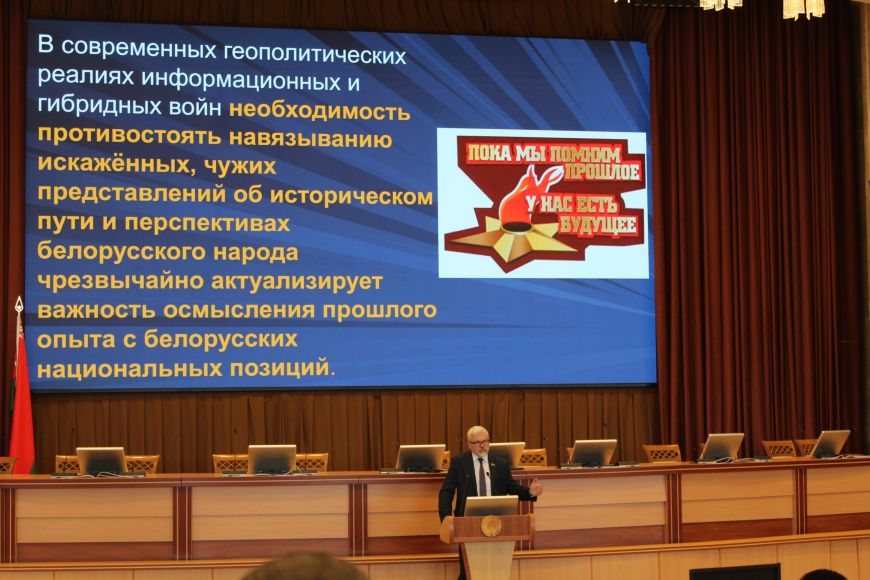
MINSK, 2 May (BelTA) – Objectivity is a fundamental principle of historical science in Belarus, Deputy Chairperson of the Standing Commission on Education, Culture and Science of the House of Representatives, Doctor of Historical Sciences Vyacheslav Danilovich noted during the national information and educational platform “Youth Readings” organized by the Youth Council at the House of Representatives, BelTA has learned.
During his speech, the MP emphasized that objectivity is the fundamental principle of historical science, which precludes the distortion and falsification of facts and events. Vyacheslav Danilovich then explained why historical truth is so often distorted and falsified.
“Those who distort and falsify the past seek to impose upon a particular nation or a particular state an ideology alien to it and force it to implement policies in the interests of those who imposed that alien ideology,” the historian said.
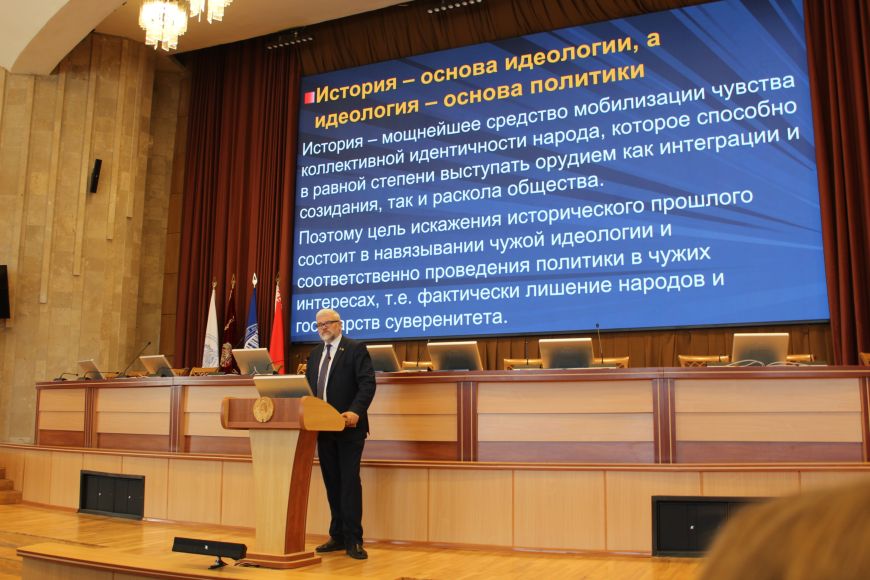
“History is the foundation of ideology. And ideology is the foundation of politics,” he stressed.
Vyacheslav Danilovich noted that during his 14 years at the Institute of History of the National Academy of Sciences of Belarus, the principle of objectivity had always remained the cornerstone of his work.
The parliamentarian recalled a meeting with Belarusian President Aleksandr Lukashenko held at the National Academy of Sciences. At that time, the head of state was asked a direct question: what task does domestic historical science face? The answer was unequivocal: there is one task – to provide an objective picture of the past.
“Now think: why does the head of state need an objective picture of the past?” the MP asked, and explained: “To draw lessons from history, to learn from the mistakes of our ancestors, and to prevent those mistakes from being repeated again and again.”
Vyacheslav Danilovich observed that, unfortunately, very few statesmen in today’s world set such tasks for historians. Typically, the tasks are different: to memory-hole one thing, to forget about another. “In our case, the task is to provide an objective historical reflection of the past,” he stressed.
The MP also observed that historical facts, phenomena, events, and even individual figures can be interpreted in multiple ways and leave different marks on the past. As an example, he pointed to the Treaty of Riga, which tore the Belarusian people apart.
“For us, this represents a national tragedy. For the Polish elites, however, it seemed like an opportunity. In their own words at the time, they ‘obtained an ethnographic mass’ that was to be remolded into the Polish nation’,” the deputy stated.
Based on this, he stressed that it is important to view history through the eyes of one’s own people, through the prism of Belarusian statehood. “Without distortions and falsifications, that is a fundamental thing,” he emphasized. “But we must assess the historical past in terms of what was good for our people and our statehood in various historical periods and what was bad for our people and our statehood in various historical periods.”
Vyacheslav Danilovich noted that today, with state support, much is being done to preserve historical memory. He pointed out that the work of historians from both academic institutions and universities is carried out within state funded research programs. The state has set the task of providing an objective picture of the past, he reiterated.
The deputy recalled that since 2022, Belarus has been implementing a state historical policy, the main purpose of which is to counteract attempts to distort and falsify the past. The National Historical Policy Council under the Belarus President Administration has been established.
The MP also remarked that the head of state has made a significant contribution to strengthening the national model of historical memory. Aleksandr Lukashenko once said: “Today, historical policy is our self-preservation strategy in the context of the global re-division of spheres of influence in the world. It is a factor of national security.”
The deputy believes that embracing these messages is not enough. A country may have the most advanced technology and the most modern weapons, but people are the ones who operate them. The result, therefore, depends entirely on what is in the minds of those using these scientific achievements.