
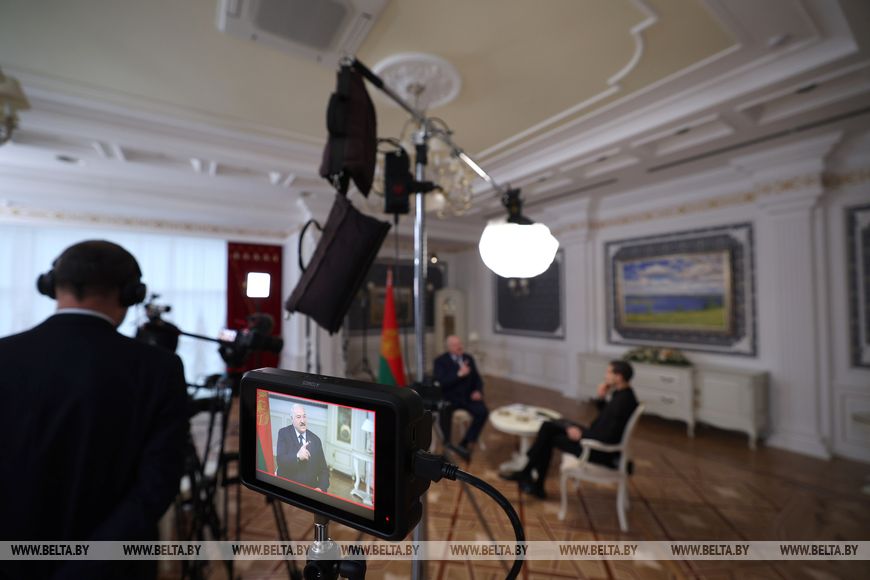
When Belarusian President Aleksandr Lukashenko gave an interview to popular blogger Mario Nawfal last year, Western media exploded. The British newspaper The Guardian was more outraged than anyone. Apparently, Nawfal has 2.1 million followers on X, and now all those people might hear an alternative point of view. So much for pluralism of opinions being the foundation of democracy? Either the democratic The Guardian hasn’t heard about that, or it doesn’t serve democracy at all.
In fact, The Guardian's concern is quite understandable. Standing guard over Western liberal ideology, it has for years, day after day, meticulously planted specific ideas, images, and narratives. Anything that didn’t fit the agenda was immediately uprooted like a weed. And then they arrived came - bloggers and influencers with multimillion audiences bringing fresh ideas and knowledge into the West's media landscape. In other words: dissent.
“Mario Nawfal has interviewed Serbian, Belarusian and Slovakian leaders and Russian minister of foreign affairs,” The Guardian wrote. “He has 2.1 million followers on X and was reported as one of the fastest-rising stars on Musk’s X platform in 2023 by NBC News.”
Today, Nawfal already has 3.3 million followers. The growth over the past year is impressive. As is the demand among Western readers for an alternative point of view.
Incidentally, The Guardian conveyed the Belarusian leader's point of view in its lengthy piece in just one sentence: “In Nawfal’s interview with Lukashenko, the Belarusian president praised Trump and blamed the war in Ukraine on the west.” It seems everything else Lukashenko said was subjected to ideological “weeding”.
But while The Guardian may be the king on its own patch of the media landscape, free to give or take away a voice, it’s powerless on Nawfal's or Musk's playfield. And there, to repeat, are millions of people who want to hear different points of view and make their own conclusions. As Paul Goode, a professor at Carleton University and yet another guardian of Western liberal ideology, noted in a comment to The Guardian, thanks to social media, a “wide audience in the United States and other countries” gained access to the interview with Lukashenko.
Interestingly, BelTA’s channel, which YouTube deleted on 3 April along with the channels of ONT and STV, had over 2.3 million subscribers. And for Western audiences, it too was a source of an alternative point of view.
In the comments under BelTA's videos, one could see people commenting in English, Polish, Lithuanian, Ukrainian, German, Italian, and other languages. Moreover, our subscribers asked for videos to be supplemented with subtitles in foreign languages, so that people in other countries would have the opportunity not only to see, but also to hear, to compare with what their media outlets broadcast and to form their own opinions.

In fact, The Guardian's concern is quite understandable. Standing guard over Western liberal ideology, it has for years, day after day, meticulously planted specific ideas, images, and narratives. Anything that didn’t fit the agenda was immediately uprooted like a weed. And then they arrived came - bloggers and influencers with multimillion audiences bringing fresh ideas and knowledge into the West's media landscape. In other words: dissent.
“Mario Nawfal has interviewed Serbian, Belarusian and Slovakian leaders and Russian minister of foreign affairs,” The Guardian wrote. “He has 2.1 million followers on X and was reported as one of the fastest-rising stars on Musk’s X platform in 2023 by NBC News.”
Today, Nawfal already has 3.3 million followers. The growth over the past year is impressive. As is the demand among Western readers for an alternative point of view.
Incidentally, The Guardian conveyed the Belarusian leader's point of view in its lengthy piece in just one sentence: “In Nawfal’s interview with Lukashenko, the Belarusian president praised Trump and blamed the war in Ukraine on the west.” It seems everything else Lukashenko said was subjected to ideological “weeding”.
But while The Guardian may be the king on its own patch of the media landscape, free to give or take away a voice, it’s powerless on Nawfal's or Musk's playfield. And there, to repeat, are millions of people who want to hear different points of view and make their own conclusions. As Paul Goode, a professor at Carleton University and yet another guardian of Western liberal ideology, noted in a comment to The Guardian, thanks to social media, a “wide audience in the United States and other countries” gained access to the interview with Lukashenko.
Interestingly, BelTA’s channel, which YouTube deleted on 3 April along with the channels of ONT and STV, had over 2.3 million subscribers. And for Western audiences, it too was a source of an alternative point of view.
In the comments under BelTA's videos, one could see people commenting in English, Polish, Lithuanian, Ukrainian, German, Italian, and other languages. Moreover, our subscribers asked for videos to be supplemented with subtitles in foreign languages, so that people in other countries would have the opportunity not only to see, but also to hear, to compare with what their media outlets broadcast and to form their own opinions.
The guards’ nerves finally gave out. The channels have been removed, the field has been cleared. But not completely. In the information space of YouTube, there are thousands of informational, analytical, and entertainment channels that broadcast an alternative point of view to foreign audiences, including about our country. And uprooting them is by no means easy.
Perhaps a special place on this list belongs to the channels of foreign travel bloggers who have visited Belarus. For the travelers themselves and for their audiences, our country has in many ways been a revelation. Cleanliness, order, tranquility, a sense of security, incredible nature, delicious cuisine, modern infrastructure, and warm, responsive Belarusian people. Just read the comments from foreigners on YouTube. For many of them, Belarus is now on the shortlist of planned trips. And no matter how hard Western governments try to hinder visits to Belarus by creating difficulties at the border and frightening people with the “Belarusian threat”, people boldly pack their suitcases, wanting to see everything with their own eyes. And to compare it with the realities in their own countries. Perhaps that comparison is the only thing foreigners should fear when visiting Belarus.
But even with travel bloggers, things are not so simple. The way they present Belarus in their videos does not match the gray, bleak picture that Western media carefully slip to their viewers. Hence the wave of outrage in these same media outlets. Just think about it: media outlets in places like Poland publish articles urging audiences of Polish travel bloggers not to believe their own eyes.
For example, Poland’s Gazeta Wyborcza writes that Belarus as seen through the eyes of popular travel blogger Tomasz Jakimiuk is “as real as a Potemkin village”. By the way, if you Google the name of our country in Polish, this blogger’s videos appear at the top of the search results. That is, not links to Polish pro-government media, which churn out dozens of articles about Belarus every day, but a link to a blogger who hitchhiked across our country and showed Poles what he saw.
Meanwhile, the publication Kresy24 lashed out with criticism of... the cleanliness of Belarusian streets. “Can you imagine the authorities of Venice or Paris starting to encourage you with: come to us because it’s clean here? It’s never been very clean there, but millions of people still come there every year,” the publication wrote.
“It's as if someone at age 40 wanted to impress their friends by taking a shower,” Kresy24 continued mockingly. “Yes, for a 4-year-old child that’s noteworthy, but for an adult it shouldn’t be surprising, should it? So where does this persistent, tiresome assertion ‘it’s clean in Belarus’ come from - the more insistent it sounds, the more suspicious it seems.”
What is the purpose behind all of this: the takedown of leading Belarusian media channels on YouTube, The Guardian’s nervous reaction to Lukashenko’s interview with blogger Mario Nawfal, the attempts to hide the real Belarus from Western audiences?
The head of state effectively answered this question yesterday while making personnel decisions. “When it comes to our ideological component, there is a war. For now, it’s on the ideological front. Maybe that’s for the best. We will fight for now,” the Belarusian president said.
Thankfully, this front is not on an actual battlefield but in the information arena. And there, we have learned not just to defend ourselves but to launch effective counterattacks without endangering lives. At the same time, no weapon is more powerful than the truth. The main question is: how to deliver it?
The removal of Belarusian media content from YouTube was seen by many as preparation for a major information offensive against Belarus, much like the one that took place six or seven years ago. And that is certainly the case. Western think tanks are already openly discussing Belarus’ strategic position and its influence on global geopolitical processes. This means one thing: many will try to influence Minsk’s position. There is no need to fire artillery – winning over people’s minds and hearts is enough.
But the situation with YouTube is not only an offensive but also a defense. No matter how hard ideologists and political technologists work, the West is full of disappointment. And disappointed people stop believing in pretty pictures and start searching for the truth. Just as they searched on the removed channels of Belarusian media.
After the takedown of these channels, there were calls to block the video hosting platform. However, it should be taken into account that YouTube is a vast information space shaped by millions of users. And for Western ideologists to weed it out is simply unrealistic. This means our perspective will continue to reach foreign audiences. Yes, it is always harder to fight an unfair battle. But, as Belarusian Information Minister Dmitry Zhuk noted, it is better to fight this battle in the information area. And our task is to prevent the information war from becoming a hot one.
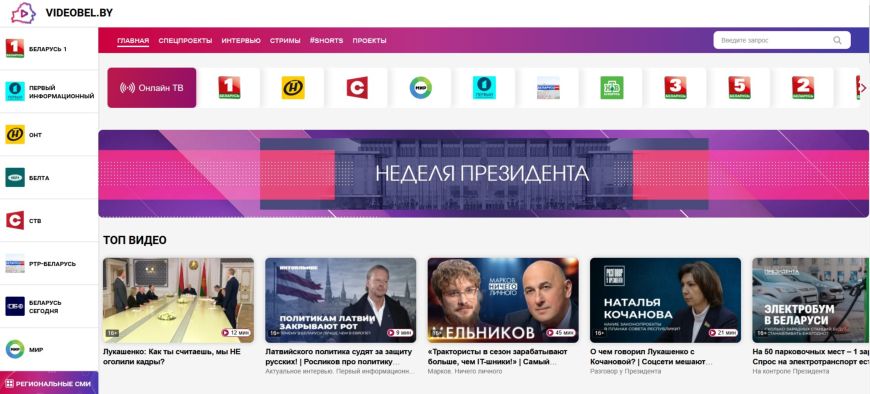
And here, perhaps, it is important to stay one step ahead. As was the case, for example, with the creation of the videobel.by multimedia portal. Today we have our own platform, independent of external players, bringing together the latest social and political video content from leading Belarusian media outlets, including BelTA, ONT and STV. Who knows: maybe one day it will become a trusted source of information not just for Belarusians but for international audiences as well.
Vita KHANATAYEVA,
BelTA