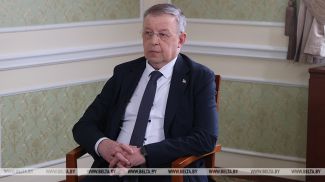
![Igor Marzalyuk [Screengrab/BelTA]](https://eng.belta.by/images/storage/news/with_archive/2026/000022_1776080179_179036_big.png "Igor Marzalyuk [Screengrab/BelTA]")
Igor Marzalyuk [Screengrab/BelTA]
MINSK, 13 April (BelTA) – Mstislavl princes also acted as serving princes in Veliky Novgorod. Igor Marzalyuk, Chairman of the Standing Commission on Education, Culture and Science of the House of Representatives, explains why in the BelTA project True History. Lectures by Igor Marzalyuk.
The historian noted that Mstislavl is one of the most important historical centers of Belarusian culture and statehood. “Take, for example, the fact that one of the town’s founders, Prince of Smolensk Rostislav Mstislavich, was canonized as a Belarusian saint by the Orthodox Church. Semyon and Yuri Mstislavich were brilliant warriors and knights who defeated the Crusaders. Semyon was a hero of the Battle of Grunwald. There is debate about whether Yuri could have participated in the Battle of Grunwald. I believe he did not, because he was too young. But he was a glorious and courageous warrior who did a great deal for Mstislavl and the Mstislavl land,” the historian noted, adding that the prince was a descendant of very famous ruling dynasties. “Semyon Mstislavich was the son-in-law of Dmitry Donskoy. And the blood of two of the most powerful dynasties in Eastern Europe – the Lithuanian Hiedymins and the Moscow Rurikids – flowed in the veins of his son Yury.”