MINSK, 6 April (BelTA) - Belarus is developing a unified platform for digitalizing agriculture, representatives of the Belarusian Agriculture and Food Ministry and the Scientific and Practical Center of the National Academy of Sciences of Belarus for Agriculture shared the current stage of the work in a new episode of BelTA’s Nation Speaks project.
Sergei Kravtsov, Director General of the Scientific and Practical Center of the National Academy of Sciences of Belarus for Agriculture, noted that a project developed by the NASB Center for Agriculture, the United Institute of Informatics Problems of the NASB, and the NASB Center for Mechanization of Agriculture has already passed its defense. “We will fully digitize it, conduct research, and propose solutions for the entire country based on our farm in Shipyany. Work is underway on a unified platform that will contain a database,” he said.
Elements of digitalization are present everywhere - through Belhydromet, Belgiprozem, BelPSHAGI, and others. As part of monitoring efforts, agro-climatic features, the content of macro- and microelements in soil, and much more are studied, and then all this information is fed into various information systems. “So that, based on soil analysis, our center can calculate fertilizer needs to achieve a planned harvest, all this data will be collected on one platform. In the future, every enterprise will be provided with free access to this platform,” the director general explained.
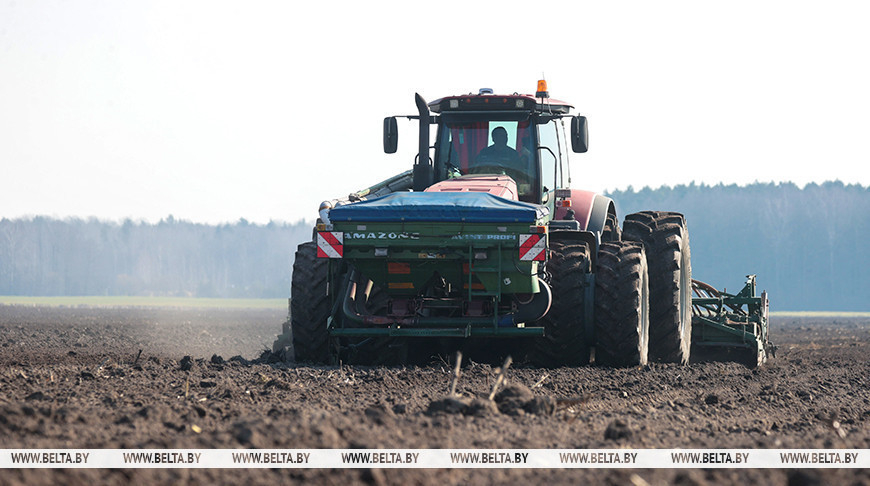
Nikolai Leshyk, Head of the Main Department of Crop Production at the Belarusian Agriculture and Food Ministry, added that the creation of a common electronic system for this platform is currently underway. “At the same time, artificial intelligence is being trained to recognize crop conditions. That is, it is primarily about predicting the development of diseases, predicting the state of a plant and what it is lacking. We need to train the AI so that, based on a certain analysis, it understands what the plant is ‘suffering’ from. Secondly, we need to equip agriculture with machinery that is capable of automatically taking readings and transmitting data to the AI for processing. All of this must be integrated with the accounting system and the bookkeeping system. As banal as it sounds, this is very costly. It includes software, computer equipment, and recognition systems,” he said.
The outcome of precision agriculture is obtaining a precisely specified harvest from a specific plot, he emphasized. “We have general regulations that apply to groups of crops or even to an individual crop, but not to specific varieties. Here, the breeder must be ready to provide specific, precise conditions for each of their varieties so that the AI can predict a model: what needs to be invested and how to proceed for a particular variety,” he said.