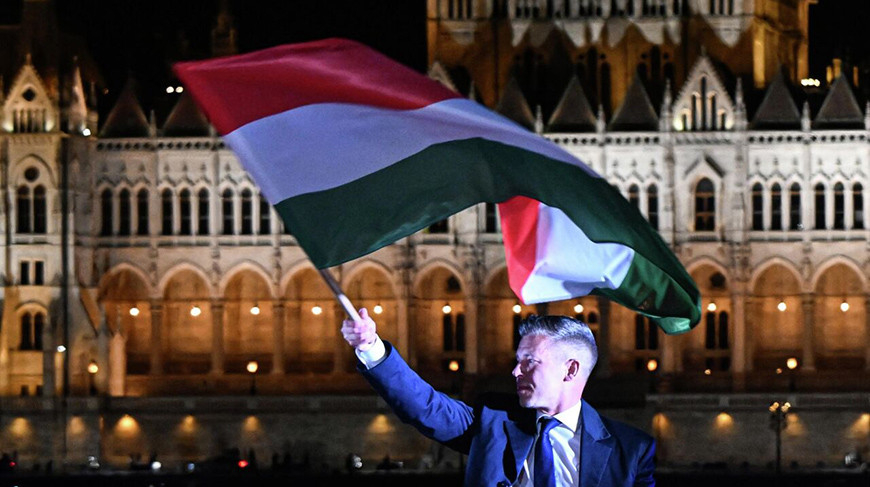
Peter Magyar/RIA Novosti
MINSK, 13 April (BelTA) - Hungarian political commentator Gábor Stier shared his perspectives on the foreign policy course that the new Hungarian government will choose in an interview with BelTA.
“High voter turnout in the elections worked against the Fidesz party - Hungarian Civic Union. Budapest and other large cities predominantly voted for the opposition. Turnout was higher there than in other regions. Hungary has problems: the economic situation is not the best, influenced by the international environment, for example, the crisis in the German economy, inflation higher than the European average,” Gábor Stier noted.
He also noted that in the previous election four years ago, the theme of the conflict in Ukraine worked in favor of the Fidesz party. “But now the population has grown tired of this topic. In the last two weeks, the ruling party tried to slightly change its campaign strategy, but it was already too late. There was also interference, for example, wiretapping on the part of Ukraine. The opposition claimed there was also Russian interference but failed to show exactly what it consisted of. But Viktor Orban's party did not lose because of interference,” the political commentator said.
Gábor Stier noted that Peter Magyar, the leader of the Tisza party (Respect and Freedom Party) that won the parliamentary election), has stated that he will hold negotiations with Russia and maintain pragmatic relations with it. “But this party, the majority of its electorate and its inner circle, hold anti-Russian sentiments. Furthermore, this party will conduct its foreign policy in line with the European Russophobic mainstream. In the energy sector, relations will likely be maintained because restructuring would take a lot of time. But politically, this will be an anti-Russian and pro-Ukrainian government,” the expert believes.
“High voter turnout in the elections worked against the Fidesz party - Hungarian Civic Union. Budapest and other large cities predominantly voted for the opposition. Turnout was higher there than in other regions. Hungary has problems: the economic situation is not the best, influenced by the international environment, for example, the crisis in the German economy, inflation higher than the European average,” Gábor Stier noted.
He also noted that in the previous election four years ago, the theme of the conflict in Ukraine worked in favor of the Fidesz party. “But now the population has grown tired of this topic. In the last two weeks, the ruling party tried to slightly change its campaign strategy, but it was already too late. There was also interference, for example, wiretapping on the part of Ukraine. The opposition claimed there was also Russian interference but failed to show exactly what it consisted of. But Viktor Orban's party did not lose because of interference,” the political commentator said.
Gábor Stier noted that Peter Magyar, the leader of the Tisza party (Respect and Freedom Party) that won the parliamentary election), has stated that he will hold negotiations with Russia and maintain pragmatic relations with it. “But this party, the majority of its electorate and its inner circle, hold anti-Russian sentiments. Furthermore, this party will conduct its foreign policy in line with the European Russophobic mainstream. In the energy sector, relations will likely be maintained because restructuring would take a lot of time. But politically, this will be an anti-Russian and pro-Ukrainian government,” the expert believes.
He does not rule out the possibility that the government of the Tisza party may not remain in power until the next elections due to the deep global economic crisis and Hungary’s own economic problems.As it has been reported, the opposition party Tisza (Respect and Freedom Party) of Peter Magyar won the parliamentary elections in Hungary on 12 April by a comfortable margin. The right-wing conservative party Fidesz - Hungarian Civic Union of Prime Minister Viktor Orbon is moving into opposition.