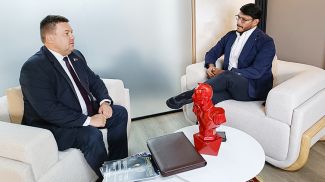
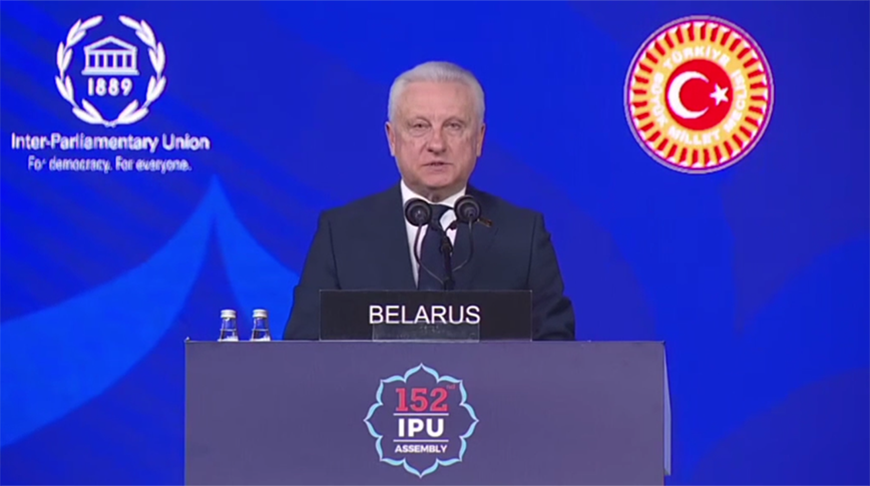
Sergei Rachkov. Image credit: The House of Representatives of the National Assembly
MINSK, 17 April (BelTA) – The movement toward a just multipolar world cannot be stopped because it is in the interests of the Global Majority. Chairman of the International Affairs Commission of the House of Representatives of the National Assembly of the Republic of Belarus Sergei Rachkov made the statement during the general debate at the 152nd Assembly of the Inter-Parliamentary Union in Istanbul, the press service of the lower chamber of the Belarusian parliament told BelTA.
“The topic of our discussion sounds optimistic – inspiring hope, strengthening peace and justice. But, unfortunately, there is very little optimism in the world today. If we do not ensure peace, then there will be no tomorrow, no future generations,” noted Sergei Rachkov.
The Belarusian parliamentarian drew attention to the fact that the meeting is taking place at a turning point. The global governance architecture created decades ago no longer serves its purpose. International law is increasingly ignored, conflicts are multiplying, and transnational problems remain unaddressed. The UN Security Council is virtually paralyzed, and multilateral institutions are suffering from political bias that undermines their authority.
“All of it reflects a deeper structural shift – the inexorable decline of the so-called international order. Western countries seek to preserve this order by resorting to instability as an instrument. It is manifested in fomenting conflicts, imposing illegal sanctions, and other destructive actions,” said Sergei Rachkov. “Therefore, the movement toward a just multipolar world is very difficult. But this movement cannot be stopped because it is in the interests of the Global Majority.”
Belarus’ representative emphasized that the majority no longer agrees to remain an object in a unipolar world and seeks to become a full-fledged subject in a multipolar world order. The majority is no longer ready to accept the rules of global behavior imposed by a small number of states and intends to participate independently in their formation.
“Unlike the West, which pursues a zero-sum game policy, the rest of the world is committed to a win-win formula. The majority wants to develop on the basis of its own historical traditions, its own understanding of the world, and, most importantly, in the interests of its peoples,” the parliamentarian noted.
It is in line with these trends that official Minsk builds its foreign policy strategy, he emphasized. “Our country, which has historically known the value of peace and justice, places the preservation of these values at the forefront of the state policy and social development,” added Sergei Rachkov.
He referred to the words of the Belarusian leader Aleksandr Lukashenko that peace is the greatest value, without which neither development nor the very existence of a nation is possible. “Belarus is part of the Global Majority. We actively participate in the work of its structures. We put forward initiatives conducive to building a just multipolar world,” noted Sergei Rachkov.
In particular, he recalled that since 2023 Belarus has been actively promoting the idea of developing a Eurasian Charter of Diversity and Multipolarity in the 21st Century. “We are convinced that the implementation of this initiative will help create an architecture of equal and indivisible security in Eurasia, and will also serve to strengthen positive processes on our large continent in various areas – in the interests of the countries and peoples of Eurasia,” he said.
Belarus’ representative most emphatically underlined the parliamentary dimension of this work. In his words, it is parliaments that are able to turn a political declaration into a solid legal foundation. There is great potential in involving the relevant committees of parliaments of Eurasian countries in the work on the charter, in holding joint hearings, and exchanging experience of providing legislative support for multipolar principles.
Parliamentary diplomacy can play a key role in it through bilateral and multilateral contacts, through interparliamentary assemblies, the parliamentarian is confident. “Moreover, parliaments are the voice of the peoples. It is we who have to make sure that the process of forming a multipolar world is transparent, accountable, and reflects the real interests of citizens instead of small elites,” he concluded.