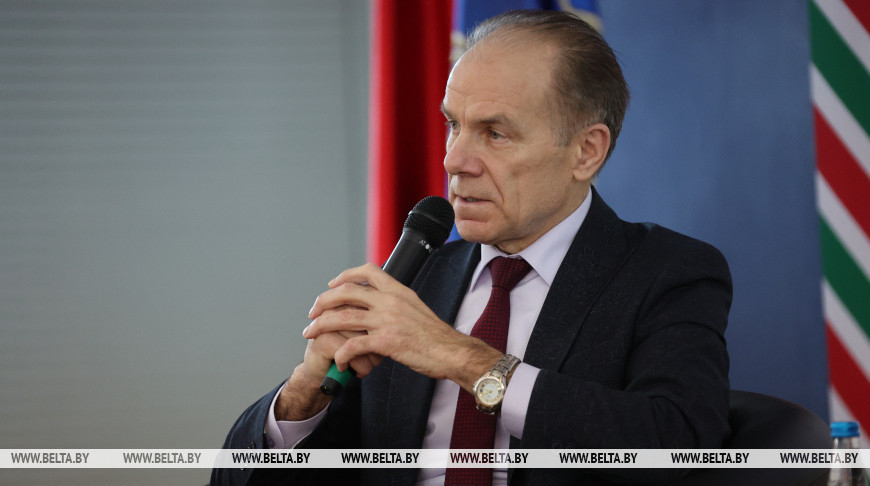
Today, Belarus marks Constitution Day - the Fundamental Law of the country, which holds supreme legal force and enshrines the key principles and norms governing the most important social relations. The event symbolizes the rule of law and the protection of citizens’ rights. The Belarusian Constitution proclaims the individual and their life as the highest value. It guarantees every citizen the freedoms and rights necessary for productive activity, a dignified existence, and harmonious, comprehensive development. Grigory Vasilevich, Head of the Department of Constitutional Law at the Faculty of Law of Belarusian State University, Corresponding Member of the National Academy of Sciences of Belarus, Professor, and Doctor of Legal Sciences, spoke with BelTA about why it is important for every citizen of Belarus to know the fundamentals of the Constitution.
Mr. Vasilevich, why is the Constitution not just the main, but the fundamental law of the country?
The Constitution is both the principal and the fundamental law of the country. It is the principal law because the Constitution holds supremacy within the legal system (the system of legislation); it heads the entire legal pyramid of acts, standing at its apex. It is the fundamental law due to the fact that on its basis, and on the basis of the principles and norms enshrined within it, the entire national legal system develops: legislative acts are adopted, the system of state authority bodies is created, and legal ideology, legal culture, and legal consciousness evolve.
Why is it important for every citizen of Belarus to know the fundamentals of the Constitution?
Knowledge of the fundamentals of the Constitution enhances a person’s general and legal culture, allows them to understand the scope of their rights and responsibilities, the nature of their relationships with state bodies and other citizens, to act lawfully, and to resolve potential disputes and conflicts in a civilized manner.
How would you assess the role of young people in the process of protecting and developing constitutional rights and freedoms in the country?
Young people are the most active part of the country’s population. They are characterized by a search for answers to the questions that young people face during the period of forming and strengthening their worldview. The future of any country lies with its youth. It is important to know one’s rights, but it is equally important and necessary to properly fulfill one’s legal duties, many of which are enshrined in the Constitution.
The Constitution and the normative legal acts adopted in accordance with it ensure the full spectrum of rights: personal, political, socio-economic, and socio-cultural rights, as well as collective rights. The state does everything possible, within the limits of its available resources, for the social protection of our citizens.
As for responsibilities, I would like to highlight the following. Everyone present on the territory of Belarus is obliged to comply with its Constitution and laws, and to respect the state symbols and national traditions of the country. Everyone is obliged to respect the dignity, rights, freedoms, and legitimate interests of others, and is obliged to protect the historical-cultural, spiritual heritage, and other national values. Preserving the historical memory of the heroic past of the Belarusian people and patriotism are the duty of every Belarusian. Protecting the natural environment and treating natural resources with care is also everyone’s duty. Furthermore, citizens of Belarus are obliged to participate in financing government expenditures through the payment of taxes, duties, and other levies. The defense of Belarus is both a duty and a sacred obligation of every citizen. Essentially, these are the responsibilities inherent in all countries that seek to ensure a balance between the interests of the individual, society, and the state as a whole. Without this, the harmonious development of the country is impossible.
I would like to draw attention to the fact that, following the 2022 referendum, the Constitution now enshrines, in particular, the provision that everyone must demonstrate social responsibility and make a tangible contribution to the development of society and the state. Only by joining efforts and working with dedication can we achieve dynamic development of the country and improve both general and personal wellbeing.
How does the Faculty of Law contribute to shaping students’ legal awareness in the context of the Constitution?
For students of the Faculty of Law, the curriculum includes lectures and practical sessions in courses such as Constitutional Law, Constitutional and Legal Responsibility, and Constitutional Justice. After all, our graduates work in public authorities - in courts, the advocacy, the prosecutor’s office, the Investigative Committee, and bodies of executive and representative power. Without knowledge of constitutional norms, it is simply impossible to become a specialist who can competently review appeals from citizens and legal entities and resolve emerging legal conflicts.
Our students are active young people; they engage in scientific research, participate, beyond studying the required subjects, in student training classes, including those organized at the Department of Constitutional Law, and take part in competitions and conferences. We practice organizing joint student training classes with other departments to demonstrate how the norms of constitutional law help to properly resolve, for example, civil disputes or issues related to legal liability.
What events are being planned at the faculty in honor of Constitution Day?
There are many events. These include lectures by instructors from the Department of Constitutional Law before student and work groups, as well as plans to hold a roundtable discussion with students, among other activities. But one of the significant events is the holding of a national conference on the theme “The Origins of State Building and Modernity in the Constitutional-Legal and Political Dimensions”. It is organized by four departments of the Faculty of Law: Constitutional Law; Theory and History of State and Law; Public Administration; and the Department of Political Science. A wide range of issues are planned for discussion.
BelTA.






![Viktor Shevaldin [Screengrab/BelTA]](https://eng.belta.by/images/storage/news/with_archive/2026/000022_1777280130_179578_medium.jpg "Viktor Shevaldin [Screengrab/BelTA]")