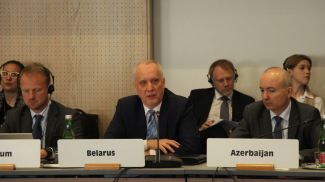

MINSK, 23 December (BelTA) - Tajikistan reaffirms its commitment to further strengthening multilateral cooperation, sustainable development, and security within the Commonwealth of Independent States (CIS), Tajikistan's Ambassador to Belarus, who is also his country's Permanent Plenipotentiary Representative to the CIS statutory and other bodies Bakhtovar Safarzoda told the media ahead of a regular meeting of the CIS Council of Permanent Plenipotentiary Representatives of at the CIS Executive Committee in Minsk on 23 December, BelTA has learned.
The draft agenda includes eight items. The main one is taking stock the results of Tajikistan's CIS chairmanship in 2025. “Tajikistan's chairmanship in 2025 was an important stage in strengthening multilateral cooperation and integration within the CIS,” Ambassador Bakhtovar Safarzoda said. “The chairmanship was based on the concept and plans of action approved by the president of the Republic of Tajikistan, with a focus on political dialogue, economic and humanitarian cooperation and also security and sustainable development of the CIS.”
He emphasized that the key event of the year was the meeting of the CIS Heads of State Council held in Dushanbe on 10 October and the two meetings of the CIS Heads of Government Council in Dushanbe and Minsk, two meetings of the CIS Ministerial Council in Almaty and Dushanbe, and four meetings of the CIS Economic Council. “These meetings undoubtedly confirmed the high level of interaction and readiness of the CIS countries to work out coordinated decisions. Throughout the year, there were also 14 meetings of the CIS Council of Permanent Plenipotentiary Representatives, including one joint meeting with the Economic Affairs Commission under the CIS Economic Council. A significant number of meetings of CIS sectoral cooperation bodies were also held,” he added.
The Ambassador noted that important documents had been adopted in economy. “These include the action plan to the second stage of the CIS Economic Development Strategy for 2026-2030, the concept for industrial cooperation and collaboration in the light industry sector and the agreement on developing the heavy machinery industries. Energy and transportation received a new impetus thanks to the declaration on cooperation in ensuring regional energy security, the concept for harmonizing air traffic, and the strategy for digitalizing the main multimodal transport corridors of the CIS. Priority attention was also given to security issues,” Ambassador Bakhtovar Safarzoda noted. “In 2025, Dushanbe hosted the international conference on glacier preservation, which concluded with the adoption of the Dushanbe Declaration on Glacier Preservation and a call to action urging the global community to join forces in protecting the cryosphere and glaciers. Humanitarian cooperation developed across a broad spectrum of areas: culture, science, education, youth policy, sports, and, of course, tourism.”
“The Republic of Tajikistan reaffirms its commitment to further strengthening multilateral cooperation, sustainable development, and security in the CIS,” Ambassador Bakhtovar Safarzoda concluded.
The draft agenda includes eight items. The main one is taking stock the results of Tajikistan's CIS chairmanship in 2025. “Tajikistan's chairmanship in 2025 was an important stage in strengthening multilateral cooperation and integration within the CIS,” Ambassador Bakhtovar Safarzoda said. “The chairmanship was based on the concept and plans of action approved by the president of the Republic of Tajikistan, with a focus on political dialogue, economic and humanitarian cooperation and also security and sustainable development of the CIS.”
He emphasized that the key event of the year was the meeting of the CIS Heads of State Council held in Dushanbe on 10 October and the two meetings of the CIS Heads of Government Council in Dushanbe and Minsk, two meetings of the CIS Ministerial Council in Almaty and Dushanbe, and four meetings of the CIS Economic Council. “These meetings undoubtedly confirmed the high level of interaction and readiness of the CIS countries to work out coordinated decisions. Throughout the year, there were also 14 meetings of the CIS Council of Permanent Plenipotentiary Representatives, including one joint meeting with the Economic Affairs Commission under the CIS Economic Council. A significant number of meetings of CIS sectoral cooperation bodies were also held,” he added.
The Ambassador noted that important documents had been adopted in economy. “These include the action plan to the second stage of the CIS Economic Development Strategy for 2026-2030, the concept for industrial cooperation and collaboration in the light industry sector and the agreement on developing the heavy machinery industries. Energy and transportation received a new impetus thanks to the declaration on cooperation in ensuring regional energy security, the concept for harmonizing air traffic, and the strategy for digitalizing the main multimodal transport corridors of the CIS. Priority attention was also given to security issues,” Ambassador Bakhtovar Safarzoda noted. “In 2025, Dushanbe hosted the international conference on glacier preservation, which concluded with the adoption of the Dushanbe Declaration on Glacier Preservation and a call to action urging the global community to join forces in protecting the cryosphere and glaciers. Humanitarian cooperation developed across a broad spectrum of areas: culture, science, education, youth policy, sports, and, of course, tourism.”
“The Republic of Tajikistan reaffirms its commitment to further strengthening multilateral cooperation, sustainable development, and security in the CIS,” Ambassador Bakhtovar Safarzoda concluded.