MINSK, 22 March (BelTA) - Today Belarusians commemorate the tragedy of residents of the village of Khatyn, which was burned down by the Nazis 83 years ago – on 22 March 1943. By remembering Khatyn, Belarusians recall thousands of other Belarusian villages destroyed by Nazi invaders during the Great Patriotic War of 1941-1945.
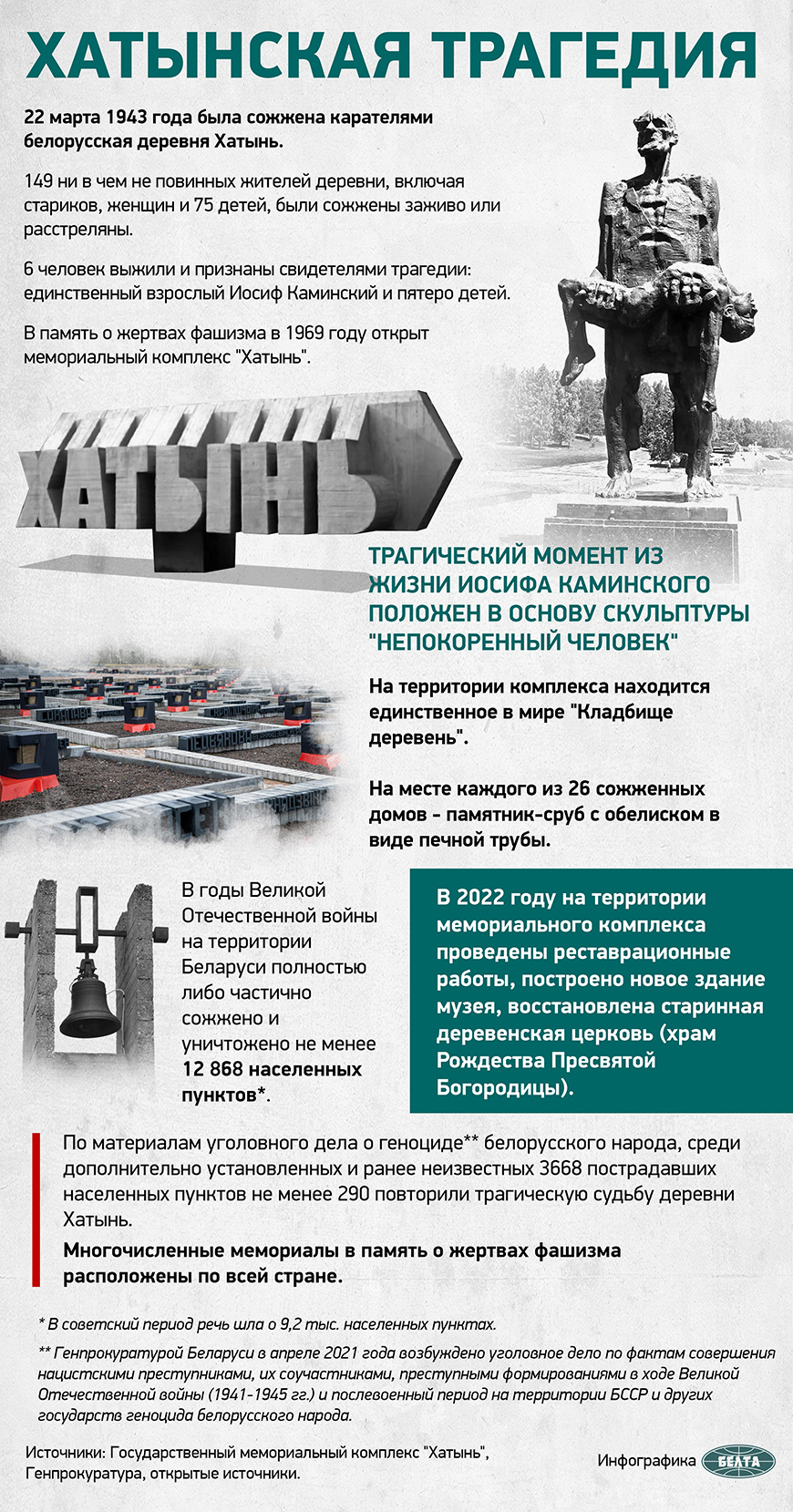
The village of Khatyn can no longer be found on the map of Belarus. The Nazis burned it down together with 149 residents, including 75 children. The Nazis passed a death sentence on innocent people. They drove out old people, children, women and men from the houses and into a hay barn on the outskirts of the village. The adults calmed the children as best they could, but the anxiety was growing stronger by the minute. Locked inside, they did not know what was going on outside.
Meanwhile several soldiers were putting straw at the walls of the barn, poured gasoline and set it ablaze. The wooden barn caught fire instantly. Children were suffocating and crying in the smoke. Adults tried to save the children. Under the pressure of dozens of human bodies, the door collapsed. In burning clothes, stricken with horror, people rushed to escape but were gunned in cold blood with assault rifles and machine guns.
The Khatyn memorial complex was created at the site of the village to commemorate the victims. The decision to build the memorial was made in 1966.
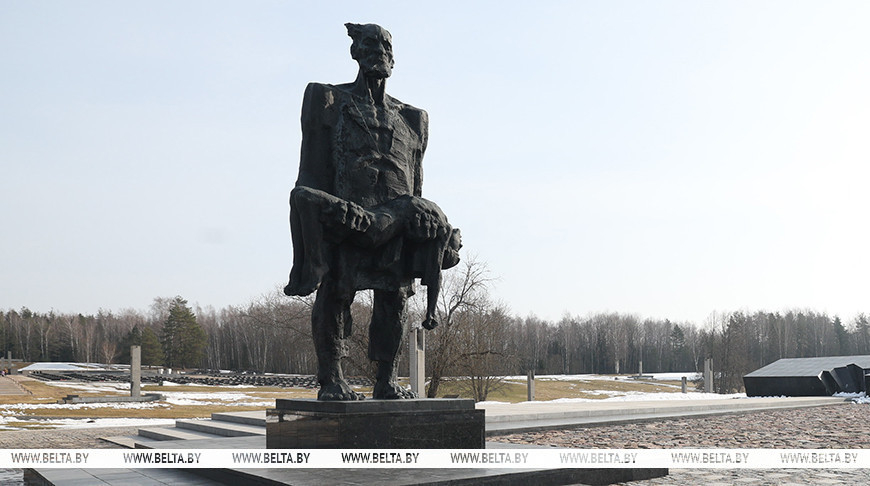
The Khatyn memorial complex has several thematic zones unified by a single theme. The design of the complex repeats the layout of the former village. In the center is the bronze sculpture Unconquered Man. It is a symbol of a man who rose alive from the fire holding a body of a boy, damning fascism and damning any evil on Earth. His prototype was Iosif Kaminsky, a witness to the Khatyn tragedy, who miraculously survived. Burned and wounded, he got out of the burning barn and found the mutilated body of his son among the corpses of his fellow villagers.
Next to the sculpture there are the granite slabs reminiscent of the roof of the barn where the executors burned the villagers. On the mass grave there is a marble wreath of memory with a symbolic address from the dead to the living asking to preserve peace on Earth: “Good people, remember: we loved life and our homeland. We loved you, dear ones. We burned alive in the fire. Our appeal to all: turn grief and sorrow into courage and strength to establish eternal peace on Earth. Make sure life never dies in the whirlwind of fires! Here or anywhere in the world!” On the other side of the wreath is the response of the living to the dead: “Our dear ones. We bow our heads in great sorrow before you. You did not submit to fascist murderers in the black days of hardship. You met your demise, but the flame of love for our Soviet Motherland will never subside. The memory of you is immortal. So is our land and the bright sun above it!”
The former street of the village is paved with gray, ash-colored, reinforced concrete slabs. In the places where the houses stood, there are 26 symbolic concrete groundsels of huts and the same number of obelisks resembling fire-scorched chimneys. In front of each of the burnt houses, there is an open gate symbolizing the hospitality of the villagers. The obelisk pipes have bronze plaques with the names of those who lived in this house and died in fire. The obelisks are capped with bells that ring every 30 seconds, reminding visitors of the tragedy that befell the village.
The complex has the world’s only Cemetery of Villages – 185 symbolic graves, each of which reminds visitors of one village that was burned down together with its residents during the Great Patriotic War of 1941-1945 and has never been restored. The 186th village that has not been restored is Khatyn itself. Each symbolic grave represents a site of fire with a pedestal in the center. The pedestal was designed in the form of a flame to remind visitors of the horrific fate of the village. There is also an urn with soil from the village destroyed by punitive forces.
However, during the investigation of the genocide of the Belarusian people, new facts were discovered. The list of villages that shared the tragic fate of Khatyn, that is, those that were completely burned with their inhabitants and were not restored after the war, was expanded. At the moment the figure makes up at least 290.
Another commemorative element of the WW2 memorial Khatyn is the Tree of Life, which branches list the 433 villages in alphabetic order that were burned by the occupying army but restored after the war. The commemorative Wall of Sorrow is a reinforced concrete block containing memorial plates with the names of 260 death camps and places of mass extermination in Belarus. The Eternal Flame burns in memory of those who died during the war.
Each element of the Khatyn memorial is symbolic and communicates a deep meaning about the tragedy our country went through during the Great Patriotic War, the resistance and courage of the Belarusian nation.
Upon instructions of President of the Republic of Belarus Aleksandr Lukashenko, the reconstruction of the State Memorial Complex Khatyn was launched in 2004, on the 60th anniversary of Belarus’ liberation from the Nazi invaders. It was completed by 25 June 2004.
The church of the Nativity of the Blessed Virgin Mary, consecrated on 18 March 2023, is a replica of the church that once stood in Khatyn. It was possible to build a replica of the church only because a description of the 18th-century church in Khatyn was kept in the National Historical Archive of Belarus.
On 22 March 2023, the day of the 80th anniversary of the tragedy of the village of Khatyn a new Museum of the Memory of the Victims of the Belarusian People during the Great Patriotic War was opened at the memorial complex. Its exhibition leaves an indelible impression and allows visitors to deeply feel the tragedy of war. It is clear why the museum is not recommended for visitors under the age of 12.
The tragedy of Khatyn was not a random episode of the war but one of thousands that reflect the deliberate genocide policy of Nazi Germany against Belarus’ population.
Belarus launched the trial of Vladimir Katryuk, known as the executioner of Khatyn, on 8 February 2024. In the autumn of 1941 he voluntarily joined Ukrainian nationalist units, and then (no later than January 1943) became a member of an armed organized criminal group - the 118th Security Police Battalion. Together with other executioners, he, being the commander of the unit, worked on the Nazi common goal of destroying the Belarusian nation by killing people, depriving them of housing, clothing and food. Vladimir Katryuk managed to escape punishment and lived in Canada until his death. On 18 March 2024 the Supreme Court of Belarus found Vladimir Katryuk guilty of committing genocide, i.e. a crime under Article 127 of the Criminal Code. He was found guilty but not sentenced.
On 30 December 2024 the Supreme Court of Belarus also found Konstantin Smovsky, commander of the 118th Security Police Battalion, guilty of committing genocide. He led the battalion almost from its inception and commanded it under the supervision of an SS officer. From January 1943 to May 1944 Smovsky committed mass killings of civilians, including those in helpless conditions, facilitated forced deportations to Germany for grueling slave labor, and other forms of exploitation. He directly participated in the murder of innocent civilians in Khatyn. After the war Smovsky lived in West Germany and later in the United States.
On 17 October 2025 the Supreme Court of Belarus found the punitive officer Osip Vinnitsky guilty of genocide. With the aim of systematically exterminating the Belarusian people, as a member of an organization of Ukrainian nationalists and a participant in the paramilitary unit Bukovinian Kuren, he joined the 118th Security Police Battalion in the autumn of 1942. In the course of the investigation, the Prosecutor General’s Office gathered irrefutable evidence confirming Vinnitsky’s participation in punitive operations, either personally or by issuing orders to his subordinates. His involvement in the extermination of residents of several villages, including Khatyn, was also proved. Osip Vinnitsky died in Canada in 1997. Due to his death he was found guilty but not sentenced.
The Khatyn Memorial Complex is on the State List of Historical and Cultural Heritage. People from various countries go there to pay tribute to the memory of all the Belarusians, who died in the flames of the war. Khatyn will forever remain a heart-wrenching symbol of thousands of Belarusian villages destroyed during the Great Patriotic War. The bells of Khatyn are a memory and a warning to the whole world that such a disaster must never repeat itself.