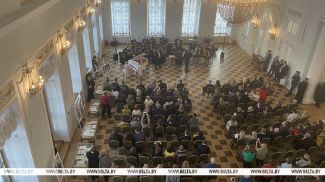
MOSCOW, 17 June (BelTA) - The CIS Anti-Terrorist Center (ATC) celebrated its 15-year anniversary. The celebrations on the occasion were held today at the Russia FSB cultural center in Moscow, BelTA has learned.
Opening the session, the head of the CIS Anti-Terrorist Center Andrei Novikov noted that the center was created at a time when the CIS states came under a powerful attack of international terrorism, which became a real threat to the stability in the region. "Within a short period of time actions were taken to create a single legal and institutional space to combat terrorism, establish contacts with the CIS statutory bodies and the bodies of sectoral cooperation in the CIS member states," he said.
The formation of the center took place in the context of the political and economic life of the CIS states, the development of interstate relations. "Including the dynamic processes taking place in the global arena: the global economic crisis, a series of color revolutions, and serious transformations of the very substance and context of terrorist activity, i.e. the emergence of new agents of terror. All this has promoted a serious reformatting of the system of anti-terrorist security," said Andrei Novikov.
According to Andrei Novikov, the global cooperation in the field of counter-terrorism will continue, and the blocs and coalitions will be strengthening their efforts, particularly at the sub-regional level. "While increasing the potential for cooperation with global international organizations such as the UN, OSCE, Interpol and a number of others, the ATC has started paying more attention to the urgent problems of the CIS states. Among them are the prevention and suppression of acts of terrorism on critically important facilities, crowded places, countering the spread of extremist ideas in cyberspace, opposition to the so-called colored revolutions and the subversive activities of unscrupulous non-governmental organizations, coordination of interstate search for criminals who committed terrorist and extremist crimes, forming a system to counteract mercenarism.”
The head of the center said that security specialists are concerned over intensified activities of international terrorist and radical extremist organizations, expansion of such a phenomenon as terrorist mercenarism and the encroachment of the Islamic State international terrorist organization directly towards the southern borders of the CIS. "Some 15 years ago, we could hardly imagine how much the nature of the terrorist threat would change and what new technological solutions and managerial decisions would be needed to lower their critical thresholds,” said Andrei Novikov. “Now we need to expand the range of practical decisions regarding the interaction and cooperation between the competent authorities. The Anti-Terrorism Center in conjunction with partners has been actively working to develop a set of measures to prevent the spread of Islamic State terrorist activity to the territory of the CIS states.
A large block of issues on the agenda of the meeting of the heads of national anti-terrorism centers of the CIS states on 18 June will be devoted to these issues, Andrei Novikov informed.
Opening the session, the head of the CIS Anti-Terrorist Center Andrei Novikov noted that the center was created at a time when the CIS states came under a powerful attack of international terrorism, which became a real threat to the stability in the region. "Within a short period of time actions were taken to create a single legal and institutional space to combat terrorism, establish contacts with the CIS statutory bodies and the bodies of sectoral cooperation in the CIS member states," he said.
The formation of the center took place in the context of the political and economic life of the CIS states, the development of interstate relations. "Including the dynamic processes taking place in the global arena: the global economic crisis, a series of color revolutions, and serious transformations of the very substance and context of terrorist activity, i.e. the emergence of new agents of terror. All this has promoted a serious reformatting of the system of anti-terrorist security," said Andrei Novikov.
According to Andrei Novikov, the global cooperation in the field of counter-terrorism will continue, and the blocs and coalitions will be strengthening their efforts, particularly at the sub-regional level. "While increasing the potential for cooperation with global international organizations such as the UN, OSCE, Interpol and a number of others, the ATC has started paying more attention to the urgent problems of the CIS states. Among them are the prevention and suppression of acts of terrorism on critically important facilities, crowded places, countering the spread of extremist ideas in cyberspace, opposition to the so-called colored revolutions and the subversive activities of unscrupulous non-governmental organizations, coordination of interstate search for criminals who committed terrorist and extremist crimes, forming a system to counteract mercenarism.”
The head of the center said that security specialists are concerned over intensified activities of international terrorist and radical extremist organizations, expansion of such a phenomenon as terrorist mercenarism and the encroachment of the Islamic State international terrorist organization directly towards the southern borders of the CIS. "Some 15 years ago, we could hardly imagine how much the nature of the terrorist threat would change and what new technological solutions and managerial decisions would be needed to lower their critical thresholds,” said Andrei Novikov. “Now we need to expand the range of practical decisions regarding the interaction and cooperation between the competent authorities. The Anti-Terrorism Center in conjunction with partners has been actively working to develop a set of measures to prevent the spread of Islamic State terrorist activity to the territory of the CIS states.
A large block of issues on the agenda of the meeting of the heads of national anti-terrorism centers of the CIS states on 18 June will be devoted to these issues, Andrei Novikov informed.