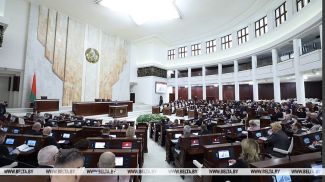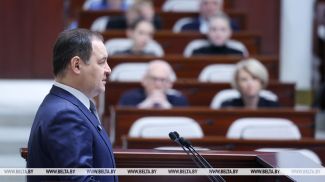

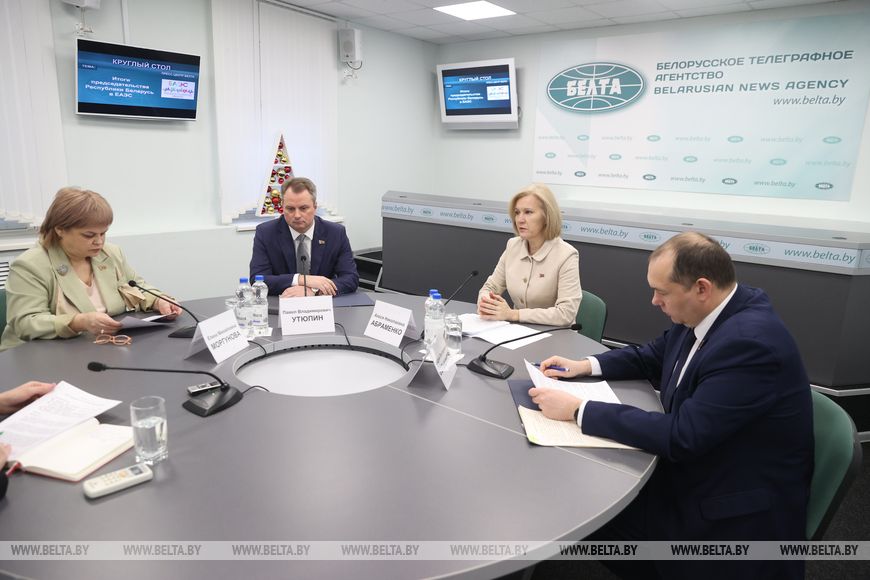
In 2025, Belarus chaired the bodies of the Eurasian Economic Union (EAEU). What key results should be highlighted in terms of strengthening international ties and the external positioning of the union? How will the signing of trade agreements affect the development of mutual trade between EAEU member states and third countries? These questions were addressed by Belarus’ Deputy Minister of Foreign Affairs Pavel Utyupin during the roundtable discussion Results of the Belarus’ chairmanship in the EAEU at the BelTA press center.
Positioning the EAEU on the international stage
“Taking stock of Belarus’ chairmanship, we can confidently say that Belarus consistently and constructively advanced the integration agenda (our initiative of ‘integration of integrations’), making a significant contribution to strengthening cooperation. During the chairmanship, important initiatives were implemented to enhance the attractiveness of the EAEU, reinforce its standing internationally, and expand practical cooperation,” Pavel Utyupin said.
Among the key events, he cited the June meeting of the Supreme Eurasian Economic Council in Minsk, accompanied by the 4th Eurasian Economic Forum, which confirmed its relevance as a dialogue platform and brought together more than 2,700 delegates from 26 countries, including representatives of major regional integration organizations (CIS, CICA, SCO). In addition, in September Minsk hosted a meeting of the Eurasian Intergovernmental Council, alongside the international exhibition INNOPROM. Belarus, where the country showcased industrial achievements to numerous foreign delegations.
“In 2025, three significant economic partnership agreements were signed by the EAEU: with Mongolia, the UAE, and Indonesia. Furthermore, the Eurasian Economic Commission received applications from Venezuela, Myanmar, and Nicaragua to obtain observer status with the EAEU. This demonstrates the growing interest in the union as a reliable partner and its importance on the international stage,” the deputy minister emphasized.
In order to reinforce the international standing of the EAEU as a successful and forward-looking model of regional integration, a report on the union’s achievements in implementing the Sustainable Development Goals was presented at the UN High-Level Political Forum in New York in July. In October, the UN headquarters in Geneva hosted the presentation event EAEU Days. “These initiatives made it possible to clearly demonstrate the achievements of the EAEU, highlight the significant results of its activities over the past 10 years, and present the union to a broad international audience,” Pavel Utyupin added.
Trade preferences
“We are very pleased with the results of our chairmanship year in terms of expanding the network of preferential trade agreements. In 2025, we signed agreements with three countries: on 27 June with Mongolia and the United Arab Emirates, and on 21 December with Indonesia,” the deputy minister noted.
According to him, comprehensive work lasting three to five years was carried out with each of these states, including preliminary consultations, joint studies on the feasibility of concluding agreements, and the negotiations themselves. The length of the talks was also due to the sensitivity of tariff concessions for all parties, requiring careful study to find mutually acceptable solutions. For example, if a particular product was of export interest to one side while being produced domestically by the other, compromises had to be found to reach balanced outcomes.
“For the signing to take place, all the stars had to align, both economically and politically, for all six parties to the agreement, meaning the five union members and the partner country. To illustrate, at present free trade agreements are in force only with Vietnam, Serbia, and Iran. Once the agreements signed in 2025 enter into force, the number of countries with which the union has established a preferential trade regime will double: from three to six. Thus, 2025 became the most productive year in the union’s history in terms of concluding preferential trade agreements with third countries. To use a sports term, we scored a ‘hat-trick’ this year,” Pavel Utyupin emphasized.
When it comes to such agreements, the primary focus is on the economic effects of lowering customs duties – tangible results that can be calculated. Each EAEU member state assesses these outcomes individually, based on the volume of its bilateral trade with the specific partner country.
“As for the effects for Belarus, the agreed tariff concessions cover more than 90% of Belarusian exports to Mongolia, the UAE, and Indonesia. If we look at bilateral trade flows with these countries, we expect Mongolia’s average tariff rate on Belarusian exports to fall from 6% to 1% immediately after the agreement enters into force, while the average rates in the Emirates and Indonesia will decline from 5% to 0% over several years of the agreements’ implementation. In addition, the agreements guarantee that our partners will not raise the current zero tariff rates in the future. For example, we secured a permanent zero tariff on potash fertilizers. Thus, we understand that this zero rate will remain in place regardless of any future tariff protection measures,” the deputy minister outlined.
It is expected that once the agreements take effect, exports of dairy products, confectionery, petroleum products, wood products, agricultural and automotive machinery and parts, and other goods to Mongolia, the UAE, and Indonesia will increase.
“At the same time, I want to emphasize that we conclude agreements ‘for life’. This applies to the UAE and Indonesia. With Mongolia, we have a temporary agreement, and we hope that after the three-year period we will be able to move to negotiations on a full-format regime,” he said.
Preferences for importing electric vehicles
The issue of preferential imports of electric vehicles was discussed in detail for several months at the EEC platform. Ultimately, the parties reached a consolidated decision to extend for one year, until 31 December 2026, the preferential regime for importing electric vehicles into certain union countries.
“Belarus requested the possibility of duty-free import of 20,000 so-called ‘pure EVs’, meaning electric vehicles that can only be charged from external power sources. This decision aligns with the national strategy for developing efficient charging infrastructure, electricity consumption, and creating a balanced EV market in Belarus. It also takes into account plans to develop domestic EV production, including the launch of mass production at the BelGee plant. That is why the decision was made for only one year. In this way, we tried to balance the interests of both producers and consumers, while also ensuring protection of the EAEU market,” the deputy minister concluded.
Valeria Gavrilova, BelTA