News of the story
"Belarusians in the focus"
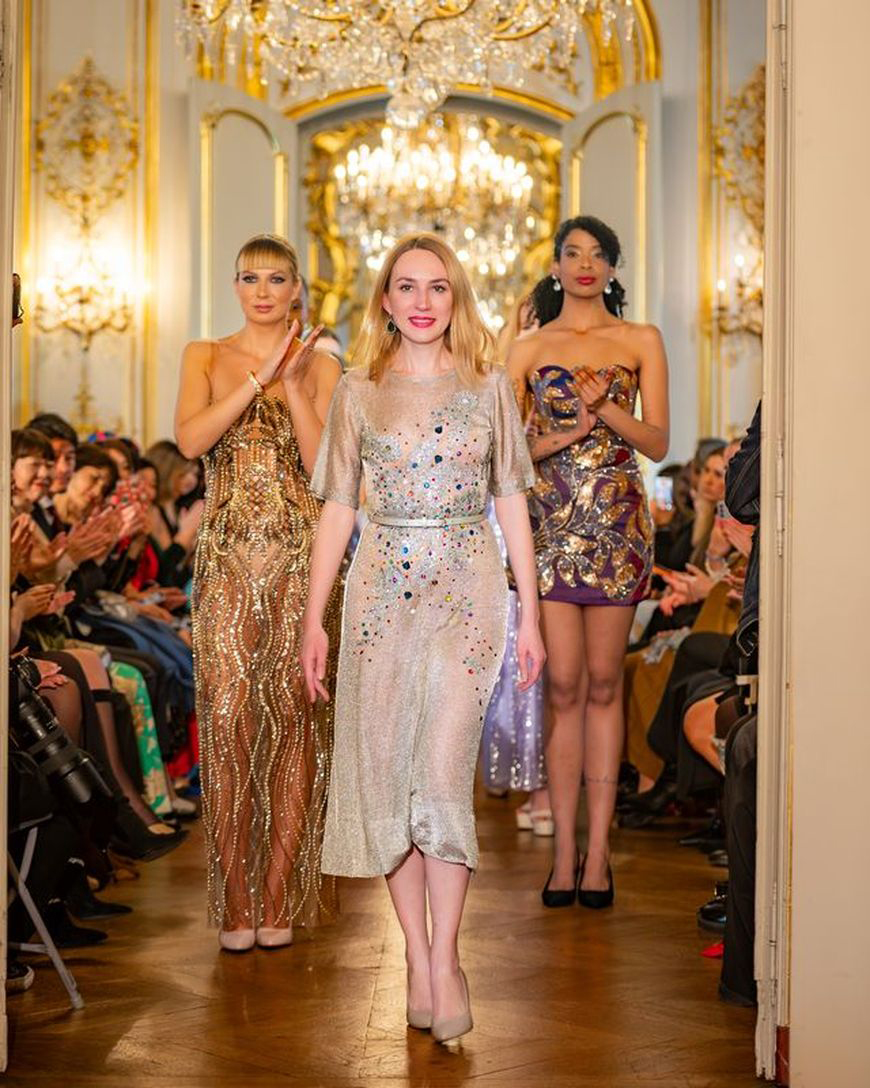
In childhood, Tatiana Davydenko made outfits for dolls; in her youth, she sewed things for herself and her loved ones; and when she grew up, she turned this hobby into her life's work. Today, Tatiana Davydenko is a renowned Belarusian designer whose works are known around the world. Just a few weeks ago, she presented her evening gown collection Aquarelle at Fashion Weeks in Paris and Milan, having been inspired by the weightlessness, transparency, and lightness of watercolor painting. The Belarusian designer’s works caused a real sensation, winning over even the most discerning critics.
‘My doll had her own fashion house’
Tatiana Davydenko grew up as a creative child. For as long as she can remember, her favorite activity was making clothing.
“From early childhood, I dreamed of becoming a fashion designer. I sewed dresses for my toys. My doll had her very own fashion house! When I got a bit older, I decided it was time to start creating real clothing. It was a time of widespread shortages, when it was difficult to buy new fabric, so I would take my grandmother’s skirts and dresses and remake them,” Tatiana recalled. “Handicraft classes were among my favorites because I could do practically everything. And the teachers, of course, took note of that."
Tatiana often came to school in a new fashionable skirt or dress, and her classmates always admired her outfits. The best compliment for the girl was the question: “Where did you buy that?” It meant that the garment looked great.
“The most memorable for me were the pants I made from my grandmother's skirt,” Tatiana said. “Plaid pants were just coming into fashion back then, and almost no one could get them. But I already had them! The whole class appreciated that new outfit.”
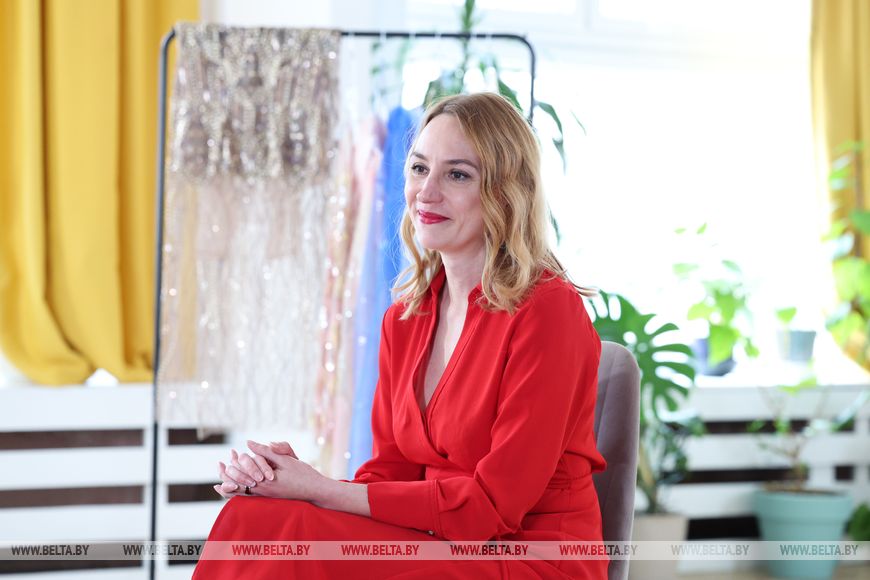
Knowing that a designer must not only know how to sew but also draw well, Tatiana Davydenko enrolled in Children's Art School No. 1 in Minsk and then the A.M. Shirokov Institute of Modern Knowledge, where she earned a degree in fashion design.
For her graduation project, Tatiana decided to create a collection of wedding dresses for pregnant brides.
“Back then, in 2007, there was nothing like it on the market,” she recalled. “The idea came about by chance. It was May, and my friends and I had gone out to bask in the sun when a fellow student of mine walked by. She was in her last months of pregnancy. When I asked how she was doing, she replied that she was preparing for a wedding. When I brought up the dress, she admitted that she’d had to buy a corseted one. I imagined how uncomfortable she would be in it, and I thought that I could help pregnant brides by creating gowns in which they would feel beautiful without experiencing any discomfort.”
'The dress dissolved, turning into birds'
Throughout her career, Tatiana Davydenko has worked with dozens of renowned performers, creating unique stage looks for each. The process of sewing a costume for a performance is very different from making an ordinary dress, even an evening gown. Before taking on such an order, our protagonist thoroughly studies how the number is staged and how active the performer’s movements will be. For example, a dress she made in 2014 for Honored Artist of Belarus Zhanet changed color right during the performance and turned into birds. Tatiana admits that she never has boring projects, each work is distinguished by some special detail.
“Since childhood, I knew that this was my path, and I worked very hard to achieve success. My parents always supported me. I remember how the whole family helped me sew buttons onto my jackets,” Tatiana noted.
She took part in her first competition as a professional designer while still a student.
"It happened in my second year of institute. The teachers noticed that my sketches had become more detailed and refined, and they suggested I take part in Melnitsa Mody (The Fashion Mill). I passed the sketch round and made my first collection for the runway. I didn't win a prize, but my work was highly praised. For a beginning designer, that was a huge success! After that, every year until the end of the institute I took part in Melnitsa Mody. One of my collections won a prize, and I was invited to the Lafayette Gallery in Paris.
“Back then, in 2007, there was nothing like it on the market,” she recalled. “The idea came about by chance. It was May, and my friends and I had gone out to bask in the sun when a fellow student of mine walked by. She was in her last months of pregnancy. When I asked how she was doing, she replied that she was preparing for a wedding. When I brought up the dress, she admitted that she’d had to buy a corseted one. I imagined how uncomfortable she would be in it, and I thought that I could help pregnant brides by creating gowns in which they would feel beautiful without experiencing any discomfort.”
'The dress dissolved, turning into birds'
Throughout her career, Tatiana Davydenko has worked with dozens of renowned performers, creating unique stage looks for each. The process of sewing a costume for a performance is very different from making an ordinary dress, even an evening gown. Before taking on such an order, our protagonist thoroughly studies how the number is staged and how active the performer’s movements will be. For example, a dress she made in 2014 for Honored Artist of Belarus Zhanet changed color right during the performance and turned into birds. Tatiana admits that she never has boring projects, each work is distinguished by some special detail.
“When creating the look with the birds, I knew the number would be static. So we had the opportunity to design a huge black dress that occupied most of the stage. In the middle of the performance, it seemed to dissolve, flying away as birds, and the singer remained in a white fitted gown. For the audience, this transformation seemed magical, but for us it was a meticulously thought-out and technically precise work, down to the smallest details,” Tatiana Davydenko said.
Creating a stage costume is always a collaboration between the performer and the designer. The performer expresses their wishes and describes their vision for the number as a whole, while the designer creates the outfit.
“For example, when Zhanet came to me, she immediately said she wanted a dress that would be black first and then white. And that at a certain moment, birds would fly out from under it. After discussing the details, I began working on the sketches,” Tatiana recalled. “The performer has their own image, their own emotions - they feel the song they are singing. For example, it was important for me to understand that the black dress represented deep sorrow, but then that sorrow disappeared, leaving only pure light, which we conveyed through the white fabric.”
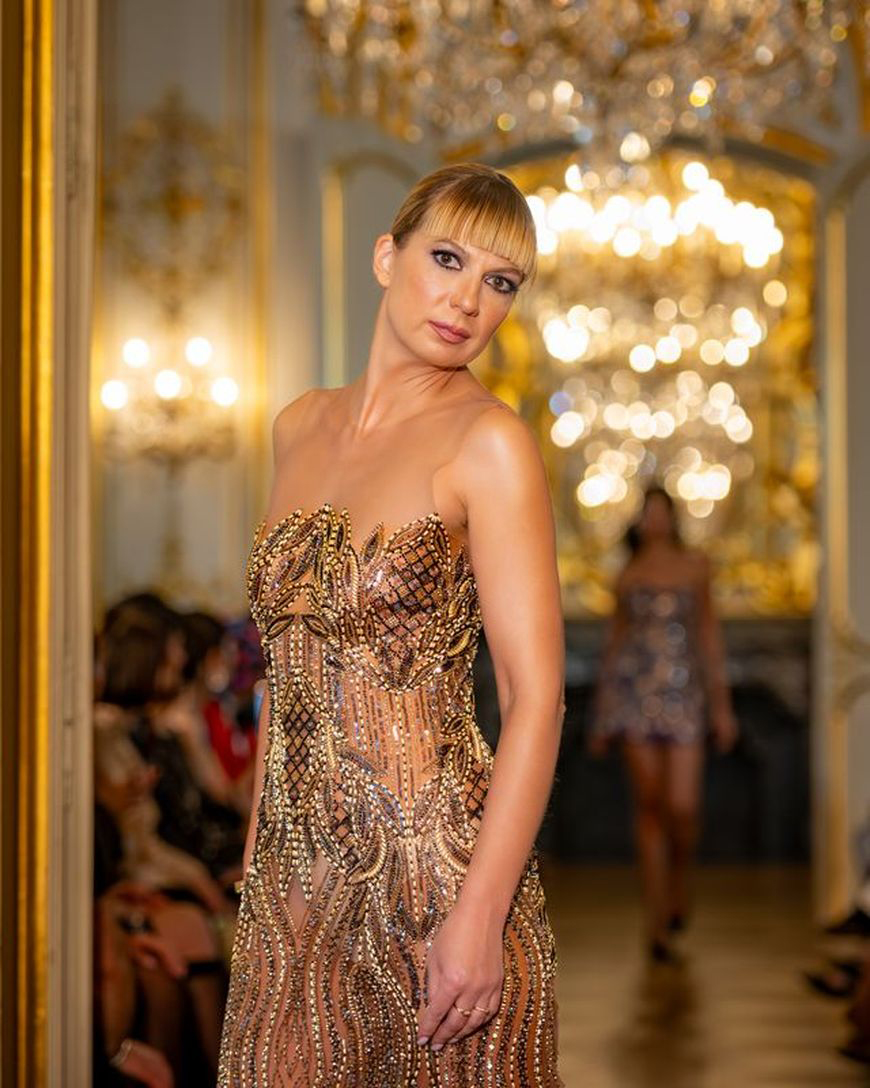
Another dress for Zhanet - the crystal dress - looks like a true work of art. This amazingly beautiful gown was made by hand from plexiglass.
 “We found them in a hardware store, then repainted them and added them to stage costumes. It looked very interesting,” Tatiana notes. “Sometimes the lack of a necessary material or a rich selection of fittings inspires a designer to go looking for missing parts in the most unusual places.”
‘The Belarusian school of design maintains a very high standard’
 Another dress from the collection that the designer draws our attention to is a semi-transparent lilac gown adorned with feathers.
 ‘The colors seem to flow into each other’
 Yulia Gavrilenko,
Creating a stage costume is always a collaboration between the performer and the designer. The performer expresses their wishes and describes their vision for the number as a whole, while the designer creates the outfit.
“For example, when Zhanet came to me, she immediately said she wanted a dress that would be black first and then white. And that at a certain moment, birds would fly out from under it. After discussing the details, I began working on the sketches,” Tatiana recalled. “The performer has their own image, their own emotions - they feel the song they are singing. For example, it was important for me to understand that the black dress represented deep sorrow, but then that sorrow disappeared, leaving only pure light, which we conveyed through the white fabric.”
Another dress for Zhanet - the crystal dress - looks like a true work of art. This amazingly beautiful gown was made by hand from plexiglass.
“It had to be completed in just two weeks, which is an impossible deadline. We practically went without sleep or food, turning ordinary flat sheets of plexiglass into crystal-like swirls day and night. But every effort was worth it. Each swirl was manually blown using an industrial heat gun,” Tatiana recalls.
In its normal state, the dress resembled ice. When a blue light was shone on it, it turned into water that seemed to flow from one drop to another. When a red spotlight was directed at it, it appeared to burst into flames. It was a mesmerizing sight.
“This dress also occupied a significant part of the stage. Since the singer had a static image, it was not hard to wear it during the performance. However, one must understand that this is not merely a dress, but an entire stage decoration. Part of it remained on the stage, which is why, in a way, the outfit can be compared to a sculpture,” the designer notes. “When it comes to dance groups where movement is the priority, comfort becomes the key requirement in creating a look. The outfit should not constrain the dancer, so a completely different cut and different materials are used.”
According to Tatiana, a designer can use any material that can inspire them or help bring an idea to life. Not only plexiglass is used, but also friezes used to decorate fireplaces, for example.
“We found them in a hardware store, then repainted them and added them to stage costumes. It looked very interesting,” Tatiana notes. “Sometimes the lack of a necessary material or a rich selection of fittings inspires a designer to go looking for missing parts in the most unusual places.”‘The Belarusian school of design maintains a very high standard’
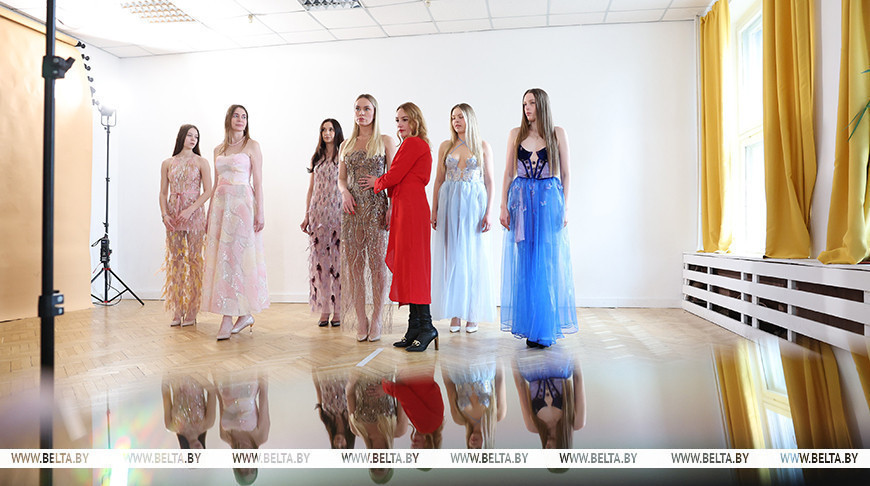
A few weeks ago, Tatiana Davydenko took part in Fashion Weeks in Milan and Paris. The designer presented the evening dress collection titled Aquarelle which caused a real sensation in Europe.
“The preparation was intense. We did an enormous amount of work, spending a long time on fittings and adjustments. The models also rehearsed extensively to perform well. And it all paid off! We demonstrated a very high standard at the Fashion Weeks in Milan and Paris. The collection made a great impression, I was interviewed by French TV channels after the show, and the audience applauded, asking where we were from. We proudly answered that we were from Belarus. And there was no surprise: they are already familiar with our country,” Tatiana Davydenko says. “The Belarusian school of design maintains a very high standard.”
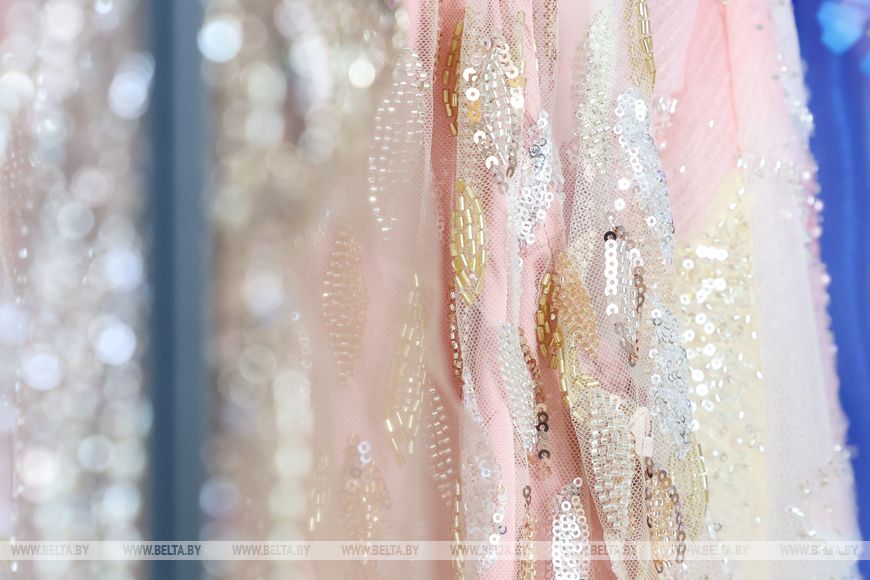
The Aquarelle collection took almost a year to create. Our heroine worked on the embroidery together with her sister.
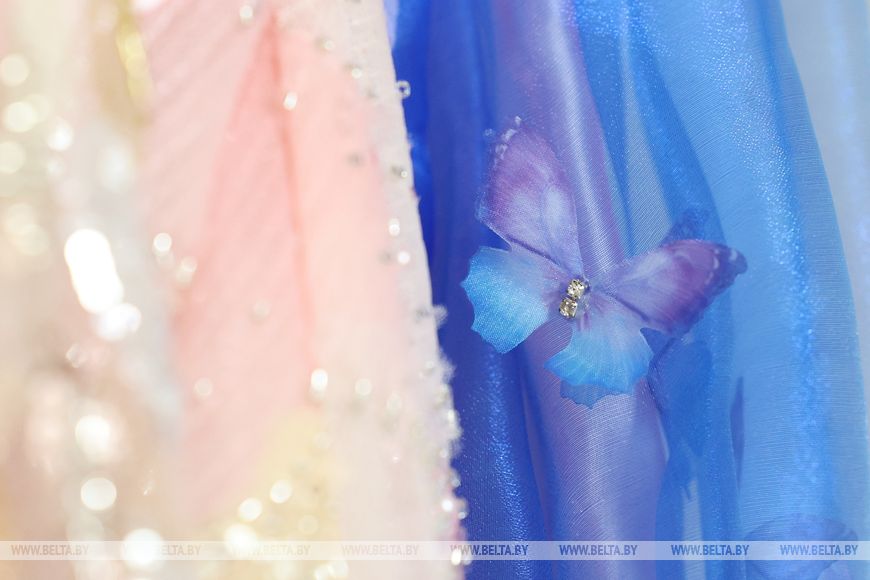
“This is extremely meticulous work based on a corset cut. For example, this corset is entirely hand-embroidered,” Tatiana said, pointing to a floor-length sky-blue dress. “I used several materials that were carefully cut out, layered on top of each other, and joined into a single canvas. The butterflies and flowers are also made entirely by hand.”
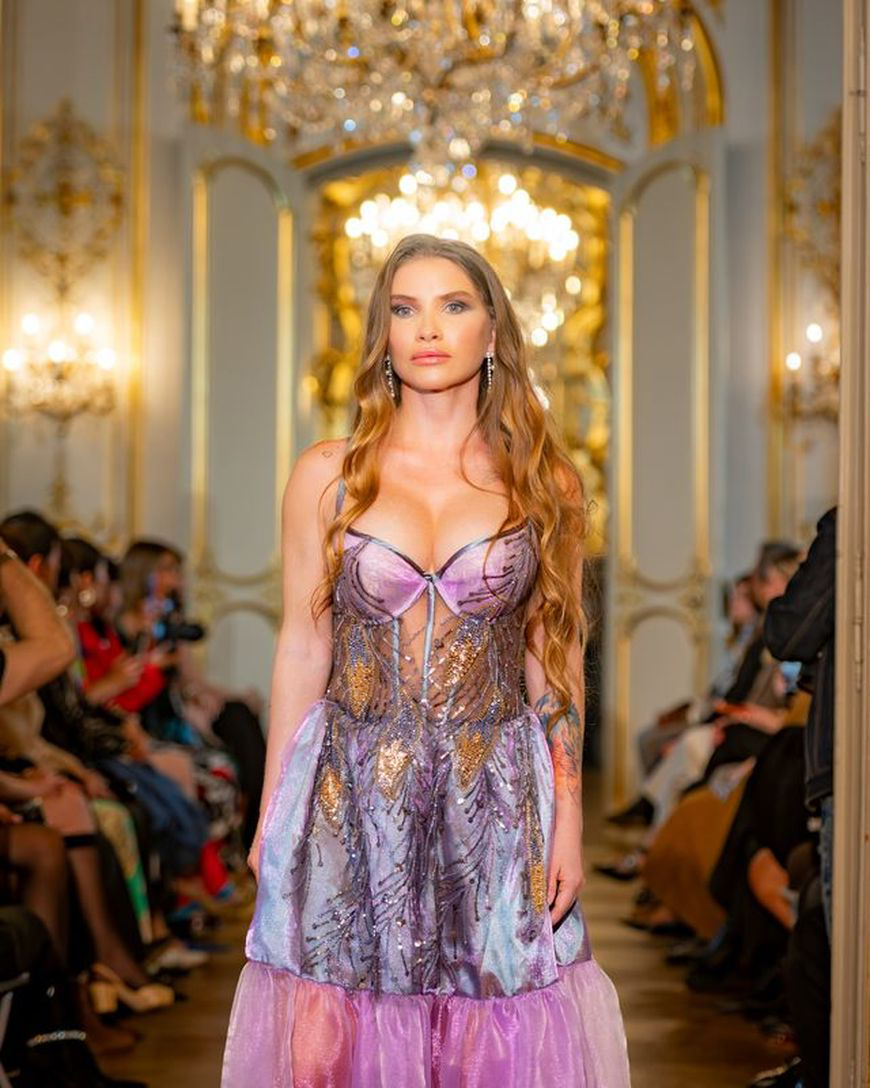
Another dress from the collection that the designer draws our attention to is a semi-transparent lilac gown adorned with feathers.
“This one is also completely handmade. In addition to feathers, the dress is decorated with beads. Here, a lilac fabric is layered over pink, which gives us a deep, rich shade,” the designer explained. “If you hang the dresses side by side, you will see the full spectrum of natural colors. You can observe similar effects in a rainbow or the northern lights. We managed to recreate in the dresses that incredible, mesmerizing transition created by nature itself.”
Before a designer is approved to participate in Fashion Week, they must pass a strict selection process. The first and most important requirement is the uniqueness of the collection.
“It is not enough for it to simply meet a certain standard. It is essential that the collection has never been published or shown anywhere before, otherwise Europeans won’t be interested. And for the project to be beautiful and successful overall, the models also undergo a rigorous selection. There are no random people there,” Tatiana emphasized.
‘The colors seem to flow into each other’
Speaking about inspiration, Tatiana noted that its source is always different.
“It can be an object, a historical costume, a combination of events or artistic directions, and, of course, nature, because it is beautiful. For example, the Aquarelle collection was inspired by watercolor painting, since it is the only technique that allows you to show degrees of transparency, when one color can shine through another. That very quality of watercolor is what I translated into the collection. It is delicate and translucent; in many pieces, the shade of the top skirt overlays the bottom one, creating an unusual dissolving effect. The colors seem to flow into each other.”
During Tatiana’s years as a designer, the fashion world has transformed significantly. Technologies and production have made a huge leap forward, many things have become more accessible, and now artificial intelligence has entered the field. In her view, this brings both advantages and disadvantages.
“All of this makes our work much easier. And yet the most important rule for a designer remains unchanged: a garment must contain the soul of the artist who created it,” she said with confidence. “No artificially invented technology can replace the love and labor that a person puts into their creation from beginning to end.”
Yulia Gavrilenko,
photos by Vitaly Pivovarchik (BelTA) and provided by Tatiana Davydenko,
7 Dnei newspaper