Photo courtesy of Belarus’ State Committee for Standardization
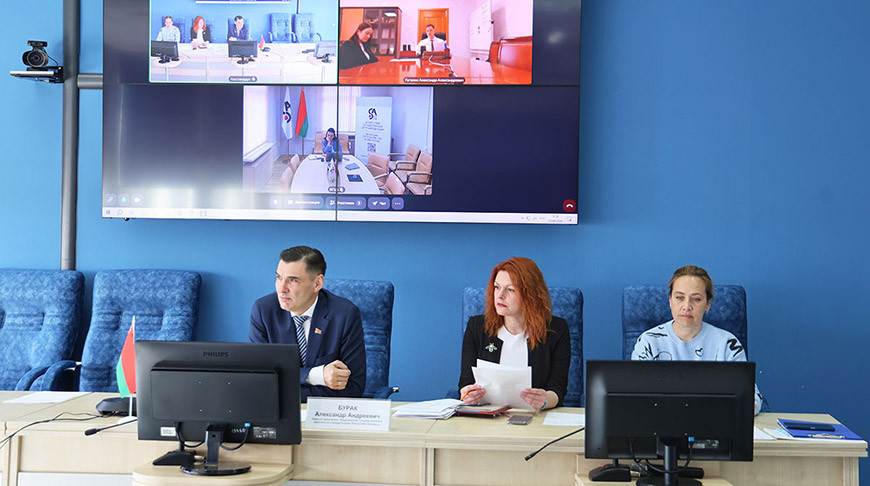
MINSK, 24 April (BelTA) – Belarus’ State Committee for Standardization and the Ministry for Effective Management of Russia’s Sakhalin Oblast will develop a roadmap for cooperation in lean management, the committee’s press service told BelTA.
The agreement was reached during a web-based meeting between the two agencies on 23 April. The Belarusian delegation from the State Committee for Standardization was led by its First Deputy Chairman Aleksandr Burak. It also included representatives of relevant departments: Belarusian State Institute of Standardization and Certification and Belarusian State Centre for Accreditation. The Russian delegation was headed by Sakhalin Oblast Minister for Effective Management Aleksandr Gogolin.
The web-based meeting was initiated by the State Committee for Standardization as a follow-up to the lean management agenda discussed at a conference in Minsk on 20 March, where the experience of Sakhalin Oblast in this field was presented. “We are interested in cooperation across various areas, studying existing experience to enhance systematic work,” Aleksandr Burak noted. “Today, the quality of Belarusian products is closely linked to innovative approaches to structuring production processes that reduce labor costs and increase production efficiency.”
The parties discussed a wide range of aspects of lean manufacturing and labor productivity improvement, as well as the results that can be achieved in industrial production, construction, social welfare, and in improving the quality of public services.
Sakhalin Oblast Minister for Effective Management Aleksandr Gogolin cited several facts. Notably, this is the only such ministry in Russia that deals with process optimization. Sakhalin Oblast is among the top 20 Russian regions in terms of labor productivity growth. The Russian region moved from 43rd to fourth place in the quality of life ranking, and from 34th to fifth place in investment attractiveness.
In terms of optimizing state and municipal services, after five years of work, there is no longer a single service in the region that takes more than 14 days to deliver. Previously, more than 60% of all services took a month. In 2026, 28 companies were included in the labor productivity improvement project. Once the project was implemented at these companies, the savings came to 250 million rubles. And they have no intention of resting on their laurels. Tourism facilities are also being drawn into lean technologies.
Aleksandr Gogolin stressed the importance of building efficiency competencies among children and young people. “To this end, we have created an infrastructure of organizations where we teach children lean technologies. In five to seven years, they will enter the workforce and be fully proficient in these technologies. This is an example of effective use of human potential,” he emphasized.
The Belarusian side showed great interest in the counterparts’ developments in digitalizing project management, data processing, analysis, and the resulting impact, as well as in submitting rational proposals for improvements in various fields. In turn, the Russian specialists said that there were things they could learn from Belarus, particularly in achieving such order and cleanliness in cities.
The draft roadmap for lean management cooperation between the State Committee for Standardization and the Ministry for Effective Management is expected to include the exchange of practical experience in implementing lean management, conducting business training and other educational events, and approaches to digitalizing the process. The document will cover 2026-2027.
As the dialogue showed, the parties intend to develop cooperation and achieve effective interaction in lean management, regardless of distance.