
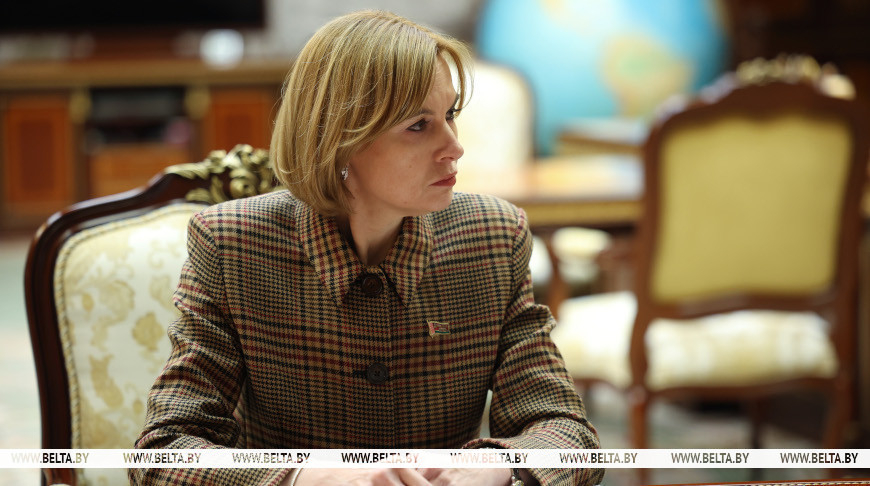
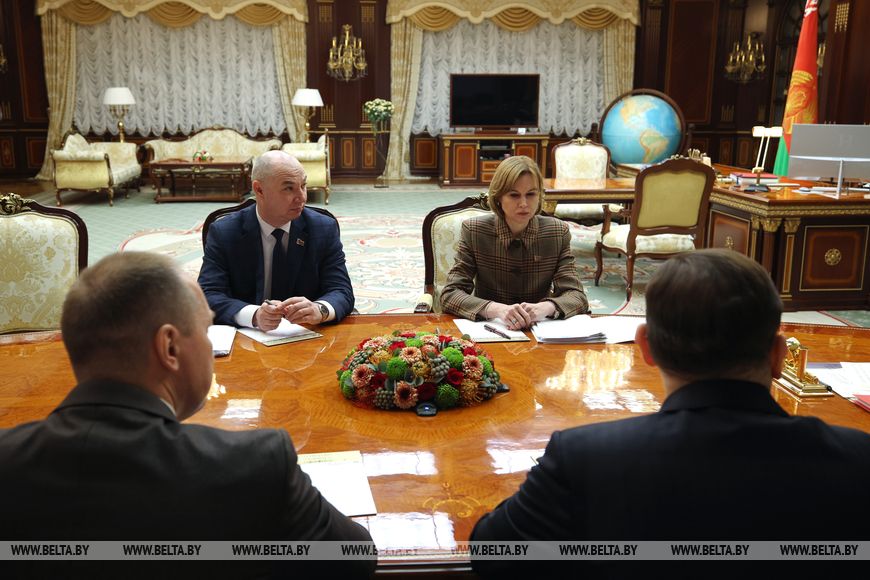
MINSK, 20 March (BelTA) – Belarusian Deputy Prime Minister Natalya Petkevich spoke with the media about the details of the draft decree “On In Vitro Fertilization” presented to the head of state on 20 March, BelTA has learned.
The deputy prime minister noted that several months ago the Belarusian leader gave instructions to revisit the topic of in vitro fertilization (IVF). “Of course, we would like everything to happen naturally, but that is not always possible. The head of state’s initiative was to make the approach even more liberal and to provide women with broader access to the IVF procedure,” Natalya Petkevich said.
Under the draft decree considered by the head of state, a woman can be offered two free IVF attempts. Moreover, the right to these attempts would be granted not only to married women but also to single women. “The president is determined to ensure that women are given this opportunity. Even if it does not result in some enormous number of children that would solve demographic problems on a global scale, every child, every new citizen of Belarus, is a great happiness and great joy,” Natalya Petkevich said.
 The deputy prime minister also drew attention to the factor of age.
Currently, a first free IVF attempt can be offered to women up to the
age of 40. Meanwhile, on a paid basis, the procedure can be performed up
to the age of 50. The draft decree “On In Vitro Fertilization”
envisions the possibility of granting a second free attempt for women up
to 49 years of age. This also applies to cases where a woman gave birth
for the first time as a result of an IVF procedure.
The deputy prime minister also drew attention to the factor of age.
Currently, a first free IVF attempt can be offered to women up to the
age of 40. Meanwhile, on a paid basis, the procedure can be performed up
to the age of 50. The draft decree “On In Vitro Fertilization”
envisions the possibility of granting a second free attempt for women up
to 49 years of age. This also applies to cases where a woman gave birth
for the first time as a result of an IVF procedure.
Furthermore, the principle remains that a free IVF attempt will only be carried out in state medical institutions. The deputy prime minister noted that the list of organizations providing IVF procedures does include private medical facilities. However, statistics show that the effectiveness of in vitro fertilization is significantly higher in state healthcare institutions.
“If the state takes upon itself the obligation to give women the opportunity to undergo IVF, then it must ensure that the procedure is carried out as effectively as possible and at a high level, with guaranteed protection of the health of both mother and child,” Natalya Petkevich emphasized.
Statistics on the effectiveness of the IVF
procedure in state medical institutions were provided to journalists by
Healthcare Minister Aleksandr Khodzhayev. According to him, this
indicator reaches 38%. At the same time, the healthcare minister noted
that this figure was not achieved immediately. “When we started IVF
practice, this figure was around 30%. Then methods were refined, and
over the past year, which we promptly analyzed, the effectiveness rate
stood at 38%. This is slightly above global figures,” Aleksandr
Khodzhayev said.
He added that during preparation for the IVF procedure, specialists work individually with each woman: “It is very important that all the processes we carry out do no harm. It is important to talk with each woman, to give her hope, if we have the opportunity to perform this procedure.”
The deputy prime minister noted that several months ago the Belarusian leader gave instructions to revisit the topic of in vitro fertilization (IVF). “Of course, we would like everything to happen naturally, but that is not always possible. The head of state’s initiative was to make the approach even more liberal and to provide women with broader access to the IVF procedure,” Natalya Petkevich said.
Under the draft decree considered by the head of state, a woman can be offered two free IVF attempts. Moreover, the right to these attempts would be granted not only to married women but also to single women. “The president is determined to ensure that women are given this opportunity. Even if it does not result in some enormous number of children that would solve demographic problems on a global scale, every child, every new citizen of Belarus, is a great happiness and great joy,” Natalya Petkevich said.
Furthermore, the principle remains that a free IVF attempt will only be carried out in state medical institutions. The deputy prime minister noted that the list of organizations providing IVF procedures does include private medical facilities. However, statistics show that the effectiveness of in vitro fertilization is significantly higher in state healthcare institutions.
“If the state takes upon itself the obligation to give women the opportunity to undergo IVF, then it must ensure that the procedure is carried out as effectively as possible and at a high level, with guaranteed protection of the health of both mother and child,” Natalya Petkevich emphasized.
According to the deputy prime
minister, the head of state also stressed the need to once again review
the world’s best practices for conducting this procedure at all stages.
“Everything necessary for this should be available in the country,
including additional funding if required. This is an issue we must
tackle thoroughly to see how our national system aligns with the best
practices,” she added.
Natalya Petkevich said that the president
instructed for the document to be coordinated with the Belarusian
Women’s Union in order to hear opinions on this matter not only from
medical professionals.
He added that during preparation for the IVF procedure, specialists work individually with each woman: “It is very important that all the processes we carry out do no harm. It is important to talk with each woman, to give her hope, if we have the opportunity to perform this procedure.”