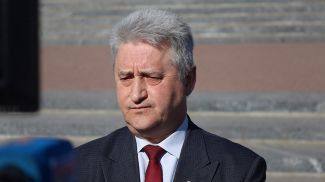

Igor Marzalyuk. Screenshot of the video
MINSK, 10 April (BelTA) – Igor Marzalyuk, Chairman of the Standing Commission on Education, Culture and Science of the House of Representatives of the National Assembly of Belarus, spoke about how the icon of the Brotherhood Mother of God saved Mogilev and how the city’s residents protected their shrine in the recent episode of BelTA project True History. Lectures by Igor Marzalyuk.
Speaking about sacred sites and shrines in the Mogilev areas along the Dnieper and Sozh rivers, the historian touched upon the icons that were particularly venerated in the current regional center. One of them is the Mogilev Brotherhood Icon of the Mother of God, which is considered the intercessor and protector of Mogilev. According to the Mogilev Chronicle, the first miracle of this icon occurred on 19 March 1655. “At that time, Mogilev was under siege by troops of the Polish-Lithuanian Commonwealth commanded by Janusz Radziwiłł. The townspeople of Mogilev, together with Moscow streltsy, were defending their city,” Igor Marzalyuk said. “They feared that the city would be stormed and wiped out, crushed by Radziwiłł. The Orthodox community of Mogilev had old scores to settle with Janusz Radziwiłł. According to the Mogilev Chronicle, on 19 March 1655, a Mogilev baker was praying before the icon for the city’s salvation from the calamities of war. Suddenly she saw tears flowing from the eyes of the Mother of God; the icon began to stream with myrrh. On that very day, the gunpowder charges that Radziwiłł had placed under the city’s defenses before the assault exploded. However, they turned back on his own army, engulfing his soldiers and inflicting heavy casualties on the attackers. The siege was lifted on 2 May 1655. In gratitude, city residents moved the icon to the Epiphany Cathedral of the Brotherhood Monastery, and the icon came to be known as the Mogilev Brotherhood Icon. From then on, a tradition of venerating the icon as the city’s protector developed. On the very spot where it had appeared – where the baker’s small house once stood – a chapel was built, dedicated to the Apparition of the Icon. It was constructed in 1702 by the Mogilev magistracy, which had obtained permission from Augustus II, King of the Polish-Lithuanian Commonwealth.”
The second miracle of this icon dates back to the time of the Great Northern War between Russia and Sweden. In the spring of 1708, during the quartering of Russian troops in the city, Alexander Menshikov, the closest associate of Emperor Peter I, wanted to destroy the city. “Legend has it that on 14 March 1708, he stood before this icon in prayer, all while devising a plan to destroy the city. Just as he thought to himself that the city must be destroyed, he fainted. After that, a terrified Menshikov never set foot in the cathedral again, praying only at the Church of the Holy Spirit,” the historian said.
Igor Marzalyuk also pointed out that this deliverance was only a short respite, as Mogilev was plundered and made to pay war reparations: first by Russian forces, and later by the Swedes. “In 1708, fearing that the Swedes would again occupy Mogilev and use it as a crucial city for their quarters and billeting, Peter I ordered the city to be burned. This disaster occurred on 8 September 1708,” the historian said, adding that other cities along the route of the Swedish army were also set on fire.
Mogilev was reduced to ashes. The residents were given three hours to abandon the city with minimal belongings. The only surviving posad (a trade and craft settlement outside the main fortifications) was the Trans-Dnieper one, as its inhabitants had taken away the boat to prevent Russian troops from reaching them. “It was a colossal catastrophe for the city. Though the entire city was in flames, the townsfolk managed to save their holy relics and the iconostasis. The Epiphany Cathedral, with its splendid iconostasis and wonderworking icon, was rescued from the raging fire. The dome and roof were consumed by fire, yet the city’s main sacred treasure was preserved, thanks to the selfless efforts of residents whose own houses were burning around them,” Igor Marzalyuk emphasized.
He explained that the image of the Most Holy Brotherhood Virgin was depicted on the banner of the Mogilev garrison and was consecrated in 1703 at the Church of the Holy Spirit. “This icon had a precious metal covering. It received it on 20 February 1745,” the historian said. “It was a silver mounting with gold plating for this icon, made at the church’s own expense.”
The rector of the Mogilev Seminary Archimandrite Sergius believed that the Mogilev Brotherhood Icon had been brought to Mogilev from Greece in the late 16th – early 17th century by one of the Eastern Orthodox hierarchs who visited the city, or by teachers of the Mogilev Brotherhood School. “Unfortunately, the original of this unique icon along with other treasures, including the cross of Euphrosyne of Polotsk which was held in the collection of the Mogilev Museum, was lost during the Great Patriotic War. Only a copy of the holy relic remains,” Igor Marzalyuk added.