
BEIJING, 26 March (BelTA - China Daily) - All prelaunch activities for
the China-Europe joint mission, the Solar wind Magnetosphere Ionosphere
Link Explorer (SMILE), have been completed at Europe's Spaceport in
French Guiana, South America, and the launch is scheduled for April 9,
the National Space Science Center of the Chinese Academy of Sciences
announced Thursday.
The spacecraft, representing a landmark collaboration between the Chinese Academy of Sciences and the European Space Agency, has been integrated onto the Vega-C rocket to connect the satellite to the launch vehicle. This marks the mission's entry into the final launch countdown.
Solar wind is a high-speed plasma flow originating from the sun, whose interaction with Earth's magnetosphere can trigger space weather events that threaten the safety of orbiting satellites, the accuracy of navigation and positioning, the stability of communication links, and the operation of power grids in high-latitude regions.
The SMILE mission, China's first comprehensive, mission-level space science partnership with the European Space Agency, will pioneer the use of a wide-field soft X-ray imager to achieve the first-ever global imaging of Earth's magnetospheric boundaries, providing transformative insights into solar-terrestrial interactions and potential breakthroughs in space weather science.
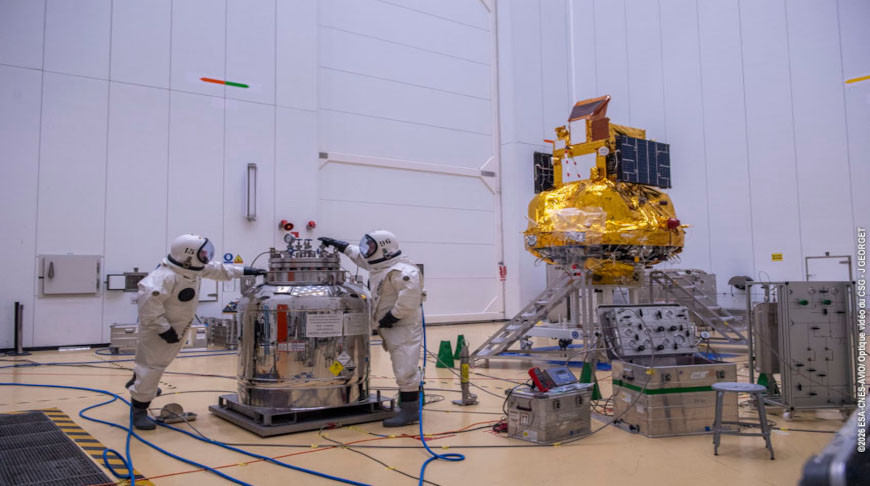
Preparation work for the launch began after the satellite passed the joint qualification and flight acceptance review on Oct 28 last year. Critical hardware was subsequently transported to the Guiana Space Center, including the satellite's propellant, which was shipped from Shanghai in late November and arrived in Kourou, French Guiana, in early February.
Meanwhile, the satellite flight model and its test equipment departed from the European Space Agency's European Space Research and Technology Centre in the Netherlands on Feb 11. Transported via the cargo vessel Colibri, the equipment arrived in French Guiana on Feb 26 and was transferred to the launch complex.
At the spaceport, the China-Europe joint test team conducted an intensive verification campaign, confirming all satellite systems were operating within specifications and were stable. The physical and functional mating of the satellite to the payload launch adapter has been completed, fulfilling all preparatory milestones.
With the launch window confirmed, the joint team is now conducting final checks on launch site weather and the integrated vehicle status to ensure readiness for a successful launch.
The spacecraft, representing a landmark collaboration between the Chinese Academy of Sciences and the European Space Agency, has been integrated onto the Vega-C rocket to connect the satellite to the launch vehicle. This marks the mission's entry into the final launch countdown.
Solar wind is a high-speed plasma flow originating from the sun, whose interaction with Earth's magnetosphere can trigger space weather events that threaten the safety of orbiting satellites, the accuracy of navigation and positioning, the stability of communication links, and the operation of power grids in high-latitude regions.
The SMILE mission, China's first comprehensive, mission-level space science partnership with the European Space Agency, will pioneer the use of a wide-field soft X-ray imager to achieve the first-ever global imaging of Earth's magnetospheric boundaries, providing transformative insights into solar-terrestrial interactions and potential breakthroughs in space weather science.
Preparation work for the launch began after the satellite passed the joint qualification and flight acceptance review on Oct 28 last year. Critical hardware was subsequently transported to the Guiana Space Center, including the satellite's propellant, which was shipped from Shanghai in late November and arrived in Kourou, French Guiana, in early February.
Meanwhile, the satellite flight model and its test equipment departed from the European Space Agency's European Space Research and Technology Centre in the Netherlands on Feb 11. Transported via the cargo vessel Colibri, the equipment arrived in French Guiana on Feb 26 and was transferred to the launch complex.
At the spaceport, the China-Europe joint test team conducted an intensive verification campaign, confirming all satellite systems were operating within specifications and were stable. The physical and functional mating of the satellite to the payload launch adapter has been completed, fulfilling all preparatory milestones.
With the launch window confirmed, the joint team is now conducting final checks on launch site weather and the integrated vehicle status to ensure readiness for a successful launch.