News of the story
"Belarusians in the focus"
Anna Yukhnovets does not simply recreate the past; she seems to live in it. She assures that it is enough to put on the right dress, gracefully wave a fan and you are already in the century before last. Her journey into historical reconstruction began 15 years ago with a video recording of dances from centuries past, and today she creates vintage outfits and shares the secrets of the Empire style. We explore her passion: from her first ball at Mir Castle to a collection of hats capable of revealing a lady’s plans for the day.
Library of destiny
We meet with Anna at the National Library of Belarus. Firstly, this has been her workplace for over 10 years. Secondly, it is hosting an exhibition featuring some items of women’s clothing from her collection.
“My name is Annushka,” the woman introduces herself. “I really like how my name sounds in this version.”
The National Library became her destiny. Living in Uruchye district of Minsk, she purposefully sought a job close to home and, by a happy coincidence, received an invitation for an interview in the Gallery and Exhibition Activities Department.
“The field was close to me: creative, eventful. Besides, shortly before that I had completed graphic design courses,” Anna said and noted that over the years of working at the library, she has participated in many exhibitions and events, but the most special one was the traveling project Along the Roads of the Victors marking the 80th anniversary of the Great Victory. The exhibition introduced visitors to the lives of 10 real wartime heroes; partisans, home front workers, tank crews… Each story is one of courage and fortitude.
At the library, Anna is also able to showcase her passion for historical reconstruction and collecting antique women’s clothing and accessories. For instance, during the autumn ball, she spoke about ladies’ attire from past centuries. Guests eagerly guessed the purpose of the antique items.
Recently, the Atrium Gallery launched The Women’s Space exhibition featuring the pieces from Anna Yukhnovets's collection. Among them are headpieces, accessories (handbags, gloves), handmade brooches, and fabric flowers crafted using antique techniques. Particular attention is drawn to hair ornaments. As Anna noted, flower crowns, brooches, flowers are not merely decoration but carriers of secret meanings. For example, a flower in the hair could signify an invitation to a mazurka or even serve as an announcement of an engagement.
“Historical details also look organic in a modern context,” Annushka noted. “Perhaps someone will want to immerse themselves in this era during Library Night on 24 April.”
Zenith of dance choreography
Annushka discovered historical reconstruction through another one of her hobbies — photography. She would capture people performing historical dances, and occasionally step in to substitute for someone, gradually becoming captivated by it herself.
She tried her hand at different styles, but she was most captivated by Empire and Regency of the early 19th century.
“The choice of era is based on personal preferences: some are captivated by elegant hats, others by luxurious dresses,” Annushka said. “I am particularly fond of the silhouette of the Empire style ladies’ costume: a high waist, a neat small sleeve, gloves, miniature ballet flats, perhaps with a ribbon. And a hairstyle with hair gathered up high, accented with feathers.”
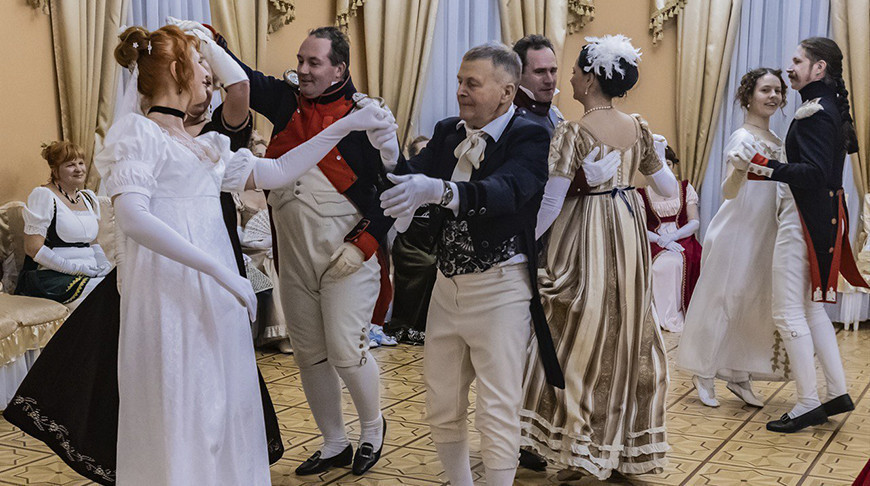
She considers the French quadrille to be the pinnacle of dance choreography of that era. This dance was fashionable and unusual: it could involve not only couples but also a gentleman with two ladies. This was especially relevant, as at balls there were always more representatives of the fairer sex.
Receiving an invitation from a gentleman to all four parts of the quadrille was considered a great honor. It emphasized special attention and respect, as the dance was complex, requiring skill and expressiveness.
“The complexity of the French quadrille lies not only in the technique of the steps – the steps themselves are seemingly simple, but they require a particular manner of execution – panache and flirtation. Without that, the dance loses its charm,” Anna said.
The mazurka also carried special significance: an invitation to it was seen almost as a proposal of marriage. Here is how the dance went: couples moved in a circle around the hall and then returned to their starting positions. The gentleman would then bow and go to invite the next lady. It was considered good form to dance with different partners. If a gentleman engaged the same lady for two rounds in a row, it signified a special regard for her.
An exquisite image
When Annushka began to take great pleasure in dancing, she wanted to attend a real ball. For that, a suitable outfit was required, so she decided to sew it herself. Especially since, after graduating from Vitebsk State Technological University, she had earned a degree in “artistic design of garments”. But her main inspiration was her mother, Tamara.
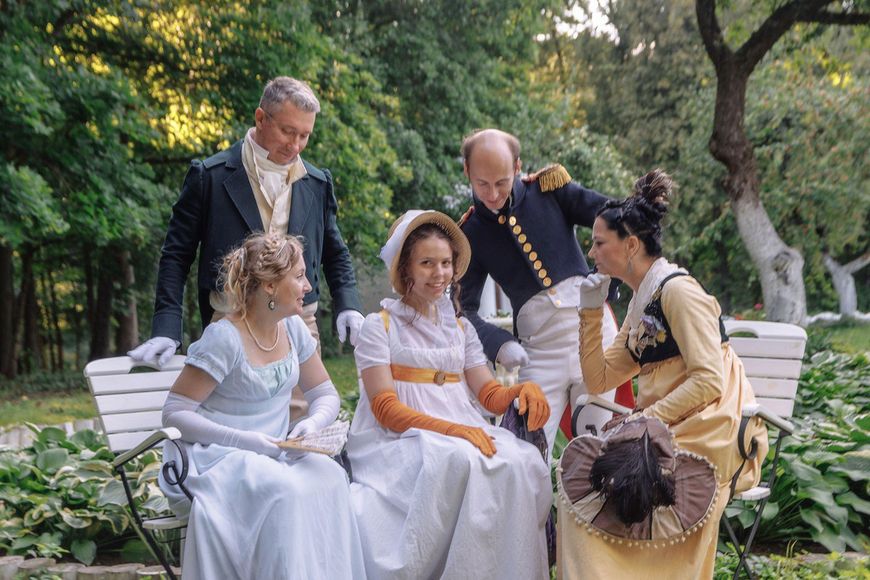
“It was she who instilled in me a love for history, traditions, and the art of creating historical costumes,” Anna admitted. “Since childhood, she was passionate about handicrafts, a passion passed down to her from her grandmother and great-grandmother: they embroidered, sewed, and knitted, preserving and passing on women’s secrets of craftsmanship. Moreover, my mother was also a musician.”
Young ladies of the 19th century preferred to wear light-colored dresses to balls. Older ladies could afford darker, richer shades. Costumes were made to order and were expensive. Moreover, appearing at a ball twice in the same outfit was considered a breach of etiquette. Therefore, they tried to vary their attire: adding a plain bodice (a vest), embellishing it with embroidery or beads. This approach allowed them to refresh their look without significant expense. Accessories and hairstyle elements were chosen to match, and a person was completely transformed.
“I am often asked whether there were any unique features in the clothing of Belarusian women of the 18th-19th centuries,” Anna said. “It’s difficult to give a definite answer, because in secular fashion, imitation of the French style dominated. Belarusian fashionistas combined the materials that were available to them and showed ingenuity in their finishing touches.”
Urban women wore dresses of the same cut as in Europe, but made from simpler, more practical fabrics. As for men’s attire, the nobleman’s outfit had some Eastern characteristics: a caftan with wide sleeves, a voluminous shirt, and a belt as an important element of the ensemble.
“Distinctive local decoration was practically absent in secular attire, at least within the scope of the historical reenactment we are engaged in,” Annushka clarified.
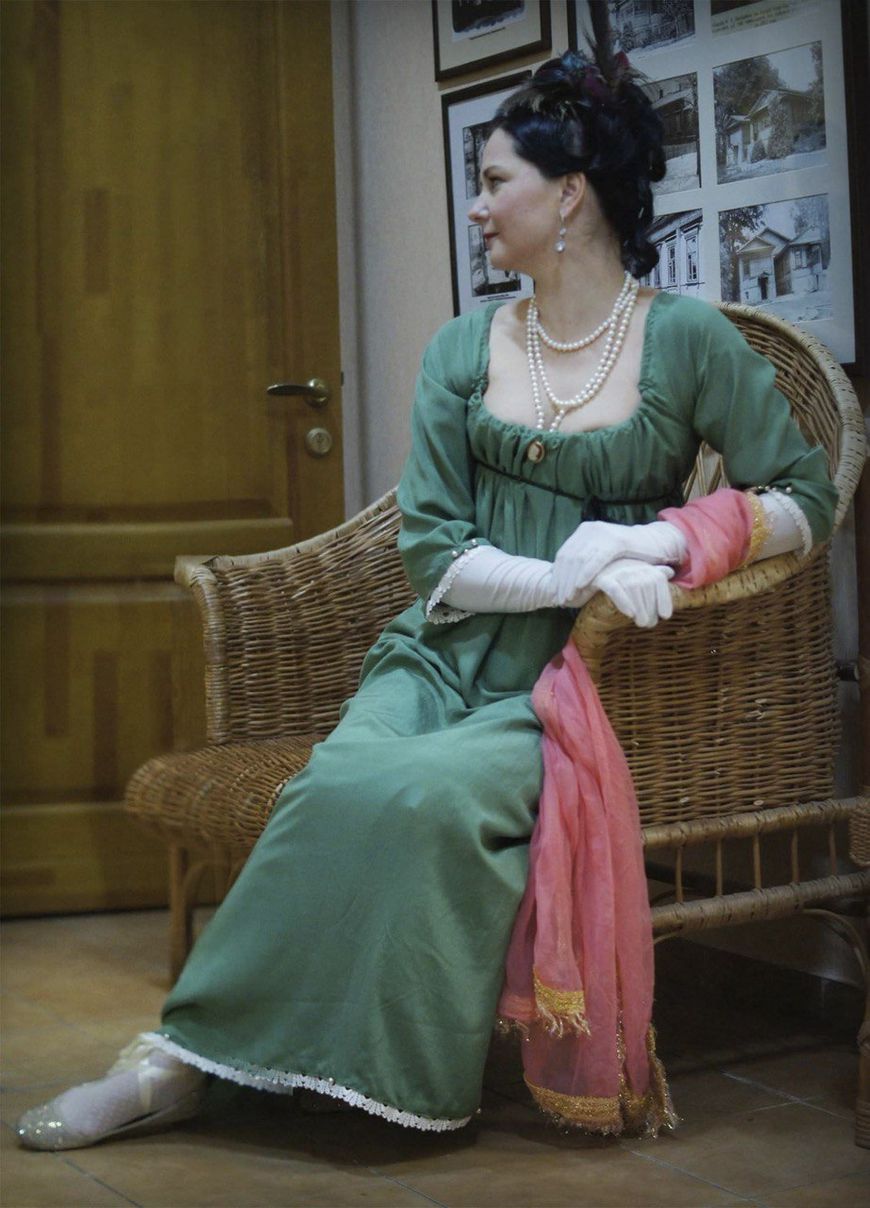 Participants of the ball must strictly follow the dress code. This means their outfits must precisely match the declared period in silhouette, cut, and fabrics. Equally important is adhering to the manners and etiquette of that era.
Young ladies of the 19th century preferred to wear light-colored dresses to balls. Older ladies could afford darker, richer shades. Costumes were made to order and were expensive. Moreover, appearing at a ball twice in the same outfit was considered a breach of etiquette. Therefore, they tried to vary their attire: adding a plain bodice (a vest), embellishing it with embroidery or beads. This approach allowed them to refresh their look without significant expense. Accessories and hairstyle elements were chosen to match, and a person was completely transformed.
“I am often asked whether there were any unique features in the clothing of Belarusian women of the 18th-19th centuries,” Anna said. “It’s difficult to give a definite answer, because in secular fashion, imitation of the French style dominated. Belarusian fashionistas combined the materials that were available to them and showed ingenuity in their finishing touches.”
Urban women wore dresses of the same cut as in Europe, but made from simpler, more practical fabrics. As for men’s attire, the nobleman’s outfit had some Eastern characteristics: a caftan with wide sleeves, a voluminous shirt, and a belt as an important element of the ensemble.
“Distinctive local decoration was practically absent in secular attire, at least within the scope of the historical reenactment we are engaged in,” Annushka clarified.
It is important that natural fabrics were used in those days. Cotton and linen “breathe” well and do not cause overheating, so a dress made from these materials feels comfortable even during a picnic. Women wore an under-shift under an open ball gown. This garment served several purposes: it concealed exposed parts of the body, protected against insects, and shielded the skin from the sun. At that time, a tan was considered a sign of non-aristocratic origin.
First impressions
Annushka remembers her first ball very well, even though it took place many years ago, in the spring of 2014. It was held in Mir Castle, in a hall with emerald curtains and portraits of historical figures. Representatives of Belarusian and Russian clubs took part.
“I felt light, joyful, and full of excitement,” she recalled. “I chose a delicate lilac dress. At the time, my hair was very short, almost boyish. I was worried about it, but we found historical evidence that such a style was possible. It was nerve-racking to meet the standards: how to offer a gloved hand, how to point the toe during a curtsy, how to smile shyly… Over time, you gain experience: you watch others, understand what you want to improve next time, and move forward.”
Participants of the ball must strictly follow the dress code. This means their outfits must precisely match the declared period in silhouette, cut, and fabrics. Equally important is adhering to the manners and etiquette of that era.
“A ball is like the pages of a book coming to life. We truly looked like characters from the past and felt that way too,” Annushka said.
At the ball, each guest received a small booklet with the list of dances and general information about the event: the title, schedule, and so on. A lady would write the name of the gentleman she planned to dance with next to each dance, so she wouldn’t forget and could remind him of his promise. Gentlemen kept their own notes as well. If someone failed to appear for a promised dance, it required a polite explanation. The booklets often came with a pencil and a ribbon. Ladies carried them on the wrist or in a small purse, while gentlemen tucked them behind the cuff of their uniform.
Balls for reenactors are held in Belarus about four times a year, with picnics organized in the summer. “There are more and more places in Belarus where you can immerse yourself in the past,” Anna said, listing local landmarks. “These include Mir Castle and Nesvizh Castle, the Kozell-Poklevsky estate in Krasny Bereg, the Vankovich estate in Minsk, and the Potemkin Palace in Krichev. For several years now, the Dahlia Ball has been held at the Mikhail Kleophas Oginski Museum-Estate in Zalesye at the end of summer, open to all who wish to attend.”
“I admire the organizers of the Dahlia Ball. Their programs become more refined every year: they borrow some elements from professional reenactors. This year they plan to present fans, and I offered my help,” she adds.
The star of the collection
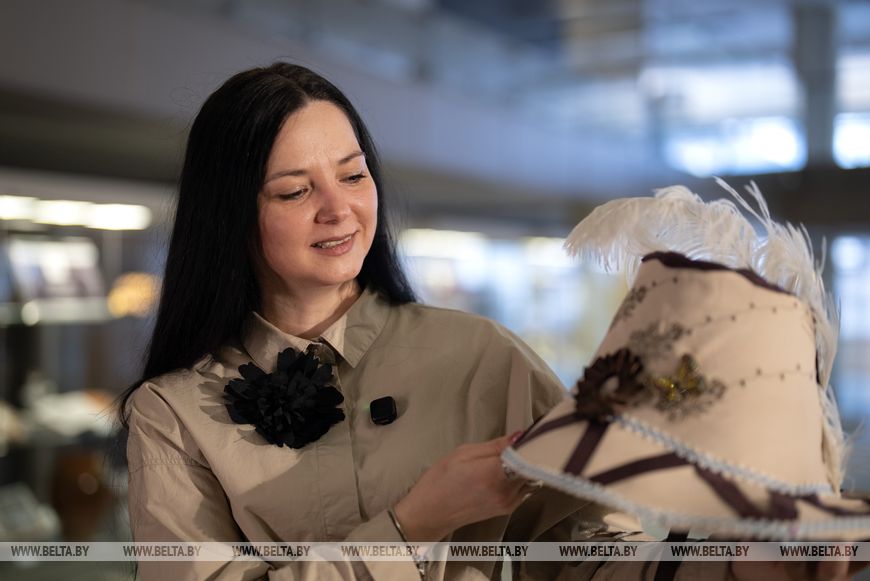
Today, Annushka’s collection includes many charming historical ladies’ accessories: more than ten dresses and over thirty headpieces. Among them are bonnets, berets, pillbox hats, straw hats, and flared-style models. The star of the headwear collection is a straw hat.
“I found it in a vintage store. It was completely unwearable. I restored it and decorated it with ribbons,” our heroine recounted her favorite find. She also creates headpieces from scratch. Making one takes from one to two weeks, while pieces with a rigid structure require more time. Finishing is one of the most crucial stages. For instance, the detail at the back not only conceals the seam but also serves a parctical role: through special loops, one or more feathers can be inserted.
“Feathers were a significant element of the costume from that era. They lent the look a sense of luxury and light sophistication, a kind of ethereality,” Anna explains.
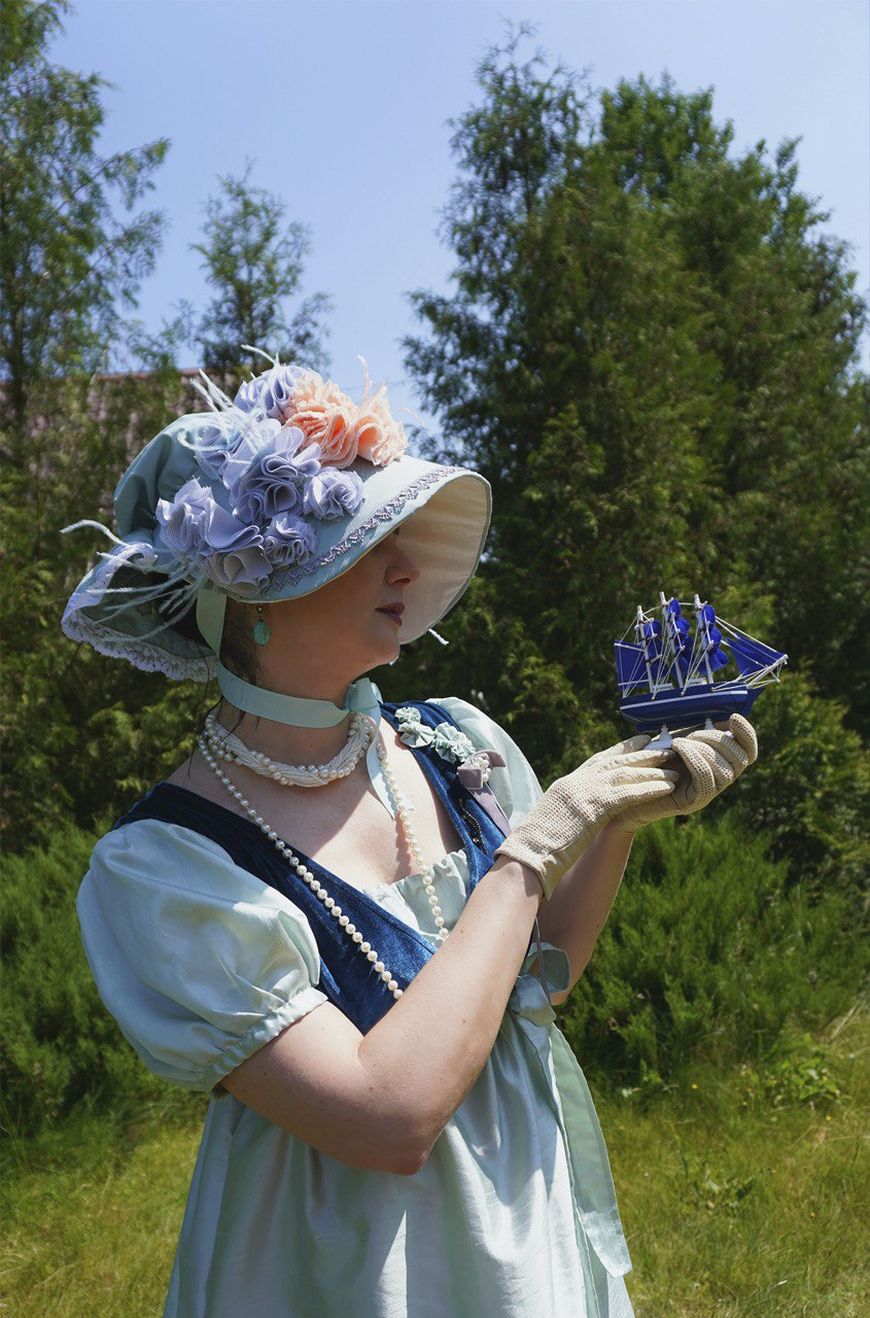
Many of her hats are complemented by handmade flowers. Some are crafted using a simple technique of cutting fabric, while others follow an old-fashioned method that allows the material to retain its strength for a long time.
The headpieces are also adorned with large decorative elements, sometimes composed of several parts. Ribbons were in vogue as a versatile option, while flowers were reserved for special occasions.
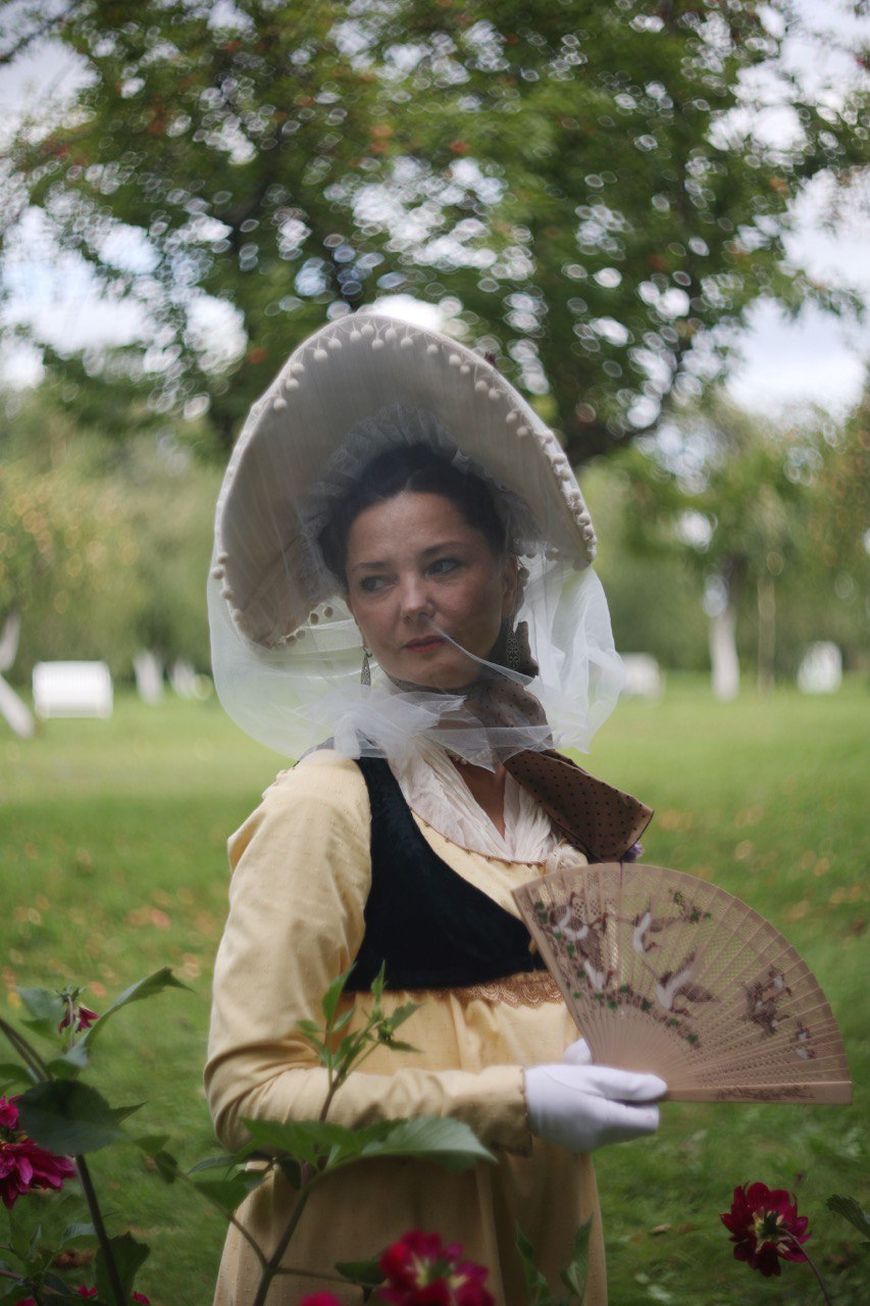 Interestingly, hats could reveal a lot about a lady’s plans for the day. For example, a headpiece with a wide brim offered protection from the sun and wind, while also shielding the face from unwanted glances. It was a kind of analogue to the modern hood, allowing one to walk down the street incognito. Models without a brim provided a better vision, making them ideal for horseback riding or leisurely strolls.
Here is a curious historical fact: in the past, a lady could not appear on the street with her head uncovered. Should she appear without a hat, police officers would immediately rush to her assistance, for it was understood that something untoward had happened: her headpiece had either been lost or forcibly removed.
“If a lady wants to look elegant and be remembered by everyone who glances her way, she should definitely get herself a hat,” Anna advises. “Today, they can be found in a wide variety of shapes and styles.”
The world at your feet
Interestingly, our heroine’s wardrobe contains no jeans, and she mostly wears trousers for sports. And Anna doesn’t reserve her stylish collectible garments and accessories solely for balls, festivals, and historical reenactments; instead, she weaves some of them into her everyday looks.
“Vintage items combine beautifully with modern ones; they look striking and businesslike,” the herione assures.
She admits that the moment she changes into a historical outfit, something within her shifts: her eyes light up, and her mannerisms change.
“I literally immerse myself in the character: I understand how to turn so my hairstyle catches the eye, how to gracefully wave a fan,” Anna says with a smile about her transformation, sharing her dreams. “I want to inspire women not to be afraid to try new things, to share my crafting secrets so that the costumes I create don’t just hang in a closet, but come to life. I also dream of traveling in costumes, of becoming a kind of fashion historian – to tell people about it.”
At the end of our meeting, Anna Yukhnovets shared a wish for Belarusian women: “Don’t be afraid to express yourself through clothing! A dress, a hat, an elegant detail – all of this transforms a woman, making her unique and expressive. Showcase your gentle nature and refinement. Choose outfits that bring you joy. And then, believe me, the world will be at your feet!”
 Svetlana KIRSANOVA
Photos by Kirill PASMURTSEV and from the project heroine’s archive
7 Days newspaper