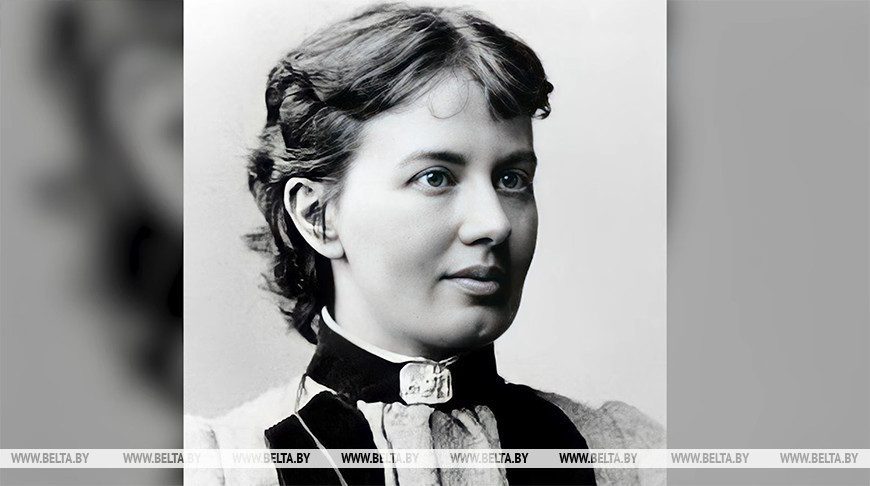
MINSK, 1 April (BelTA) – In a new episode of the V Teme. Nashi [On Point. The Nation’s Pride] project on BelTA’s YouTube channel we look into Sofya Kovalevskaya’s contribution to mathematical science, and explore why the unofficial title ‘Princess of Mathematics’ initially had a negative connotation.
Sofya Kovalevskaya was a world renowned mathematician and mechanic who lived in the 19th century. She was the first woman in the world to become a professor of mathematics and a corresponding member of the St. Petersburg Academy of Sciences. The scientist left behind a great scientific legacy.
“She laid the foundation for all differential equations. Her main theorem, which bears her name - the Cauchy–Kovalevskaya theorem, deals with the existence and uniqueness of solutions to equations. In fact, all physical phenomena are described by differential equations,” Academic Secretary of the National academy of Science of Belarus Tatiana Busel said.
“Take school physics, Newton's second law, the relationship between force and acceleration. What is acceleration? It’s the derivative of velocity. The relationship between a derivative and a function - that is precisely a differential equation. So how do you solve it? If a solution exists, this theorem [the Cauchy–Kovalevskaya theorem] comes to your aid,” Tatiana Busel explained.
She noted that Sofya Kovalevskaya's scientific research was influenced by her mentor Karl Weierstrass, the father of mathematical analysis. He laid the groundwork for the female scientist to present her ideas clearly, precisely, and with rigorous proof. “It was precisely this theorem that she presented in sufficient detail and clarity,” Tatiana Busel said.
In addition, Sofya Kovalevskaya studied the works of the Russian mathematician and mechanic Mikhail Ostrogradsky, and the walls of her home were papered with his lectures. “Probably, these lectures also set the direction that led her to pursue integral calculus and differential calculus,” Tatiana Busel noted.
She emphasized that the first female professor approached her research analytically. “She essentially united and systematized many studies and discoveries. In principle, Weierstrass also systematized analysis and proved it thoroughly. She was truly a worthy student of her teacher,” Tatiana Busel noted.
During her lifetime, Sofya Kovalevskaya was called the “Princess of Mathematics”. “If you look into it, initially ‘Princess of Mathematics’ had a somewhat negative connotation,” the academic secretary explained. “If you look at her story, her biography, a time in her life when her husband died (he ended his life by suicide) it was precisely Weierstrass and his student Gösta Mittag-Leffler who came to her aid. They tried to secure a professorship for her at Stockholms Högskola (now Stockholm University). Mittag-Leffler wanted to do a good deed and placed an advertisement in the newspaper: ‘A Russian mathematician, the first female professor, is coming to our university to give lectures.’ Those who read it, all those learned men, perceived it somewhat negatively. Later, they started calling her the ‘Princess of Mathematics’ suggesting they should boycott her or something along those lines. And again, Mittag-Leffler realized his mistake and tried to correct it, to smooth things over somehow.
Gösta Mittag-Leffler, who organized a dinner party for introductions, spoke with the male scholars and asked them to be loyal, to accept this beautiful and intelligent woman who had recently lost her husband. “They were won over by her refinement. She had governesses, a mathematics teacher. She received a very good home education. Later, when she went to St. Petersburg, she received a very good education. She attended lectures by the likes of Sechenov and Mendeleev as an external student. For her time, she received a fairly extensive education. Her relatives were also educated. Her father was educated, her mother spoke four languages and was a pianist,” Tatiana Busel said adding that on her father’s side, many of Sofya Kovalevskaya's relatives were connected to the exact sciences.
“She laid the foundation for all differential equations. Her main theorem, which bears her name - the Cauchy–Kovalevskaya theorem, deals with the existence and uniqueness of solutions to equations. In fact, all physical phenomena are described by differential equations,” Academic Secretary of the National academy of Science of Belarus Tatiana Busel said.
“Take school physics, Newton's second law, the relationship between force and acceleration. What is acceleration? It’s the derivative of velocity. The relationship between a derivative and a function - that is precisely a differential equation. So how do you solve it? If a solution exists, this theorem [the Cauchy–Kovalevskaya theorem] comes to your aid,” Tatiana Busel explained.
She noted that Sofya Kovalevskaya's scientific research was influenced by her mentor Karl Weierstrass, the father of mathematical analysis. He laid the groundwork for the female scientist to present her ideas clearly, precisely, and with rigorous proof. “It was precisely this theorem that she presented in sufficient detail and clarity,” Tatiana Busel said.
In addition, Sofya Kovalevskaya studied the works of the Russian mathematician and mechanic Mikhail Ostrogradsky, and the walls of her home were papered with his lectures. “Probably, these lectures also set the direction that led her to pursue integral calculus and differential calculus,” Tatiana Busel noted.
She emphasized that the first female professor approached her research analytically. “She essentially united and systematized many studies and discoveries. In principle, Weierstrass also systematized analysis and proved it thoroughly. She was truly a worthy student of her teacher,” Tatiana Busel noted.
During her lifetime, Sofya Kovalevskaya was called the “Princess of Mathematics”. “If you look into it, initially ‘Princess of Mathematics’ had a somewhat negative connotation,” the academic secretary explained. “If you look at her story, her biography, a time in her life when her husband died (he ended his life by suicide) it was precisely Weierstrass and his student Gösta Mittag-Leffler who came to her aid. They tried to secure a professorship for her at Stockholms Högskola (now Stockholm University). Mittag-Leffler wanted to do a good deed and placed an advertisement in the newspaper: ‘A Russian mathematician, the first female professor, is coming to our university to give lectures.’ Those who read it, all those learned men, perceived it somewhat negatively. Later, they started calling her the ‘Princess of Mathematics’ suggesting they should boycott her or something along those lines. And again, Mittag-Leffler realized his mistake and tried to correct it, to smooth things over somehow.
Gösta Mittag-Leffler, who organized a dinner party for introductions, spoke with the male scholars and asked them to be loyal, to accept this beautiful and intelligent woman who had recently lost her husband. “They were won over by her refinement. She had governesses, a mathematics teacher. She received a very good home education. Later, when she went to St. Petersburg, she received a very good education. She attended lectures by the likes of Sechenov and Mendeleev as an external student. For her time, she received a fairly extensive education. Her relatives were also educated. Her father was educated, her mother spoke four languages and was a pianist,” Tatiana Busel said adding that on her father’s side, many of Sofya Kovalevskaya's relatives were connected to the exact sciences.