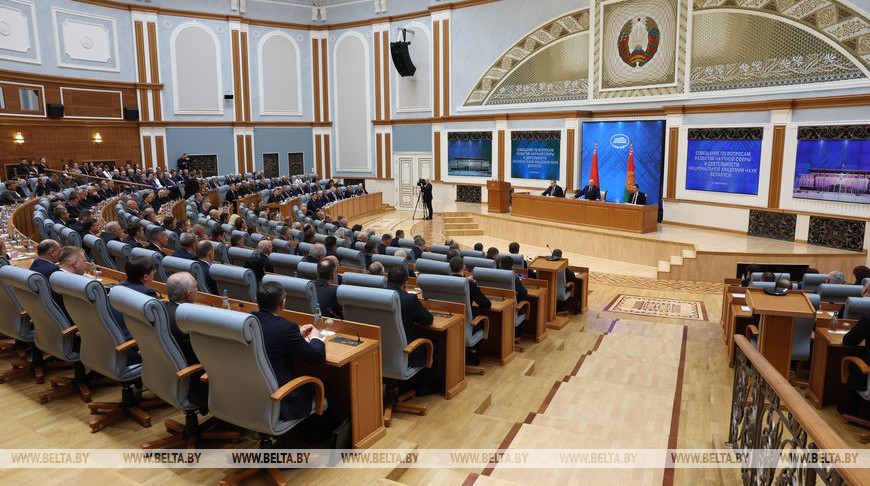
MINSK, 21 November (BelTA) – Belarusian medical scientists have achieved great results in treating cancerous diseases and have the potential to secure the world’s leadership in a number of areas. Belarus President Aleksandr Lukashenko was informed about the accomplishments during the government conference held on 21 November to discuss the development of the scientific sphere and the operation of the National Academy of Sciences of Belarus, BelTA has learned.
Deputy Director for Science of the N.N. Alexandrov National Cancer Center of Belarus Sergei Krasny made a speech during the conference. He informed those present about accomplishments in the field of cancer therapy that relies on chimeric antigen receptors (CAR) T-cells. He talked about accomplishments in the field of CAR-T therapy for treating oncological diseases. It is one of the fields where researchers and practitioners work together shoulder to shoulder. While the R&D products allow fully curing the patients, who were doomed to live only for a few months in the past.
The scientist said: “We develop exactly what we need now. We primarily carry out practice-oriented researches and the results are applied in practice immediately. We work out the most breakthrough technologies in cooperation with organizations of the National Academy of Sciences of Belarus.”
The therapy powered by chimeric antigen receptors (CAR) T-cells is built around the genetic modification of the patient’s lymphocytes in order to enable them to detect specific tumor cells, attack them, and destroy them. “The Bioorganic Chemistry Institute has designed a special genetic structure that uses a virus to infiltrate the patient’s lymphocytes. And then lymphocytes start producing special receptors that allow detecting tumor cells. I am talking about untreated lymphoid tumors and leukemias that are resistant to chemical treatment. In other words, when the patient is essentially dying and has about two months left to live,” the scientist said.
The patient gets injected with over 100 million of these lymphocytes. “It causes a massive immune response akin to the cytokine storm. Lymphocytes attack tumor cells and destroy them,” Sergei Krasny shared details of the process. “We have the largest experience in Eastern Europe. Neighboring countries either do not have the technology at all or the technology is in a nascent state.”
The technology has already been used to treat 85 patients. Of them 60% have been totally cured and have recovered. Lives of the rest have been greatly extended. Patients with myeloma (a blood cancer) demonstrate 100% full recovery rate.
As for the cost of the treatment, in Belarus it is way less than what the treatment costs in Western Europe where one course of treatment costs about €500,000. “In Belarus it costs the equivalent of $55,000. Naturally, it is free for Belarus citizens. But the cost attracts foreigners. As many as 52 people have been treated. They are mainly from nearby countries. It has allowed us to earn some money,” Sergei Krasny said.
He added that similar methods are now being developed to treat other kinds of tumors and non-neoplastic diseases such as systemic lupus erythematosus and disseminated sclerosis. “And we also hope to succeed,” the scientist noted.
After hearing the speech, Aleksandr Lukashenko noted that it was the first time he had heard specifically about this accomplishment. The head of state reminded that the matter of developing cell technologies for oncological applications had been raised in Belarus a long time before and it had been necessary to make a decision back then.
“Back then scientists were only starting to think about it. They started deliberations. Some said we didn’t need it. Others said it would save lives and the rest. And I had to make the call. I said that it was done abroad after all, it was the future, and we should work on that. And if you have achieved such success, albeit in treating some two to three kinds of cancer diseases, it is very important,” the president said.
The head of state expressed the desire to visit the N.N. Alexandrov National Cancer Center of Belarus in the foreseeable future, maybe this winter in order to more thoroughly get familiar with the existing R&D products and accomplishments. He drew attention to the fact that this institution can indeed serve as an example of a research center where science is married to practice.
“I keep an eye on this national applied science center starting with the personnel and ending with other matters. We’ve also built housing over there, including for the sake of developing this cancer center. We will pay serious attention to it. A disease of the century, nothing can be done about it,” the Belarusian leader stressed.
Chairman of the Presidium of the National Academy of Sciences of Belarus Vladimir Karanik, who is a medic by education and has specialized in oncology for a long time, had something to say on the topic of developing this scientific field.
In his words, three institutions in Belarus focus on CAR-T therapy today. “Those are the children’s center, the national applied science center for oncology, and the applied science center for surgery and transplantology. Each has its own unique experience and each of the three centers employs genuine enthusiasts and professionals. But bringing them together into one location in order to potentiate [enhance the effect from interaction] each other’s achievements was a challenging task,” he said.
Nevertheless, this task has been accomplished. Speaking about the CAR-T therapy, Vladimir Karanik explained that although Belarusian medical scientists had reached serious heights there is still room for advancement in developing this technology in comparison with the world experience.
“Nobody has this experience in Eastern Europe but we should strive to move forward after all. We have invented something, we have assimilated some products. The key is not to stop, to continue developing,” the head of the National Academy of Sciences of Belarus stressed.
He is convinced that with the available personnel it will be possible to soon secure new high results and competences of the world level. There are many “saplings” in science like that. It is necessary to find them and nurture them.
Vladimir Karanik made a proposal on improving this work. The proposal concerns the work of research personnel in medical national applied science centers of any kind. “In addition to their being research personnel, they participate in all the conciliums, commissions on handling complaints, they operate on the most complicated patients. In other words, they provide the research and methodological support for the treatment process. But they don’t get paid for it. They need to invent some research topic every time in order to get scientific sector funding,” the NASB head said.
In his words, the matter has been discussed with Prime Minister of Belarus Aleksandr Turchin and an understanding has been reached: “We said that it is necessary to suggest the following scheme: get rid of small-scope research, provide basic funding, and focus all the intellectual and financial efforts on research fields like the CAR-T therapy where we can become a world elite without modesty. Otherwise, we would dilute our efforts on reports and small-scope research.”
“Good. It is exactly about the topic we’ve been discussing,” Aleksandr Lukashenko backed the proposal.