An archive photo
Belarus is making a noticeable return to Africa. Not as a newcomer, but as a country trying to reimagine the ties it inherited from the Soviet Union in a world that has fundamentally changed. In an age of sanctions and geopolitical turbulence, Minsk is seeking growth opportunities beyond its traditional markets, offering African countries not just routine trade, but a new and more practical partnership model: turnkey production chains and agricultural industrialization. This focus on the continent of the future reflects a mix of economic pragmatism, political necessity and a bet on a window of opportunity that may not stay open for long. Belarus’ chosen strategy has already yielded notable successes, but the challenges the country faces or may face in the future are also evident. BelTA takes a closer look.
From Soviet legacy to new strategy
Ties with Africa go back a long way. In the 1960s, when dozens of countries on the continent were gaining independence, the Soviet Union actively supported anti-colonial movements and developed educational programs. Belarus was also involved in these processes. However, with the collapse of the USSR, most of these ties weakened. Young Belarusian diplomacy focused on relations with Russia and Europe, while Africa remained the weakest area in foreign policy for a long time.
Thus, Minsk’s return to the continent appears all the more striking – not as part of an ideological project, but as part of a pragmatic economic strategy. One recent example is Foreign Minister Maxim Ryzhenkov’s visit to Ghana and Togo in March. These were the first visits at the level of foreign minister in the history of bilateral relations, and they were by no means spontaneous.
“We planned this visit for quite some time, about a year, to make it truly productive. Serious projects were prepared for the visit, and their implementation was effectively launched during meetings with the leaders of the two countries. This involves delivering a batch of our equipment to both countries during 2026 with the aim of mechanizing agriculture. In addition to the equipment itself, service centers will be set up in these countries for maintenance, and local specialists will begin training,” Maxim Ryzhenkov said in an interview with the Belarus One TV channel following his foreign trip.
Footholds on the continent
Remember Archimedes’ famous phrase? “Give me a place to stand and I will move the world,” the ancient Greek scientist said. Western Africa, and in particular Ghana, Togo and Nigeria, which the foreign minister visited in 2025, has become such foothold for Belarus on the continent. Of course, we are not going to move the world, but why not gain a solid foothold on the continent and help African countries advance their development?
“We are building relations with African countries on the principles of reciprocity. We go where we are welcome and where we see prospects for our goods,” Maxim Ryzhenkov stated. “For example, when it comes to these three countries, the most evident area is the mechanization of agriculture, which can quite effectively address the issue of food security in these nations. It is the foundation of sovereignty and independence. Furthermore, we bring our educational technologies there and help them train their own citizens.”
Belarus has also identified key partners in other parts of Africa. For example, in the north, these are Egypt and Algeria. Over time, Libya may be added to the list. In the east, there is potential to work with several countries through Oman. In southern Africa, Belarus has begun productive cooperation with Zimbabwe, and there is an opportunity to involve Mozambique in this process.
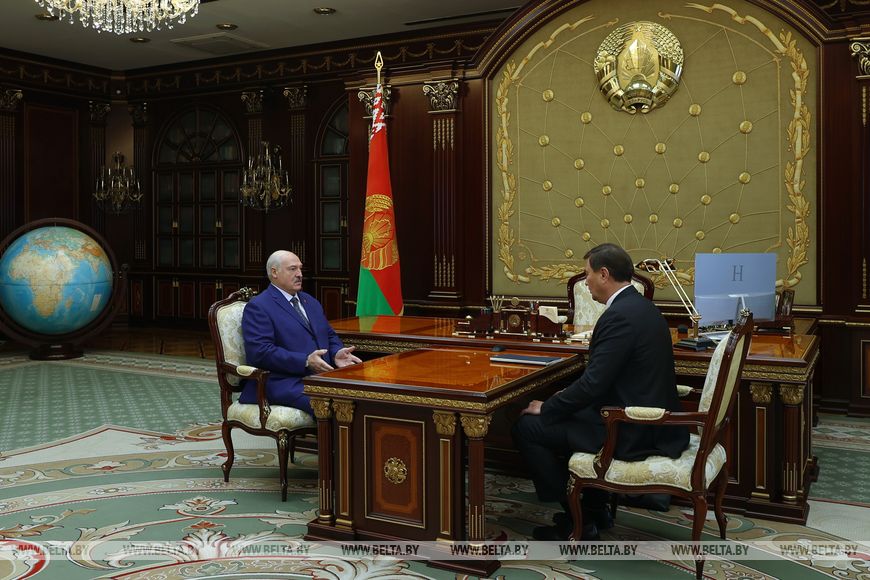
“Africa is the future. But most importantly, we must remember that we are not an empire, we are not the Americans: we cannot cover the entire continent. We need footholds from which we can work in the countries that interest us. That is the main thing,” Aleksandr Lukashenko said recently while hearing a report from Maxim Ryzhenkov.
Take Togo, for example. A massive flow of goods passes through the port of this country, then moving deeper into Africa. It is a kind of gateway to the continent. That is reason enough to establish a presence in this region. For Belarus, this is an opportunity to use the country as a transport hub for trade with an entire region, not just one state.
Ghana is one of the fastest growing countries in West Africa. It is a market with resources, a growing population and political stability. It produces gold (more than anywhere else in Africa), develops agriculture and urban infrastructure. A perfect match: Belarusian enterprises produce equipment for any needs, possess modern agricultural technologies and manufacture mineral fertilizers.
It is known that a visit by Ghanaian President John Dramani Mahama to Minsk is currently being prepared. The countries plan to conclude agreements on visa-free travel for diplomatic and service passports, agricultural mechanization, export credits, and the creation of an intergovernmental commission on trade and economic cooperation.
“There are two factors that attract us. The African continent is a very promising and capacious region. One and a half billion people live here, and GDP is estimated at $3.4 trillion. And this is a region friendly to us. From this perspective, we should not be talking about whether we need to go to Africa as a strategy, but rather about how to implement this strategy,” PhD in Economics Georgy Grits noted.
Back in 2015, the African Union adopted the Agenda 2063 strategy, which envisions the transformation of the continent into a future global player through sustainable development, economic integration, democratic governance and peace. Belarusian-African projects, the economic analyst stressed, should fit into this strategy. Then they have a good chance of securing the necessary funding and succeeding, given that substantial resources will be needed.
“Belarusian enterprises should be at the forefront of this work. It is they who must now take up the baton from the government,” Georgy Grits believes. “Visits by the head of state, government officials and the foreign minister are very important, but matters must move into practical channels. That means seeking specific contracts, partners and attracting external financing.”
Playing the long game: opportunities and risks
When it comes to developing relations with African countries, many experts recall how Belarus once built cooperation with China. 25 years ago, China was greatly underestimated: what could it do, produce counterfeit goods? And now it is a global technology leader, one of Belarus’ key economic partners. Trade between the two countries is measured in billions of dollars.
Today, Africa is being underestimated in a similar way. Of course, these are completely different regions and economic models. Such a comparison is more of a metaphor than an exact parallel, but sometimes that is how it is: what seems niche today can become a major market tomorrow.
“The continent is huge. And we must not forget that the world’s leading countries are competing for this region using every tool available,” Georgy Grits observed. “Africa, in general, is a long-term endeavor. You should not always chase immediate profits; you need to work for the future. It is very important in these turbulent times to find and claim your niche. It is important to show yourself, to make your presence felt, while others are waiting for things to get better. But maybe things will never get better, God forbid.”
According to the economic analyst, developing educational programs for African students would be a successful move. Especially since there is demand for this.
“Approximately 3,000 African students are studying in Belarus. That is, of course, a modest number – not just when it comes to educational services, but also in terms of spreading influence in the region. In Soviet times, the number of African students reached 300,000 across the USSR,” Georgy Grits said.
This raises a question: how effective are the mechanisms for advancing Belarusian interests abroad? At the end of 2025, speaking at the second session of the 7th Belarusian People’s Congress, President Aleksandr Lukashenko criticized the work of the so-called development institutions.
“Why are we spending so much money on organizations that are neither seen nor heard? The National Investment Agency under the Ministry of Economy, correct? The National Center for Marketing, Price Study under the Ministry of Foreign Affairs, the Foreign Economic Activity Agency under the Development Bank, the Belarusian Chamber of Commerce and Industry, and so on. You know, I look at the National Center for Marketing and Price Study under the Ministry of Foreign Affairs. What marketing? What price study? Yes, these issues exist. But this is what the Ministry of Foreign Affairs as a whole should be dealing with. What are these additional structures for? They are nothing but cushy positions for officials with inflated staff and salaries,” Aleksandr Lukashenko said at the time.
And the president’s criticism is justified. The role of these organizations in exploring new markets is not particularly noticeable. This is evident in the work on the African continent as well. A significant portion of trade goes through intermediary organizations, and Belarusian enterprises lose huge amounts of money as a result. Whether this is justified remains unclear.
“Finding reliable partners, conducting marketing research, identifying growth points, investment projects – enterprises cannot perform this function simply because they lack the expertise. From this perspective, the African continent is an opportunity for these development institutions that have landed on the head of state’s blacklist. This is a collective issue: they do this work for the industries. If MAZ starts studying these issues, it will keep all the expertise to itself. It will not share it with MZKT or MTZ. A unified state policy is needed, and these development institutions should be handling this,” Georgy Grits explained.
For Belarus, Africa is not about a rapid export drive, but a long-term commitment. There are no simple solutions here, no quick returns, but there is an opportunity to establish a presence in a space that has not yet been fully carved up by global powers. The question is whether Minsk can turn individual projects and political contacts into a sustainable system of presence – with investment, production and human connections. This will largely determine what place Africa will occupy in Belarus’ economic strategy in the future.