Golden pancakes, lively festivities, and the anticipation of spring - Maslenitsa week has traditionally become a vibrant and “delicious” period in the Belarusian calendar. But beneath the merriment lies a deep layer of folk wisdom and ancient rituals. In an interview with BelTA, Professor Irina Kazakova, Doctor of Philology and Professor in the Department of Theoretical and Belarusian Literary Studies at the Philological Faculty of Belarusian State University, discussed the reasons why sadness is off-limits during Maslenitsa, what kind of pancakes were traditionally made in Belarus, and what the burning of the effigy really represents.
Maslenitsa is a very ancient holiday. How has its perception changed with the transition to the church calendar?
Long ago, our ancestors marked the New Year in spring, when the earth stirred from its winter sleep and was reborn. This holiday marked the beginning of the spring agricultural calendar. However, with the arrival of Christianity, Great Lent caused it to be moved slightly toward the winter festive period. Still, many folklorists classify it as part of the spring celebration period. Maslenitsa is tied to the date of Easter, one of the main Christian holidays, while simultaneously maintaining a strong connection to folk rites and traditions. This is indeed what makes the holiday unique.
The celebration lasts an entire week, known as Cheese-Fare Week. During this week, meat was not to be eaten, but dairy products were still permitted. This marked the beginning of the gradual preparation for Great Lent. Why is the holiday so lengthy? Because the moment of nature’s transition from winter to spring renewal does not happen instantly. Our ancestors considered it necessary to perform rituals associated with preparing for the rebirth of the sun. They perceived time cyclically and feared that if all the rituals were not performed correctly, the sun would not be reborn, and the life cycle could be interrupted. Certain elements connected with celebrating the New Year in spring have been preserved in Maslenitsa rituals, such as grand feasts, going from house to house and yard to yard, and commemorating ancestors.
The church also commemorates the departed. On the eve of Cheese-Fare Week, Parental Saturday is observed, and memorial services for ancestors are held in churches. This is a very significant moment, placing many sacred touchpoints in people’s consciousness. It existed since ancient pagan times and carried over into the Christian framework of the holiday.
How did Maslenitsa celebrations vary between wealthy and poor families?
Everyone celebrated Maslenitsa. The only difference was in the richness of the table. More affluent families laid out large spreads. It was believed that if you were generous and kind, the year would go well. Of course, the main dish was pancakes. In Slavic tradition, these are not only a symbol of the sun and spring warmth, but also an important element of funerary rites, symbolizing the connection with ancestors. In Russia, they were made fluffy and served with caviar and fish, while in poorer families, they were served with poppy seeds. Belarusian pancakes, unlike Russian ones, were thinner and lighter. They were served with cottage cheese, butter, sour cream, jam, and berries. Poorer peasant families baked pancakes from rye and buckwheat flour. Ukrainian cuisine featured dumplings filled with cottage cheese, baked casseroles, cottage cheese pancakes, and small savory buns.
How did the tradition of Forgiveness Sunday come to be? Why does the holiday culminate in it?
Forgiveness Sunday is a very ancient tradition that dates back to early Christian times in Egypt. There, monks would go into the desert for 40 days before the start of Great Lent and, knowing that not all of them might return, they would ask each other for forgiveness. Later, this tradition evolved into a church ritual necessary to enter Great Lent with a clear conscience, to forgive others, and to receive God's forgiveness.
What are the specific features of Belarusian Maslenitsa? What unique rituals distinguish it from Russian or Ukrainian Maslenitsas?
Some regional peculiarities have been preserved in the borderlands of Belarus and Russia. For instance, in Russia there was a clearer division of activities by day. For example, on Monday, it was necessary to invite matchmakers and relatives over, and a married woman was to visit her family. Tuesday was for bride viewings, as parents wanted to arrange marriages for the young people before the start of Great Lent. On Wednesday, people went to their mothers-in-law for pancakes; on Thursday, the festivities began; and on Friday, the mother-in-law would pay a return visit. Belarusians, for the most part, would go to their mother-in-law for pancakes on the last day of the celebration. Additionally, Maslenitsa is divided into Narrow Maslenitsa (until Thursday) and Wide Maslenitsa. From Monday to Wednesday, one could do certain housework: cleaning, tidying up, but from Thursday onwards, it was time for nothing but fun: setting the tables, baking pancakes, and inviting friends over.
A unique ritual called “The Funeral of the Old Man”, which has been included in the list of the intangible cultural heritage of Belarus, has been preserved in Vitebsk Oblast. It is a simulated funeral, but it carries a deep meaning. The fact is that in the consciousness of ancient people - in mythological thinking - nothing exists on its own; everything is interconnected. The energy of nature's rebirth awakens love and passion in people themselves. Therefore, Belarusian Maslenitsa songs contain quite a few erotic elements. They are connected to the rebirth of life, the future harvest, the creation of families, and the continuation of the lineage.
For the “Funeral of the Old Man” ritual, an effigy wearing a shirt, made of straw and rags, with a mustache and curly hair, was placed in a coffin. Then, women would lament over it, saying that he had been a very good man, but loved to party and frequently changed women. After lamenting the man, the coffin was carried out of the village and buried in the snow. In some places, it was burned and the ashes were scattered over the fields to ensure a good harvest.
The "Kolodka" (wooden block) ritual is known to both Russians and Ukrainians, but it always had a unique execution among Belarusians. A wooden block would be tied to the legs of young men who were delaying marriage, as a form of punishment for not starting a family in due time. If a young man did not want to drag this block around, he could buy his way out with money, sweets, or treats. Sometimes, a similar block would be used to prop open the door of a house where there was an adult daughter who was not yet married. It was considered a bad omen if they passed by her house. In Ukraine, there was a whole Kolodiy, or "Women's Holiday." Also, during Maslenitsa, it was necessary to visit the local midwife who had delivered the babies. Usually, there was one for the entire village or for several villages. Grandchildren would also visit their grandmothers, give them sleigh rides, and the grandmothers would treat them to sweets.
During these days, they would break in young horses and bulls. It was believed that if the animal was cheerful and joyful afterward, it was worth keeping on the farm, but if it was gloomy and tired, it would be better to sell it. People were also not allowed to be sad, as despondency could bring trouble. There were other beliefs as well: many icicles during Maslenitsa days meant a good harvest, and snow on the first day of Maslenitsa meant a prosperous year.
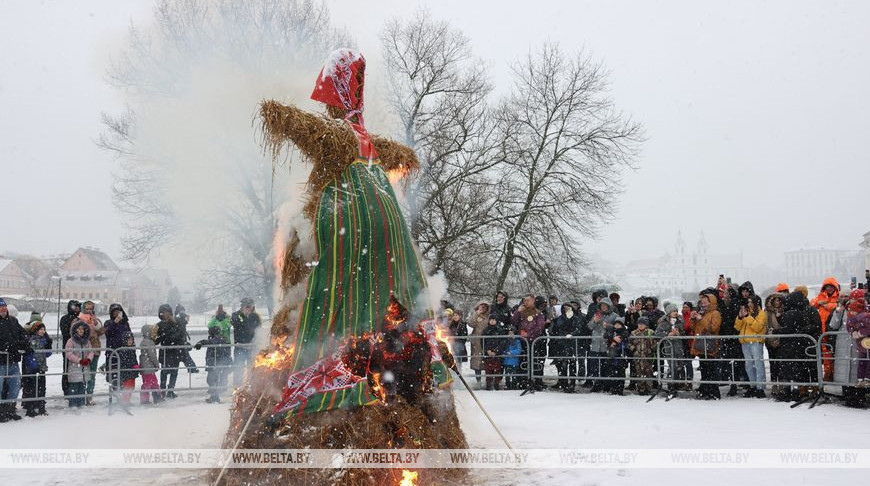
The burning of the Maslenitsa effigy of Morana, the goddess of death, was very important. This is not simply a farewell to winter, but a sacrifice for future fertility. People often brought broken, old, or unnecessary items to the bonfire, such as a scrap of clothing from a sick person. By burning the effigy, one could burn away all troubles, problems, and illnesses, with hope for a new, bright, and good life.