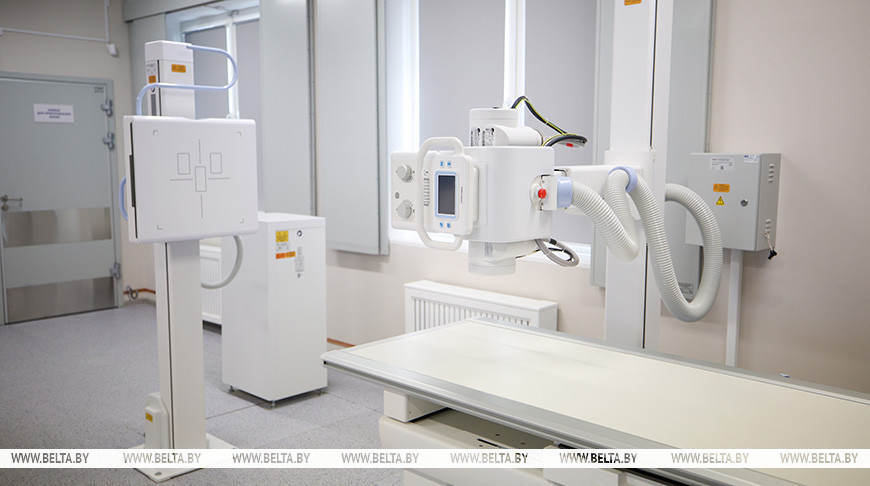
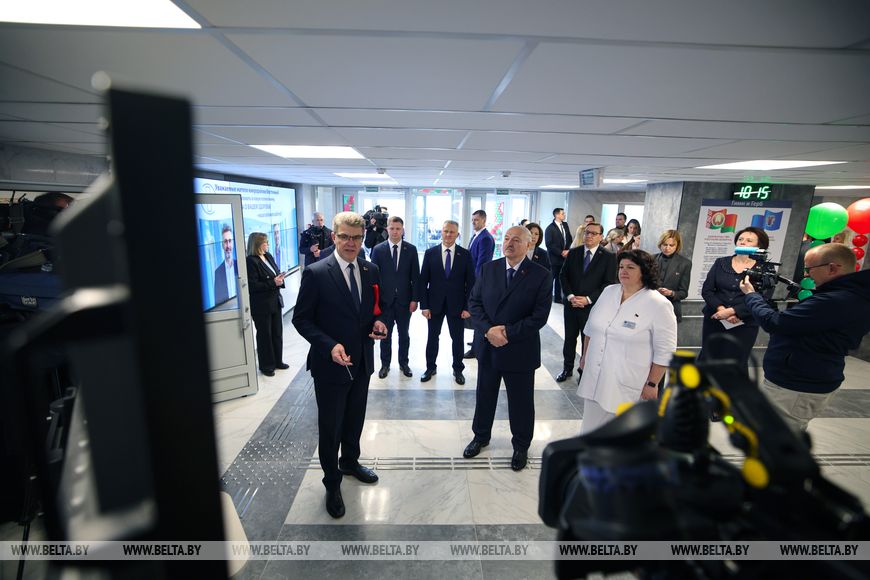
MINSK, 3 April (BelTA) – Belarusian President Aleksandr Lukashenko was briefed on the development of Minsk's healthcare system as he visited new polyclinic No. 42 in the Vostochny neighborhood of the Belarusian capital city, BelTA has learned.
According to Minsk Mayor Vladimir Kukharev, several years ago, after analyzing the situation in the healthcare system, the city administration determined which facilities needed targeted improvements and which districted needed new ones n. Decisions were made not arbitrarily or all at once, but based on real necessity and a rational approach. “It was decided that for some hospitals, instead of building something entirely new, we would simply add an extension or additional departments, or add doctors. We also revised all the designs for new facility to ensure they were compact without large foyers or corridors, only what is necessary for work,” the mayor said.
“We see that there is no longer a need to build new polyclinics or hospitals or to reconstruct the existing ones. We have done this work,” he emphasized, providing a number of examples.
A new polyclinic has been built in Sukharevo, and an outpatient clinic in Sokol. In Loshitsa, due to the growth of the microdistrict and the commissioning of new residential buildings, a new children's polyclinic was put into operation. Children's and adult polyclinics have been built in the Minsk Mir neighborhood, and according to the city authorities, there is currently no need to build medical facilities there. City Polyclinic No. 13 has reopened after renovations. In the Vostochny microdistrict, Polyclinic No. 42 was opened with the participation of the head of state. Its construction was necessary given the growing population of the district and plans for new residential development. On the site of long-standing unfinished construction projects, the Minsk authorities plan to build three residential buildings for large families, for those in need of better housing, and as rental housing.
As for larger medical centers, City Clinical Hospital No.5 has been completely reconstructed, and a new building has been constructed at City Clinical Hospital No. 4. The Minsk Research and Treatment Center for Surgery, Transplantology, and Hematology has a new unit added, state-of-the-art equipment installed.
On the site of a long-standing unfinished construction project on Mayakovsky Street, three medical facilities have been opened: City Dental Polyclinic No. 10, the City Endocrinology Center, and the Clinical Center for Plastic Surgery and Medical Cosmetology.
Another former long-term unfinished construction project, in the Karvata Street area, was reconstructed using city resources, and a new modern building of the Minsk City Clinical Narcological Center was opened there. Now, all stages of addiction treatment are provided in one location, with a particular emphasis on rehabilitation.
Construction is currently underway on a polyclinic at the Minsk City Clinical Oncology Center. The previous building had fallen into disrepair and was in an emergency condition. A new one is being built in its place. “We will complete all construction work by the end of the year ann unveil the new facility early next year [2027],” the Minsk mayor said. Two new buildings are being constructed at City Hospital No. 6. They are scheduled to be put into operation next year.
Construction is also continuing on a new building for the City Infectious Diseases Hospital in the Dolginovsky Trakt area. It is being built at a rapid pace using lightweight steel structures. “Very fast, convenient. Weather conditions have virtually no impact,” Vladimir Kukharev noted.
According to Minsk Mayor Vladimir Kukharev, several years ago, after analyzing the situation in the healthcare system, the city administration determined which facilities needed targeted improvements and which districted needed new ones n. Decisions were made not arbitrarily or all at once, but based on real necessity and a rational approach. “It was decided that for some hospitals, instead of building something entirely new, we would simply add an extension or additional departments, or add doctors. We also revised all the designs for new facility to ensure they were compact without large foyers or corridors, only what is necessary for work,” the mayor said.
“We see that there is no longer a need to build new polyclinics or hospitals or to reconstruct the existing ones. We have done this work,” he emphasized, providing a number of examples.
A new polyclinic has been built in Sukharevo, and an outpatient clinic in Sokol. In Loshitsa, due to the growth of the microdistrict and the commissioning of new residential buildings, a new children's polyclinic was put into operation. Children's and adult polyclinics have been built in the Minsk Mir neighborhood, and according to the city authorities, there is currently no need to build medical facilities there. City Polyclinic No. 13 has reopened after renovations. In the Vostochny microdistrict, Polyclinic No. 42 was opened with the participation of the head of state. Its construction was necessary given the growing population of the district and plans for new residential development. On the site of long-standing unfinished construction projects, the Minsk authorities plan to build three residential buildings for large families, for those in need of better housing, and as rental housing.
As for larger medical centers, City Clinical Hospital No.5 has been completely reconstructed, and a new building has been constructed at City Clinical Hospital No. 4. The Minsk Research and Treatment Center for Surgery, Transplantology, and Hematology has a new unit added, state-of-the-art equipment installed.
On the site of a long-standing unfinished construction project on Mayakovsky Street, three medical facilities have been opened: City Dental Polyclinic No. 10, the City Endocrinology Center, and the Clinical Center for Plastic Surgery and Medical Cosmetology.
Another former long-term unfinished construction project, in the Karvata Street area, was reconstructed using city resources, and a new modern building of the Minsk City Clinical Narcological Center was opened there. Now, all stages of addiction treatment are provided in one location, with a particular emphasis on rehabilitation.
Construction is currently underway on a polyclinic at the Minsk City Clinical Oncology Center. The previous building had fallen into disrepair and was in an emergency condition. A new one is being built in its place. “We will complete all construction work by the end of the year ann unveil the new facility early next year [2027],” the Minsk mayor said. Two new buildings are being constructed at City Hospital No. 6. They are scheduled to be put into operation next year.
Construction is also continuing on a new building for the City Infectious Diseases Hospital in the Dolginovsky Trakt area. It is being built at a rapid pace using lightweight steel structures. “Very fast, convenient. Weather conditions have virtually no impact,” Vladimir Kukharev noted.