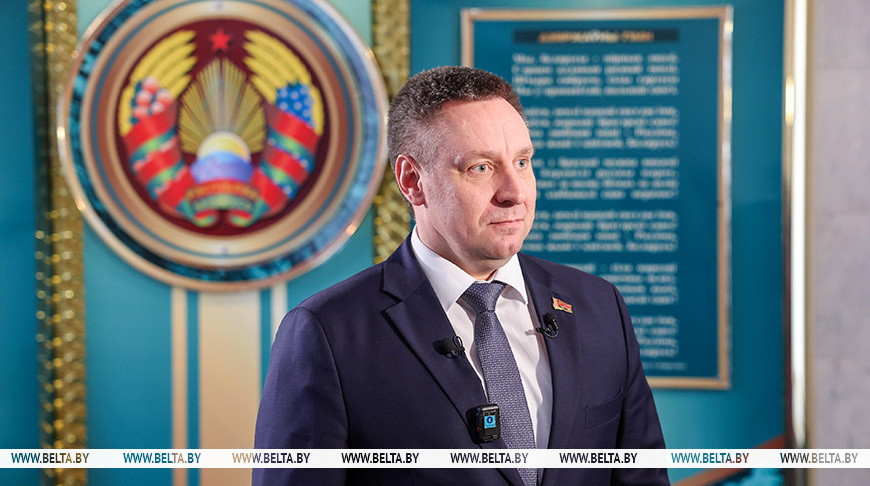
Yuri Gorlov
MINSK, 18 March (BelTA) – Belarus’ agrarians are supposed to gather in 11.5 million tonnes of grain this year. Belarusian Agriculture and Food Minister Yuri Gorlov mentioned the figure after delivering a report to Belarus President Aleksandr Lukashenko on 18 March, BelTA has learned.
Yuri Gorlov said: “This year the head of state wants grain harvest at least as large as last year’s. We see 2025 as the baseline year when we gathered in 11.1 million tonnes of grain taking into account all the private farmers and rapeseed harvest. This year we have to gather in as much. 11.5 million tonnes is the target. Everything is available for it. Agrarians are ready to accomplish the assigned tasks.”
In his words, all the regions of the country except for Vitebsk Oblast have already started sowing early spring cereal crops. “Vitebsk Oblast will get down to it next week considering the location of this northern region and the snow mantle that still can be found primarily in Vitebsk Oblast fields,” the agriculture and food minister explained.
He pointed out that this year’s spring favors an early start of spring field works and many of them are already in progress. In particular, organic fertilizers are being applied in addition to additional nutrition for winter crops and winter rapeseed, perennial grasses.
The minister stressed that agricultural enterprises have everything they need to carry out spring field works. The readiness rate of machines and vehicles is 95%, with the readiness rate of powerful tractors at 94-95% and the readiness rate of tillage outfits, planting outfits, machines for applying solid mineral fertilizers at 96%. “Certainly, we don’t stop at that. The head of state wants all our machines and vehicles repaired. This is why we will get to it virtually within days,” he assured.

According to Yuri Gorlov, technical capabilities of agricultural enterprises allow sowing early spring cereal crops within 12-15 days. The total area under spring crops across the country stands at 2.3 million hectares, including 573,000 hectares allocated for early spring cereal crops.
Maize is in focus this year, with 1.3 million hectares of land allocated for this crop, including 376,000 hectares allocated for grain maize.
“Maize is likely to dominate this year. Although it may not be entirely correct and objective to talk about it in advance. Nevertheless, we need to make some plans,” Yuri Gorlov noted. “Last year’s summer and autumn were humid. There was plenty of precipitation in the form of snow in winter. This is why we assume that this year will not be as humid. It may have a substantial impact on increasing the maize yield.”
He clarified that last year was not a favorable one for maize, with 1.930 million tonnes of grain maize collected. Meanwhile, as much as 2.5 million tonnes of grain maize was harvested in 2024. This year this crop will be focused on in order to gather in at least as much as in 2024. It has to be done in order to hit the target of 11.5 million tonnes of cereals set by the head of state.
“We have determined that we need at least 2.5 million tonnes of grain maize, at least 1 million tonnes of rapeseed (because rapeseed is a highly profitable crop and earns good money for agricultural enterprises), and at least 7.5-8 million tonnes of headed cereal crops. The total gross harvest of cereals and leguminous crops will be secured like that,” Yuri Gorlov said.
The agriculture and food minister assured that agrarians have everything they need to accomplish the assigned tasks. Thanks to state support all the state-run agricultural enterprises are supplied with fuel and workforce. “We employ about 2,400 people every year for the duration of the sowing campaign. Those are people, who work at industrial enterprises and have experience of working in agriculture. We also hire workers of other organizations and students of higher education institutions and secondary specialized education institutions, who are authorized to operate agricultural machines. And with this large team we will secure the results we need and desire,” the official is convinced.
Speaking about the possible negative influence of natural factors, Yuri Gorlov said he believes that agrarians can accomplish their tasks properly and on time in any weather. For instance, various kinds of crops on an area of about 100,000 hectares were hit with frosts in May 2025. “All of that had to be resown. We did everything on time and properly. Nevertheless, we incurred additional costs. Certainly, if those crops had survived, we would have had more,” the agriculture and food minister noted. “But I cannot say that nature greatly affects our results nowadays. On the contrary, we should influence the results by leveraging our technologies, skills, and tactics.”