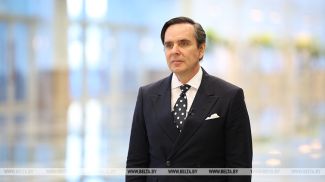

An archive photo
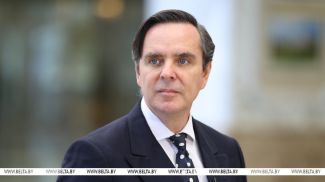
MINSK, 21 December (BelTA) – Residents of the Belarusian Hi-Tech Park (HTP) have been doing more work on the domestic market, Belarusian Communications and Informatization Minister Kirill Zalessky said on the air of the First News TV Channel as he summed up results of the Belarusian People’s Congress, BelTA has learned.
“The program for the next five-year period places great emphasis on digital transformation of the economy and social welfare. Gradually, our IT companies are setting course for domestic market. If five years ago the share of HTP residents on the domestic market accounted for about 5-10%, today it is already about 30% of their total workload. Certainly, in order for our IT companies to do something, they must have clients. And these are the government, government agencies, the Communications and Informatization Ministry. In the new five-year period, we will concentrate our efforts on making sure these tasks are connected with creating systems, apps, and platforms, which will allow maximizing convenience for people and for businesses. We have reached a point where numerous government agencies have their own IT systems. Now, cross-agency integration and the deployment of unified platforms enable us to turn various ideas into reality to make people’s lives easier. We will concentrate on this avenue in the next five-year term,” Kirill Zalessky said.
In his words, each system has its own set of requirements, which are determined by its architecture: its location and design principles, such as being centralized in one location or decentralized and distributed across multiple nodes. “Certainly, the main principle is that sensitive information of our state and personal data of our citizens must not be transferred to servers physically located abroad. Therefore, in critical sectors, we will develop our own infrastructure and host all systems on our territory,” the minister noted.
As for the centralized healthcare information system, according to the head of the Communications and Informatization Ministry, it is now undergoing trial operation and is supposed to go online soon. “The implementation of the system will make it easier for people to access healthcare services, for instance. We plan to apply this same approach to other sectors,” Kirill Zalessky stressed.
Belarus studies the world’s experience in digitalization. “We have to understand what makes sense to adopt here and what would be impractical. We work as closely as possible with Russian colleagues, with colleagues from China, we also study the experience of the countries of the Middle East, and so on. I am convinced that studying this experience will allow us to make effective systems with maximally reasonable government investments,” the minister noted. “As for artificial intelligence, we have to use it where it can simplify decision-making, for instance, in healthcare. Certainly, AI should not make the final decision. But with the aid of such an assistant, which allows processing huge amounts of data and taking into account every detail, a doctor will certainly make much more precise, verified, and correct decisions for the patient’s health.”