Belarusian athletes first competed in the Winter Olympic Games in 1964. The first medal was won by cross-country skier Rita Achkina in 1968 (a bronze in the relay). After that, for a full 20 years, Belarusians did not medal at the Winter Olympics. Moreover, Belarusian representation on the Soviet Union's team at the Winter Games was minimal. However, the changing political situation also had an impact on the state of sports.
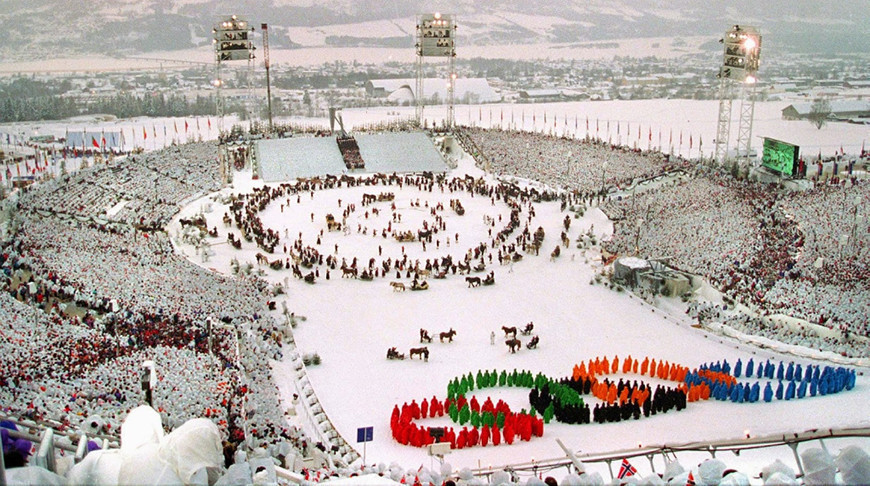
In 1993, at the 101st session of the International Olympic Committee, the National Olympic Committee of Belarus, established two years earlier, was officially recognized as a full member of the IOC. This meant that Belarus gained the right to send its own team to the XVII Winter Olympic Games in 1994 in Lillehammer. This was the first Olympic exam for the young sovereign state. Leonid Khromenkov, Honored Coach of the BSSR and First Deputy Chairman of the Belarusian Public Association “Veterans of Physical Culture and Sports” (in 1994, he was the Deputy Chairman of the State Committee for Sports and Chef de Mission at the first Olympic Games for sovereign Belarus), shared with BelTA first Olympic experience.
Gear for souvenirs
“When we were admitted into the Olympic family in 1993, we were delighted. But, honestly, we didn’t expect to be able to send our team to the Olympic Games so quickly. The situation in the country and in sports was dire: no money, no connections, no experience. There was no time to think things over; we had to solve problems fast. The most painful issue, of course, was financial. It’s worth noting that, despite all the economic difficulties, the state supported sports as best it could. The president of the NOC, Vladimir Ryzhenkov, being a wise leader and a person dedicated to sports, managed to convince the country's leadership that it was very important for the young sovereign state to perform well at the Olympic Games. And for that, it was essential to provide the team with everything necessary. We, the sports officials, worked without fear or reproach, knocking on every door. We were young, active, not constrained by the old school, and we solved all issues decisively, assertively, without procrastinating, especially since problems were piling up like a snowball,” Leonid Khromenkov described the situation.
As is known, clothes make the man. Therefore, the issue of gear procurement became a major headache for sports officials. Especially since in winter sports, this is a matter not only of appearance but also of the athletes’ comfort. In 1994, Belarus had not yet learned to produce high-quality sports gear, and there was no money to buy it from foreign manufacturers. “We had to use their ingenuity and Belarusian charm. We had no choice but to go on a tour of Europe visiting European manufacturers like Fischer and Atomic. We asked them to equip our athletes, promising that as soon as we had money, we would only buy equipment and gear from them. All we could offer them in return were Belarusian souvenirs. It was a kind of adventure, but we had no other option. European manufacturers knew about Belarus mainly thanks to our athletes. And they agreed to provide equipment only to the best athletes. By any means necessary, we negotiated equipment for the entire team. The Slovenians helped, and Alpina and Adidas outfitted the entire Belarusian national team, sewing the Athletes Parade uniform. We had to travel across half of Europe so that Belarusian athletes could go to Lillehammer with quality equipment and good gear,” Leonid Khromenkov recalled.
 And Dan Jansen, who was preparing for the event, seemed to have been energized by his failure in the 500 meters. With that energy, he skated a world record in the 1000 meters and won the gold medal. One of the greatest sprinters of his time finally reached the peak. The equally brilliant Belarusian speed skater unfortunately ended his athletic career without Olympic gold.
The joy and heartbreak of biathlon
Medals were also expected from the biathletes. Overall, those expectations were met, but not without their share of drama. In the first stage of the 7.5 km sprint, Svetlana Paramygina had two misses. The Belarusian biathlete withstood the pressure from Canadian Myriam Bédard, the champion of the 15km race, when they met on the shooting range, with Bédard having started a minute behind. At the second shooting stage, Svetlana hit all five targets with machine-gun-like precision and sped off toward the final stretch. Bédard, however, was not ready to give up, and right at the finish line, she snatched the victory from Svetlana Paramygina by just 1.1 seconds. The American biathlete became Olympic champion; the Belarusian took silver.
“The Olympics will be memorable because my dream came true. I will never forget the moment I stood on the podium and heard the name of our small country announced. It’s impossible to describe the feelings that overwhelmed me at that moment. It was joy, pride, true happiness, a tiny drop of bitterness from not getting to hear the Belarusian anthem, and something else inexplicable,” Svetlana later confessed in an interview with the Athlete of Belarus Magazine.
Medals were also expected from 1992 Olympic champion Evgeny Redkin, but fortune turned away from him. It also failed to smile upon another medal contender, 1988 Olympic champion Aleksandr Popov. In Lillehammer, he caught a severe cold; the team’s doctor, Zhanna Levchik, and masseur, Valery Daderkin, managed to get him back on his feet in three days. But that didn’t guarantee him a medal. At the 1992 Olympics, in the 20 km individual race, Popov was let down by his shooting. It was because of that that he lost a medal and ended up in the most agonizing fourth place. In Lillehammer, the situation repeated itself exactly. Journalists called that race fateful for the athlete. “Fourth place is the most painful. You’re right next to the podium, but there’s no place for you on it, especially when you lose by just a few seconds. But I’m to blame myself. I guess I fell short somewhere,” Aleksandr Popov recounted in an interview with the Athlete of Belarus Magazine.
Elusive happiness of freestyle skiing
Happiness was close but ultimately out of reach for the freestyle skiers as well. In the Aerials qualification round, Alexei Parfenkov brilliantly executed both a triple somersault with four twists and a triple somersault with three pirouettes, outpacing the recognized trendsetters – Canada’s Philippe Laroche and Trace Worthington of the USA. But in the final, the athlete burned out. Not a trace remained of his former confidence and inspiration. His opponents, on the other hand, caught the wave. In the final, Alexei Parfenkov began his descent cautiously, but he lacked the speed to perform a good jump. He had a second attempt left, and he went all in. And again, failure, which pushed the Belarusian down to 12th place. To have made it onto the podium, Alexei Parfenkov only needed to repeat his preliminary result. He couldn’t.
No reason to be ashamed for the country
In the overall standings of the Olympics, Belarusians took 15th place. Whether this is good or bad is a rhetorical question, but Leonid Khromenkov has an answer to it: “Of course, we were all hoping for a gold medal. But two silver medals, in my opinion, given the circumstances, is a very respectable result. All the athletes tried their best. Every coach, every athlete did the maximum they could. We had no reason to reproach them. The biathletes and skiers aren’t to blame for the frost hitting and them lacking experience working with ski wax at such low temperatures. We didn’t have a single serviceman, the coaches handled the equipment. We couldn’t afford to arrive in Norway earlier for acclimatization. In those difficult conditions, we managed to assemble a strong team across various sports. We had athletes competing in moguls [a freestyle discipline], Nordic combined, and ski jumping - events that our athletes currently don’t qualify for in the Olympics. At that time, under those conditions, with nothing to our name, we showed a very decent result.”
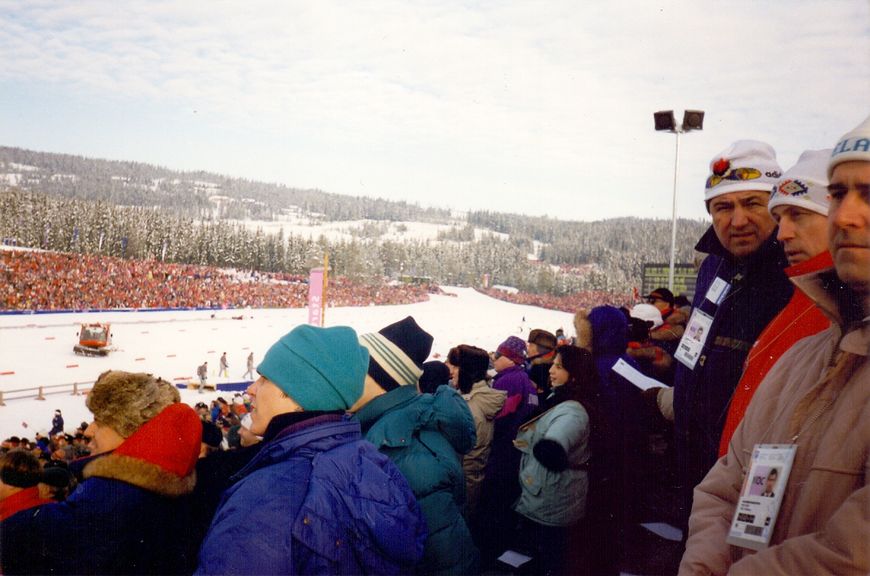
In 1993, at the 101st session of the International Olympic Committee, the National Olympic Committee of Belarus, established two years earlier, was officially recognized as a full member of the IOC. This meant that Belarus gained the right to send its own team to the XVII Winter Olympic Games in 1994 in Lillehammer. This was the first Olympic exam for the young sovereign state. Leonid Khromenkov, Honored Coach of the BSSR and First Deputy Chairman of the Belarusian Public Association “Veterans of Physical Culture and Sports” (in 1994, he was the Deputy Chairman of the State Committee for Sports and Chef de Mission at the first Olympic Games for sovereign Belarus), shared with BelTA first Olympic experience.
Gear for souvenirs
“When we were admitted into the Olympic family in 1993, we were delighted. But, honestly, we didn’t expect to be able to send our team to the Olympic Games so quickly. The situation in the country and in sports was dire: no money, no connections, no experience. There was no time to think things over; we had to solve problems fast. The most painful issue, of course, was financial. It’s worth noting that, despite all the economic difficulties, the state supported sports as best it could. The president of the NOC, Vladimir Ryzhenkov, being a wise leader and a person dedicated to sports, managed to convince the country's leadership that it was very important for the young sovereign state to perform well at the Olympic Games. And for that, it was essential to provide the team with everything necessary. We, the sports officials, worked without fear or reproach, knocking on every door. We were young, active, not constrained by the old school, and we solved all issues decisively, assertively, without procrastinating, especially since problems were piling up like a snowball,” Leonid Khromenkov described the situation.
As is known, clothes make the man. Therefore, the issue of gear procurement became a major headache for sports officials. Especially since in winter sports, this is a matter not only of appearance but also of the athletes’ comfort. In 1994, Belarus had not yet learned to produce high-quality sports gear, and there was no money to buy it from foreign manufacturers. “We had to use their ingenuity and Belarusian charm. We had no choice but to go on a tour of Europe visiting European manufacturers like Fischer and Atomic. We asked them to equip our athletes, promising that as soon as we had money, we would only buy equipment and gear from them. All we could offer them in return were Belarusian souvenirs. It was a kind of adventure, but we had no other option. European manufacturers knew about Belarus mainly thanks to our athletes. And they agreed to provide equipment only to the best athletes. By any means necessary, we negotiated equipment for the entire team. The Slovenians helped, and Alpina and Adidas outfitted the entire Belarusian national team, sewing the Athletes Parade uniform. We had to travel across half of Europe so that Belarusian athletes could go to Lillehammer with quality equipment and good gear,” Leonid Khromenkov recalled.
The team was assembled, equipped, and uniforms were made for all members of the delegation. Then came the next challenge - how to get to Norway. There was still no money for tickets for the sizable delegation. Friends helped out. The owner of a private airline provided a plane. But with one condition - the team had to fuel it at own expense. We asked the Finance Ministry and NOC sponsors to help with funds for the fuel. We flew to Norway and went to refuel the plane for the return trip with cash. The Norwegians, our foreign colleagues, were shocked that the delegation at the Olympic Games had to deal with such an issue. But who else but us was going to solve these problems? Everything related to the team was our responsibility,” Leonid Khromenkov noted.
According to him, essentially the whole country helped send the team to the Olympic Games. And the country had the right to know and see everything that was happening there, to receive prompt information about the performance of Belarusian athletes. The Belarusian NOC had no existing contacts or established procedures for organizing press work. They had to improvise, as usual. Journalists Vladimir Novitsky and Elena Danilchenko had to work extremely hard. The issue of medical support was resolved in a similar fashion. Today, a team of professional medics travels with the team of athletes to the Olympic Games, but in 1994, the health of the Belarusian Olympians became the responsibility of one doctor from a sports clinic - Zhanna Levchik.
“Since I was in charge of winter sports at the State Committee for Sports, I was chosen as Chef de Mission. Few people really understood what Chef de Mission was supposed to do. It turned out that Chef de Mission is responsible for everything,” Leonid Khromenkov said.
A sea of snow, a touch of home – how Norway welcomed the Belarusians
“Norway greeted us with a sea of snow – an element they battle with relentless determination, clearing it from roadways and rooftops around the clock. Upon reaching Lillehammer by bus two hours later, the athletes were split into two groups: the figure skaters and speed skaters headed to Hamar, closer to their arenas, while the rest settled into four charming chalets in the main Olympic Village. Despite their simplicity, these wooden cabins are surprisingly cozy and comfortable, and remain warm even with the outside temperature dropping to minus 15°C. The atmosphere is genuinely homey: our neighbors in the village include Russians and Ukrainians, Kazakhstanis and Moldovans. As one Norwegian friend has joked, the most widely spoken language in the village is Russian,” wrote Yelena Danilchenko in one of the first Olympic reports for the Athlete of Belarus Magazine.
Leonid Khromenkov recalled that the weather made things significantly more difficult for the athletes back then. The roads were not cleared very well, and competitions were held in different towns. Furthermore, the severe cold presented an additional challenge for freestyle skiers, cross-country skiers, and biathletes. It was challenging for everyone, but everyone was determined to perform well.
Thirty-three Belarusian athletes arrived in Lillehammer. A total of 1,988 athletes from 69 countries participated in the 17th Winter Olympics. According to Leonid Khromenkov, the delegation was given a very specific goal: to return home with medals. And, in principle, there was a chance of achieving this. But there was also room for sporting drama.
Igor Zhelezovsky’s swan song
The biggest star of Belarusian sport back then was speed skater Igor Zhelezovsky. The six-time world champion announced before the Olympics that he would retire from professional sports after Lillehammer. “These Olympics are my last chance,” said the 30-year-old speed skater, whose impressive collection of trophies before 1994 included only one Olympic medal, a bronze in 1988. He could have won at the 1992 Albertville Games, but the skaters were housed at high altitude instead of the valley near the rink. The altitude had a detrimental effect on the athletes’ performance, as they only had enough strength for the first hundred meters of the race. The Lillehammer Games were Igor Zhelezovsky’s last chance to win the coveted Olympic gold he deserved and was capable of.
“We knew how the coaches and athletes lived, we knew what they needed. They knew they could come to us, the managers, with any question and it would be resolved. Because we were a large, close-knit team, united by a common goal. And when Igor Zhelezovsky asked for his wife to go with him to the pre-Olympic training camp, even that issue was resolved,” recalled Leonid Khromenkov.
But winning Olympic gold in 1994 was the dream of another speed skater, American Dan Jansen. Three times he gave his all to the Olympic Games, and three times he failed. In 1984, he placed fourth in the 500m race and 16th in the 1,000m race. In 1988, on the very day of the 500m race, Jansen’s sister died of leukemia, which prevented him from focusing on the competition; he fell in both races. In 1992, Jansen was the favorite, but only finished fourth in the 500m event.
The Belarusian and American speed skaters arrived in Lillehammer with the sole goal of winning Olympic gold. They suffered a common misfortune in the 500m event. Jansen had a mysterious malfunction on the final turn, and the only speed skater at the time to break 36 seconds in the sprint (his last time doing so was in Hamar on the eve of the Olympic competition) finished only eighth. Igor Zhelezovsky, for whom the 500m was not his strongest distance, achieved his best result of the season. However, it was only enough for tenth place.
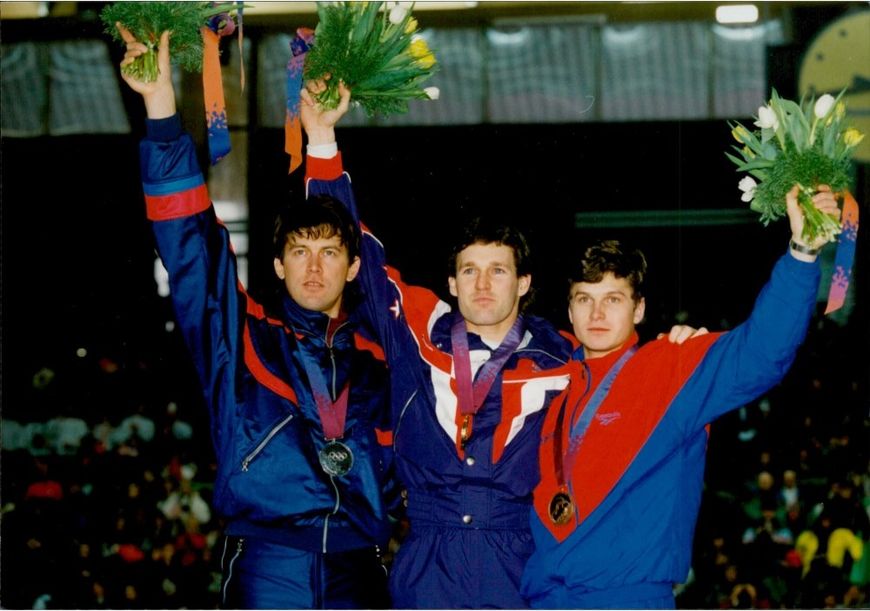
The decisive day arrived on 18 February 1994, when they took to the ice for the 1000m event. The draw was not kind to Igor Zhelezovsky: he skated in the first pair on a long track and against an “inconvenient” rival, Russian Sergei Klevchenya, the silver medalist in the short sprint. Klevchenya skated the first 200 meters of the race better, practically flying to the finish line. But Igor Zhelezovsky still managed to overtake his competitor and pull ahead.
And Dan Jansen, who was preparing for the event, seemed to have been energized by his failure in the 500 meters. With that energy, he skated a world record in the 1000 meters and won the gold medal. One of the greatest sprinters of his time finally reached the peak. The equally brilliant Belarusian speed skater unfortunately ended his athletic career without Olympic gold.
“I’ve been waiting for this for a long time. It’s been a long journey. And finally, the goal has been achieved. Ironically, I’m the one who won, even though Igor has always been the king of this distance,” Jansen would later say in an interview.
One can only imagine what was going through the Belarusian athlete’s head. “I can’t say I’m overjoyed. Of course, I wanted to win gold. But what can you do? Such is life. Apparently, I was not destined to become an Olympic champion. I’ll have to settle for second place. I felt fine the morning before the start. Perhaps even too fine. True, the skating was tough. The last lap was especially difficult. But I did everything I could and showed my best result of the season at this distance,” Igor Zhelezovsky said in an interview with the Athlete of Belarus Magazine. Thus, the first Olympic medal for sovereign Belarus was won in dramatic fashion. A joyful event, but with a bitter aftertaste.
The joy and heartbreak of biathlon
Medals were also expected from the biathletes. Overall, those expectations were met, but not without their share of drama. In the first stage of the 7.5 km sprint, Svetlana Paramygina had two misses. The Belarusian biathlete withstood the pressure from Canadian Myriam Bédard, the champion of the 15km race, when they met on the shooting range, with Bédard having started a minute behind. At the second shooting stage, Svetlana hit all five targets with machine-gun-like precision and sped off toward the final stretch. Bédard, however, was not ready to give up, and right at the finish line, she snatched the victory from Svetlana Paramygina by just 1.1 seconds. The American biathlete became Olympic champion; the Belarusian took silver.
“The Olympics will be memorable because my dream came true. I will never forget the moment I stood on the podium and heard the name of our small country announced. It’s impossible to describe the feelings that overwhelmed me at that moment. It was joy, pride, true happiness, a tiny drop of bitterness from not getting to hear the Belarusian anthem, and something else inexplicable,” Svetlana later confessed in an interview with the Athlete of Belarus Magazine.
Medals were also expected from 1992 Olympic champion Evgeny Redkin, but fortune turned away from him. It also failed to smile upon another medal contender, 1988 Olympic champion Aleksandr Popov. In Lillehammer, he caught a severe cold; the team’s doctor, Zhanna Levchik, and masseur, Valery Daderkin, managed to get him back on his feet in three days. But that didn’t guarantee him a medal. At the 1992 Olympics, in the 20 km individual race, Popov was let down by his shooting. It was because of that that he lost a medal and ended up in the most agonizing fourth place. In Lillehammer, the situation repeated itself exactly. Journalists called that race fateful for the athlete. “Fourth place is the most painful. You’re right next to the podium, but there’s no place for you on it, especially when you lose by just a few seconds. But I’m to blame myself. I guess I fell short somewhere,” Aleksandr Popov recounted in an interview with the Athlete of Belarus Magazine.
Elusive happiness of freestyle skiing
Happiness was close but ultimately out of reach for the freestyle skiers as well. In the Aerials qualification round, Alexei Parfenkov brilliantly executed both a triple somersault with four twists and a triple somersault with three pirouettes, outpacing the recognized trendsetters – Canada’s Philippe Laroche and Trace Worthington of the USA. But in the final, the athlete burned out. Not a trace remained of his former confidence and inspiration. His opponents, on the other hand, caught the wave. In the final, Alexei Parfenkov began his descent cautiously, but he lacked the speed to perform a good jump. He had a second attempt left, and he went all in. And again, failure, which pushed the Belarusian down to 12th place. To have made it onto the podium, Alexei Parfenkov only needed to repeat his preliminary result. He couldn’t.
No reason to be ashamed for the country
In the overall standings of the Olympics, Belarusians took 15th place. Whether this is good or bad is a rhetorical question, but Leonid Khromenkov has an answer to it: “Of course, we were all hoping for a gold medal. But two silver medals, in my opinion, given the circumstances, is a very respectable result. All the athletes tried their best. Every coach, every athlete did the maximum they could. We had no reason to reproach them. The biathletes and skiers aren’t to blame for the frost hitting and them lacking experience working with ski wax at such low temperatures. We didn’t have a single serviceman, the coaches handled the equipment. We couldn’t afford to arrive in Norway earlier for acclimatization. In those difficult conditions, we managed to assemble a strong team across various sports. We had athletes competing in moguls [a freestyle discipline], Nordic combined, and ski jumping - events that our athletes currently don’t qualify for in the Olympics. At that time, under those conditions, with nothing to our name, we showed a very decent result.”
“We weren’t representing a huge, long-respected Soviet Union, but a young state. Undoubtedly, Zhelezovsky’s silver was a great victory. But at the same time, it wasn’t without bitterness, because we know Igor was aiming for more. The same can be said for Svetlana Paramygina. But look, in the overall standings, we surpassed such powerful nations as France, England, Finland, China, and our western neighbor Poland. After this, can we consider the debut a failure? I am convinced the team performed successfully,” said President of the NOC of Belarus Vladimir Ryzhenkov after the Olympic Games.
In Lillehammer, the athletes went for medals, and the sports administrators went for experience and contacts. During the Olympics, Vladimir Ryzhenkov, together with his colleagues, held numerous meetings with heads of international federations and Olympic committees from other countries. They exchanged contacts, presented Belarus as a sporting nation open to cooperation and ready to host various competitions. They were building the country’s image in world sports.
“We were pioneers in the development of professional sports in a sovereign country. And if there’s no professionalism in sports, there won’t be results. We were interested in everything, learning everything through practice. Belarusians are calm people, but they quickly catch on and try to do everything as best they can. And we succeed in it. We’ve proven this in sports, in the economy, and in the social sector - in all areas, we have no reason to be ashamed of our country. And most importantly, our people don’t stop and keep moving forward,” Leonid Khromenkov said. “For objective reasons, it was difficult for us to work, but we tried to do everything so that athletes could prove themselves. And today, when athletes have all the conditions, they are being prevented, for fabricated reasons, from realizing their potential on the international stage. Back then, 32 years ago, we became part of the Olympic family, where we were supported, where we were helped - I still remember that time warmly. But what has happened to the Olympic family today? How can you deprive athletes of their flag, not allow them to attend the opening ceremony, openly lowball their scores? It’s sheer barbarity. It’s sad, of course, but our Belarusian athletes aren’t used to giving up, even in the most difficult conditions.”

In Lillehammer, the athletes went for medals, and the sports administrators went for experience and contacts. During the Olympics, Vladimir Ryzhenkov, together with his colleagues, held numerous meetings with heads of international federations and Olympic committees from other countries. They exchanged contacts, presented Belarus as a sporting nation open to cooperation and ready to host various competitions. They were building the country’s image in world sports.
“We were pioneers in the development of professional sports in a sovereign country. And if there’s no professionalism in sports, there won’t be results. We were interested in everything, learning everything through practice. Belarusians are calm people, but they quickly catch on and try to do everything as best they can. And we succeed in it. We’ve proven this in sports, in the economy, and in the social sector - in all areas, we have no reason to be ashamed of our country. And most importantly, our people don’t stop and keep moving forward,” Leonid Khromenkov said. “For objective reasons, it was difficult for us to work, but we tried to do everything so that athletes could prove themselves. And today, when athletes have all the conditions, they are being prevented, for fabricated reasons, from realizing their potential on the international stage. Back then, 32 years ago, we became part of the Olympic family, where we were supported, where we were helped - I still remember that time warmly. But what has happened to the Olympic family today? How can you deprive athletes of their flag, not allow them to attend the opening ceremony, openly lowball their scores? It’s sheer barbarity. It’s sad, of course, but our Belarusian athletes aren’t used to giving up, even in the most difficult conditions.”
Valeriya Stetsko,
photos from the archive of the NOC of Belarus,
BelTA.
photos from the archive of the NOC of Belarus,
BelTA.