
If there were no universally recognized time, everyone would show up for work, school, or meetings whenever they pleased. People wouldn't know when to arrive at train stations or airports. Fortunately, time exists, and it is synchronized with standards in other countries around the world. How is its accuracy determined in Belarus? Do the clocks on city streets, in the metro, and on public transport display boards show the correct time? And most importantly, are discrepancies possible? The answers are in the Deep Dive project.
Guardian of the standard
To find out how clock accuracy is verified and which reference is used for comparison, we visited the Belarusian State Institute of Metrology (BelGIM), where most of the national standards are kept.
“The time standard stores and transmits the unit of time — the second. It is the foundation for forming the national timescale of Belarus,” said Yuri Ivanov, Deputy Director of BelGIM, Candidate of Technical Sciences. “A country that does not possess its own standards cannot be considered technologically developed and independent. Belarus currently has 70 national standards in operation, which almost fully meets the needs of our industrial complex.”

Yuri Ivanov
In turn, the time standard is widely used in various sectors of the economy, including mobile communications, navigation systems, nuclear energy, defense, and ground and air transport.
“It’s hard to name a field of activity that isn’t connected to time. The simplest example is sport,” Yuri Ivanov explained. “Two runners reach the finish line almost simultaneously. How do you determine who came first? If we use a stopwatch that isn’t accurate, the gold medal could go to the wrong athlete. That’s why all instruments are calibrated and compared against the standard. BelGIM has now achieved a level of precision in maintaining the national timescale where a deviation of one second occurs once every million years.”
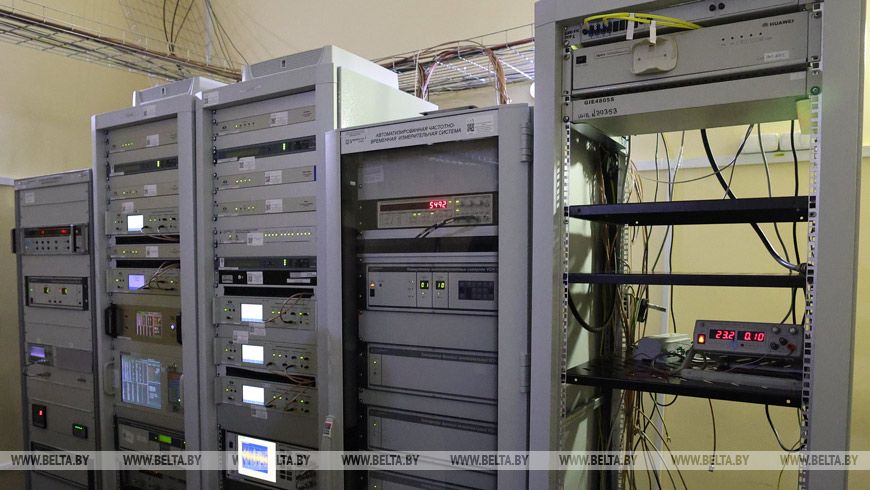
The national standard of units of time (second), frequency (hertz), and time scale (its full designation) was established in 1995. It is an extremely sophisticated complex of continuously operating measuring instruments. Physically, the standard is a system that includes a group of atomic clocks, a complex for external comparisons based on satellite navigation signals, and an internal comparison system for monitoring the characteristics of the atomic clocks and environmental parameters. The standard is housed in a room with a controlled temperature. It also contains control and correction equipment, as well as video surveillance, fire suppression, and uninterruptible power supply systems. The latter includes a diesel generator developed by MTZ.
Yelena Takun
Data from the Belarusian time standard, and those of Russia, China, the United States, and others, are continuously transmitted to the International Bureau of Weights and Measures, located in Paris. There, the information received from all countries across different time zones is processed. This is how the Coordinated Universal Time (UTC) scale is formed.
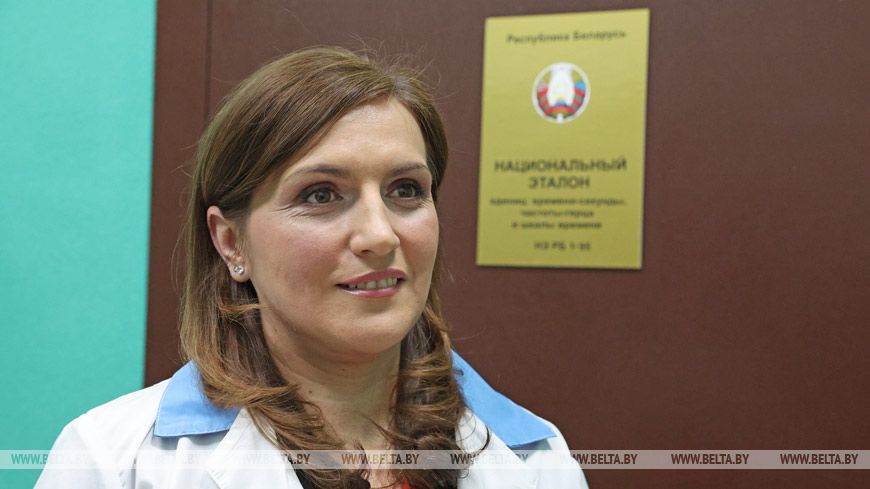
“The person who oversees this process in Belarus can rightfully be called the keeper of time,” said Yelena Takun, lead engineer in metrology and research at BelGIM, scientist-keeper of the national standard of units of time (second), frequency (hertz), and time scale. “My work involves constant monitoring and calculation of all the component blocks of the standard: from the characteristics of the atomic clocks to the comparison system."
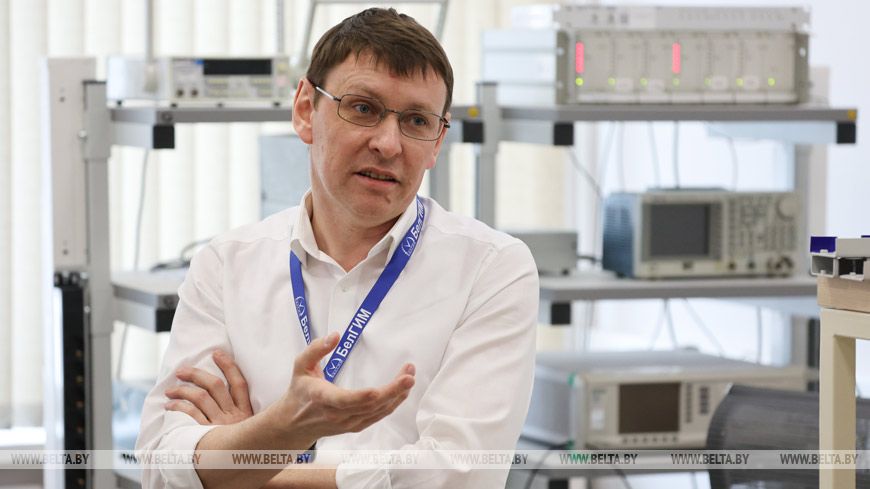
"Today, the most accurate time information is available on the websites of Gosstandart and BelGIM. On the main pages, you can see data with precision down to three decimal places,” explained Yuri Shershun, head of the radio-electronic measurements department at BelGIM.
On the internet, the transmission of accurate time from reference servers occurs via dedicated lines. This service is used by more than 30 Belarusian organizations, including the Banking Processing Center and all telecommunications operators, including Beltelecom. Photo and video recording systems are also periodically checked for time synchronization with the national timescale. The specialists explain that the permissible deviation from the standard is one second. This is caused by the signal transmission time over communication lines to display boards or clock faces.
On the other hand, the clocks on the Main Post Office building, on the tower near the railway station in Minsk, and on buildings in Minsk are mechanical and are not synchronized with the time standard.
Guardian of the standard
To find out how clock accuracy is verified and which reference is used for comparison, we visited the Belarusian State Institute of Metrology (BelGIM), where most of the national standards are kept.
“The time standard stores and transmits the unit of time — the second. It is the foundation for forming the national timescale of Belarus,” said Yuri Ivanov, Deputy Director of BelGIM, Candidate of Technical Sciences. “A country that does not possess its own standards cannot be considered technologically developed and independent. Belarus currently has 70 national standards in operation, which almost fully meets the needs of our industrial complex.”
Yuri Ivanov
In turn, the time standard is widely used in various sectors of the economy, including mobile communications, navigation systems, nuclear energy, defense, and ground and air transport.
“It’s hard to name a field of activity that isn’t connected to time. The simplest example is sport,” Yuri Ivanov explained. “Two runners reach the finish line almost simultaneously. How do you determine who came first? If we use a stopwatch that isn’t accurate, the gold medal could go to the wrong athlete. That’s why all instruments are calibrated and compared against the standard. BelGIM has now achieved a level of precision in maintaining the national timescale where a deviation of one second occurs once every million years.”
The national standard of units of time (second), frequency (hertz), and time scale (its full designation) was established in 1995. It is an extremely sophisticated complex of continuously operating measuring instruments. Physically, the standard is a system that includes a group of atomic clocks, a complex for external comparisons based on satellite navigation signals, and an internal comparison system for monitoring the characteristics of the atomic clocks and environmental parameters. The standard is housed in a room with a controlled temperature. It also contains control and correction equipment, as well as video surveillance, fire suppression, and uninterruptible power supply systems. The latter includes a diesel generator developed by MTZ.
Yelena Takun
Data from the Belarusian time standard, and those of Russia, China, the United States, and others, are continuously transmitted to the International Bureau of Weights and Measures, located in Paris. There, the information received from all countries across different time zones is processed. This is how the Coordinated Universal Time (UTC) scale is formed.
“The person who oversees this process in Belarus can rightfully be called the keeper of time,” said Yelena Takun, lead engineer in metrology and research at BelGIM, scientist-keeper of the national standard of units of time (second), frequency (hertz), and time scale. “My work involves constant monitoring and calculation of all the component blocks of the standard: from the characteristics of the atomic clocks to the comparison system."
"Today, the most accurate time information is available on the websites of Gosstandart and BelGIM. On the main pages, you can see data with precision down to three decimal places,” explained Yuri Shershun, head of the radio-electronic measurements department at BelGIM.
On the internet, the transmission of accurate time from reference servers occurs via dedicated lines. This service is used by more than 30 Belarusian organizations, including the Banking Processing Center and all telecommunications operators, including Beltelecom. Photo and video recording systems are also periodically checked for time synchronization with the national timescale. The specialists explain that the permissible deviation from the standard is one second. This is caused by the signal transmission time over communication lines to display boards or clock faces.
Yuri Shershun
On the other hand, the clocks on the Main Post Office building, on the tower near the railway station in Minsk, and on buildings in Minsk are mechanical and are not synchronized with the time standard.
“We do not have any regulations requiring all timepieces to be verified against the time standard,” Yelena Takun explains. “There are clocks that cannot be synchronized without mechanical adjustment. But every Belarusian always has accurate time information at their fingertips. It is displayed on the smartphone screen: all mobile operators synchronize time directly with the national standard.”
A matter of hands
It turns out that every Belarusian has a device for checking any timekeeping mechanism against the reference standard in their pocket. Having compared the data on our smartphone screens with the clock in the room where the standard is kept, we set off through the streets of the Belarusian capital in search of accurate time.
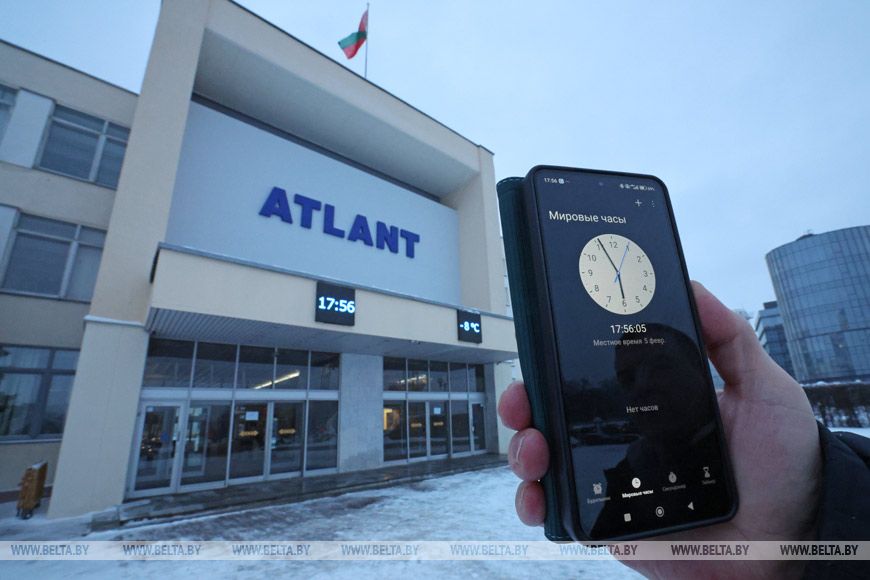
Our first stop is the checkpoint of the Atlant enterprise. Above it hangs an electronic display seen every day by factory workers hurrying to their shifts. The time matches the standard to the minute – seconds are not shown here.
Employees of the Atlant enterprise can easily verify they have arrived at work on time. A glance at the clock above the entrance is enough
We move on to Independence Avenue, where the Minsk Watch Factory building rises, crowned with a vast clock mechanism. Our measurements show that today it is running absolutely accurately, matching the standard to the minute. Tearing our gaze away from the Luch factory tower, we make a surprising discovery: checking the time on a wristwatch, fitness bracelet or smartphone is far more convenient than craning one’s neck skywards. The latter is highly impractical and leaves the neck stiff. It is unlikely that anyone today, wanting to know the time, would glance around in search of a city clock.
But an experiment is an experiment. We move to the heart of the Belarusian capital – Privokzalnaya Square, where the largest clock in our country on one of the towers of the Minsk Gates counts the moments of eternity. The diameter of their face is 3.5 meters. And although tour guides claim the mechanism is nearly a century old, it shows the time accurate to the minute.
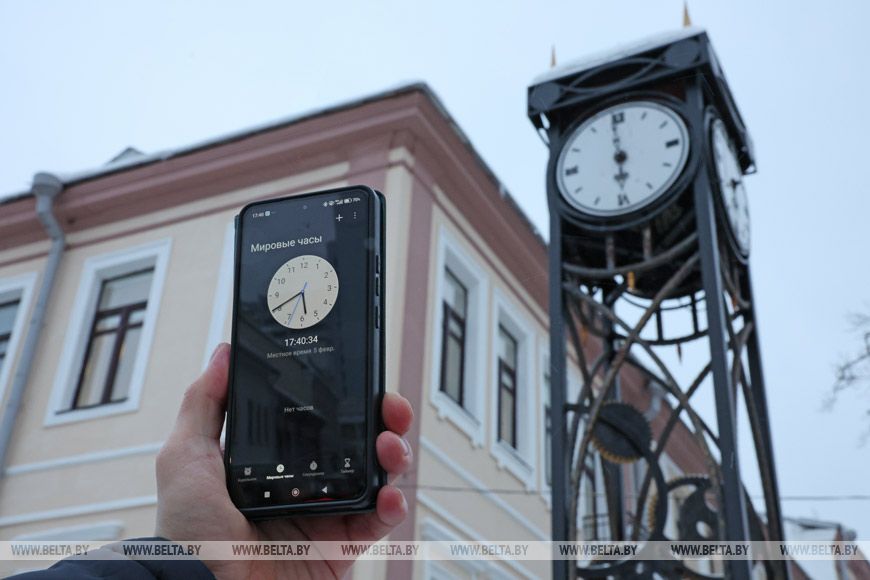
The clock on the Minsk Main Post Office building also passed the punctuality test. They run precisely, even without a second hand. Some might smirk: surely not all clocks in Minsk are so pedantic? No. The skeleton clock installed at the intersection of Komsomolskaya and Revolyutsionnaya streets simply astonished us with its lack of precision. When the smartphone showed 17:40, the hands on its face were frozen at 18:00. At first, we thought it was a sculptural composition with time stopped still, but then the photographer recalled that in summer the hands seemed to move. So, we found the organization responsible for maintaining the timepiece. They explained that the skeleton mechanism on the pedestrian street near Nemiga, due to its design, only operates in positive temperatures, or at most in slight minus degrees. Meanwhile, the smartphone in our hands showed -10°C.
The only clock among those we inspected – located at the intersection of Komsomolskaya and Revolyutsionnaya streets – was not running on the day of our experiment. Its mechanism does not function in severe sub-zero temperatures
By and large, city clocks, especially in the capital, have today almost lost their practical significance. Yet they remain architectural landmarks, the capital’s calling cards, each with its own remarkable story. Thus, the mechanisms on Privokzalnaya Square and beside the monument to Felix Dzerzhinsky are trophy pieces, at least a century old. The clock on Minsk City Hall, the only musical timepiece in the capital, plays a melody every hour, composed by a legendary musician. The timepiece at 106 Partizansky Avenue has changed its appearance several times. Originally mechanical, it later became electronic, and in the summer of 2024 once again received a familiar dial with Roman numerals…
Public transport stops go digital
Chilled by the cold wind, we went to the Minsk Metro, and the precision marathon continued. The time on the display board at the tunnel entrance matched the standard to the second. We repeated the measurements five minutes later: nothing had changed. One could confidently set a mechanical wristwatch by the electronic display in the metro. Perfectly accurate time is shown on the vast screen displaying train schedules at Minsk-Passazhirsky railway station.
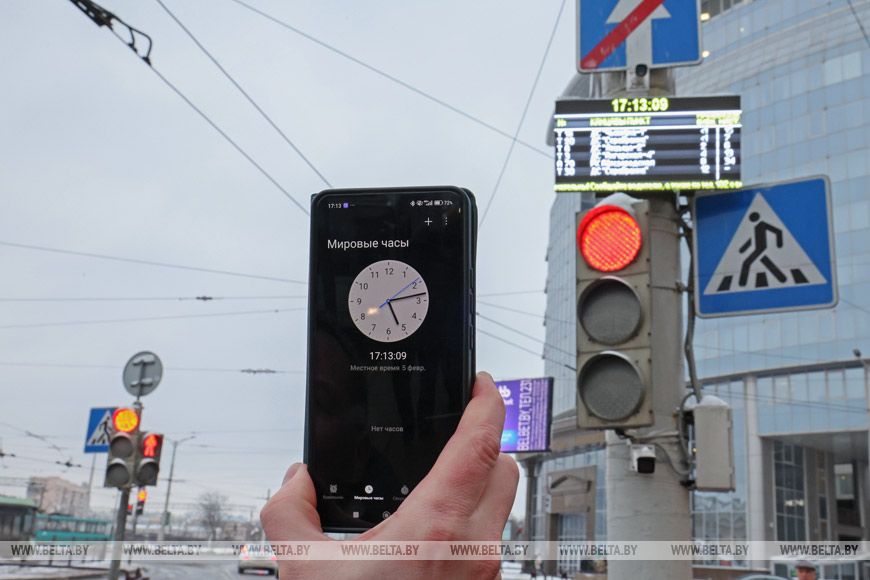
The same result awaited us at a public transport stop, where on the electronic display we once again found time matching to the second.
Could the display be wrong in predicting the arrival time of the vehicle we need? However, both buses and trolleybuses arrived exactly as indicated on the information board. Their drivers and passengers at the public transport stop looked in surprise at the group of freaks trying to find a flaw.
The time at public transport stops coincides with the reference time to the second
According to the mass transit operator Minsktrans, they started installing information boards in the capital city in 2012. Since then about 530 units have been installed. However, there are no plans to further expand the network of these devices, which are now a familiar sight. Transport operators are now moving towards digitization and are busy optimizing cost-intensive processes.
“Like all urban passenger transport the electronic information boards are part of an automated traffic control system based on satellite navigation,” Minsktrans explains. “They display the estimated time of arrival in relation to the timetable. Every vehicle is fitted with a GPS sensor that transmits data about the vehicle’s location to the server in real time. After that, information about the arrival of the vehicle at the stop is calculated automatically and displayed on the electronic information board.”
Today passengers have access to services that allow them to obtain information similar to that displayed at public transport stops. For example, Minsktrans’ official website has a service called “Virtual information board”. It can be used to track the location of ground urban transportation in real time from computers and smartphones. To find out the estimated time of arrival of a bus at a stop, you can use the service from your mobile phone via a USSD request or by scanning the information sign with a QR code with your mobile phone.
Part of the complex equipment in the room where the Belarusian time standard is stored
“For the convenience of passengers a free information service about the arrival of vehicles at public transport stops was added last year as another alternative to the information boards. The service can be accessed by dialing the short number 488,” notes Minsktrans. “Calls can be made through all mobile carriers. After dialing the number and telling the voice assistant the stop code (by voice or as numbers), you will receive voice information about the arrival time of buses, trolleybuses, and trams in real time. The five-digit code of the public transport stop is located on the information board with the transport schedule next to the QR code required for USSD requests.
Up to the second
So who monitors the accuracy of the city clocks in the capital? The Minsk City Executive Committee informed us that there is no special department within their structure that deals with this matter. Meanwhile, the Mingorsvet enterprise maintains a number of clocks in Minsk. These include a mechanism with a three-sided dial at the intersection of Komsomolskaya Street and Nezavisimosti Avenue as well as a two-sided clock near the Music Theater, with one dial showing the Minsk time and the other showing the time in the Japanese sister city of Sendai.
“In most cases the clocks are assigned to a specific organization. For example, the one on the building of the Luch factory belongs to the factory and the one in Privokzalnaya Square belongs to Belarusian Railways,” says Oleg Glushenkov, head of the operations and dispatch service at the Mingorsvet enterprise. “There is no enterprise in Minsk that oversees this matter in a centralized manner. Our single specialist who deals with maintenance — adjusting, repairs, replacement of parts — is only responsible for the clocks that belong to us. But if we notice somewhere in the city that someone else’s clock is not working properly, we will, of course, contact the owner and tell them about it. We do this on a voluntary basis.”
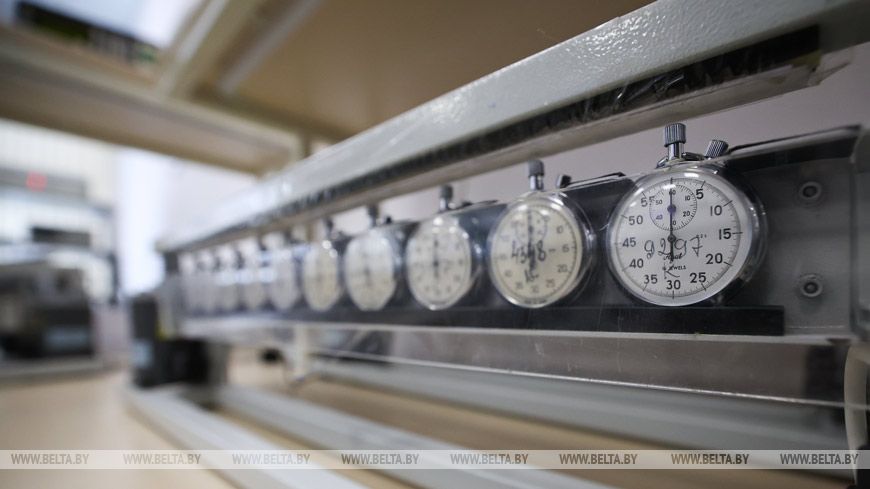
This is how medical stopwatches and sport stopwatches are calibrated in Belarus
It seems that many specialists and organizations take care of the accuracy of the clocks in Belarus. Apart from that, it is as much a trend as the cleanliness of our streets.
The Belarusian time standard is kept within the walls of the Belarusian State Institute of Metrology. Its data is provided to all interested organizations. To find out what time it is, just look at the screen of your smartphone. It will display information synchronized with the standard and it is accurate to the second. You can manually set your mechanical clocks or quartz clocks to “mobile” time. The key thing is to remember that it is unlikely that you will be able to set the absolutely correct time manually on analog devices. Almost all of the clocks we have checked in the capital city were accurate to the minute. Besides, not all of them display seconds. Ground transport vehicles run on schedule. You can find out their arrival time using electronic information boards at public transport stops or by using dedicated services offered by the Minsktrans enterprise today.
In other words, Belarusian time exists, and it is correct. It has been verified!
By Aleksei Gorbunov, 7 Dnei newspaper. Photos by Andrei Sinyavsky.