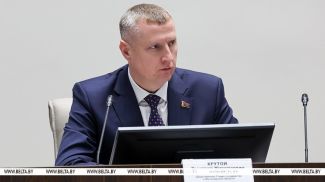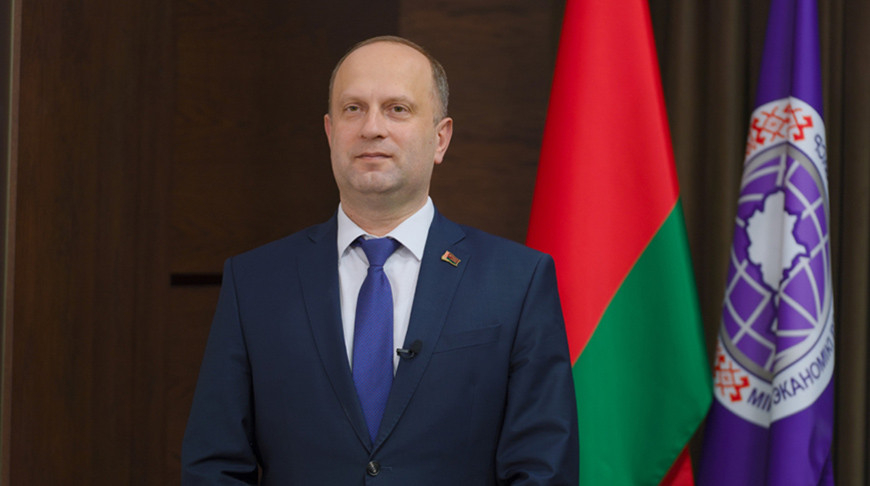
Yuri Chebotar. Photo courtesy of the Economy Ministry
MINSK, 12 December (BelTA) – The investment policy for the new five-year period is aimed at bolstering the economic potential of Belarus’ regions, Economy Minister Yuri Chebotar said at a meeting of the National Union of Industrialists and Entrepreneurs, BelTA learned from the ministry’s press service.
The minister presented a draft of Belarus’ socio-economic development program for 2026-2030 and discussed incentives for implementing regional investment projects. He reiterated that strong regions are a state priority embedded in the national program for both the current and the upcoming five‑year period, and stressed that implementing investment projects remains the key instrument for regional development.
“New production facilities strengthen the regional framework for sustainable development nationwide,” explained Yuri Chebotar. “In the current five-year plan, special emphasis was placed on the One District – One Project initiative. More than a hundred projects have already been implemented, creating approximately 4,900 new jobs. This year, we have ensured its evolution by introducing the new Regional Initiative, whose distinctive feature is a simplified decision-making process. We are seeing widespread interest from businesses: since the beginning of the year, about 150 projects have been launched under it, with over Br1.1 billion in funding and the creation of around 2,600 jobs.”
“In 2026, the Regional Initiative will be further developed. The Investment Development loan product will be transformed into new loan instruments aimed at achieving the objectives of the upcoming five-year plan and reflecting its key priorities: strong regions, technological self-sufficiency, and tourism potential,” he added.
The minister also reported on the status of cooperation projects with the Russian Federation: 26 projects are currently underway, one has been completed, and four more are planned for completion by year’s end.
Yuri Chebotar highlighted the relevance of mechanisms under the updated Law “On investments.” To date, three investment agreements worth Br2.6 billion have been signed, and decisions have been made to implement 24 preferential investment projects totaling approximately Br1.4 billion.
“Therefore, a comprehensive business support package has been created and is successfully operating in the country, including incentives, preferences, and financing, which will serve as an impetus for the further development of both the regions and the country as a whole,” concluded Yuri Chebotar.