

In the history of the modern Olympic Games, only ten cities have had the honor of hosting the main quadrennial sporting event twice. Among them is the mountain resort of Cortina d’Ampezzo, which in 2026, together with Milan, Italy’s fashion and economic hub, has become the capital of the XXV Winter Olympic Games. Cortina d’Ampezzo itself hosts competitions in bobsleigh, alpine skiing, curling, luge, and skeleton. The remaining Olympic events are scattered throughout much of northern Italy. But 70 years ago, Cortina d’Ampezzo was the sole Olympic city. The 1956 Olympic Games became a significant milestone in the history of this small, picturesque town nestled in the Italian Alps. Yet there are other reasons to look back 70 years.
The bread and gold of Cortina
“Cortina d’Ampezzo is a small Italian town with a population of 10,000-15,000. The entire life here depends on tourists. There are many hotels, guesthouses, restaurants, and cafes, and absolutely no industrial enterprises. The town has only two cinemas, but both are widescreen. Cortina d’Ampezzo also has its own newspaper, Notiziario di Cortina, which serves as the voice of tourist and sports organizations, as well as the association of hotel owners. The newspaper’s content is entirely focused on the interests of visitors.
In summer, on the slopes of the reddish-brown mountains surrounding the hollow where Cortina nestles, you can see dozens of rock climbers storming the sheer rock faces. In winter, they are replaced by alpine skiing enthusiasts. Both categories of visitors, naturally, tend to be fairly well-off. Every year, the town’s residents eagerly await the first snow, which brings with it many tourists. They even call the snow – half-jokingly, half-seriously – their bread and their gold,” this is how Mikhail Kanunnikov, the sports attaché of the Olympic Committee of the Soviet Union to the Organizing Committee of the VII Winter Olympic Games, described the Olympic capital in 1956 for the Sovetsky Sport (Soviet Sport) newspaper.

Over the course of 1955, the town’s appearance changed significantly. Many new buildings, mostly hotels, were constructed. Sports venues also appeared. The Organizing Committee had to do a great deal of work to achieve this. “A covered stadium has been built in the town, where hockey players can compete simultaneously on two rinks with artificial ice. The stadium’s stands, designed for 15,000 spectators, are U-shaped and are made of reinforced concrete. To avoid disturbing the town’s overall architectural ensemble, it was decided to finish the heavy, bulky structure with wood, which immediately gave it an elegant look and a sense of lightness. The lighting is so successful and bright that it allows for color film shooting in the evening,” Mikhail Kanunnikov wrote in Sovetsky Sport.
Speaking of shooting and film, the 1956 Winter Olympics were the first Winter Games to be broadcast live on television. Although in black and white, residents of eight European countries could watch the competitions in real time from their homes. And the first sports venue in history from which a live television broadcast was made was precisely the Olympic Ice Stadium in Cortina d’Ampezzo. In 1956, it hosted the Olympic opening and closing ceremonies, as well as the figure skating and ice hockey tournaments. In 2026, now a multi-purpose sports complex, it is hosting the curling tournaments.
Technical achievements
“Two kilometers from the town center, the enormous Italia ski jump towers. This reinforced concrete structure was built to replace the old wooden jump especially for the Winter Olympics. An elevator can deliver athletes to one of four starting platforms located at different heights. Not one, but two judges’ towers have been built at the jump. This will allow judges to avoid interference from sunlight in their work. On both sides of the landing hill, stands for 10,000 spectators have been installed. Below the hill, in specially marked sectors, there is far more space for thrill-seekers. The Organizing Committee expects that on competition days, no fewer than one hundred thousand people will gather at the jump,” Mikhail Kanunnikov reported from the 1956 Olympic capital. “The start and finish of the cross-country skiing events will take place at a special Snow Stadium. Furthermore, the 15km, 30km, and 50km race courses will be shaped like figure eights, with intersections at the same stadium. The changeover stages for the men’s and women’s relay races will also take place here. While at the stadium, spectators will be able to follow the battle on the course among the top ten racers. On a huge board, judges connected to checkpoints along the courses via radio and telephone will report the times achieved by athletes on individual segments.”
The 1956 Olympics went down in history for a number of technological innovations. For instance, thanks to the use of the latest timing technology, results in cross-country skiing were measured with an accuracy of one hundredth of a second. In alpine skiing, starting gates (a specialized structure of two vertical poles with a Teflon coating, holding the skier until the start command) were used for the first time, and the official start time was determined by optical and sound signals.
Human potential
Not only technologically but also in human terms, those Games were a first. For the first time in Olympic history, the Olympic oath at the opening ceremony was pronounced by a woman – Italian alpine skier Giuliana Minuzzo. It was a symbolic moment that expanded the role of women in the Olympic arena.
The 1956 Games were the first Winter Olympics for Soviet athletes. In total, over 800 athletes from 32 countries came to compete in Cortina d’Ampezzo in 1956, participating in competitions across 24 disciplines. The Soviet delegation consisted of 125 people. Soviet athletes took part in 19 events.
The main heroes of the Soviet team were the speed skaters and hockey players. And here is another interesting fact about the Games from 70 years ago. The 1956 Olympics were the last Games where speed skating competitions were held outdoors, on Lake Misurina. “The conditions for competition here, as in Cortina in general, are ideal. The lake is sheltered by mountains, and the ice on it is excellent. For the speed skating competitions, it is planned to use a starting pistol directly connected to the timing device, which completely eliminates errors in timekeeping,” Mikhail Kanunnikov reported from the Olympic capital.

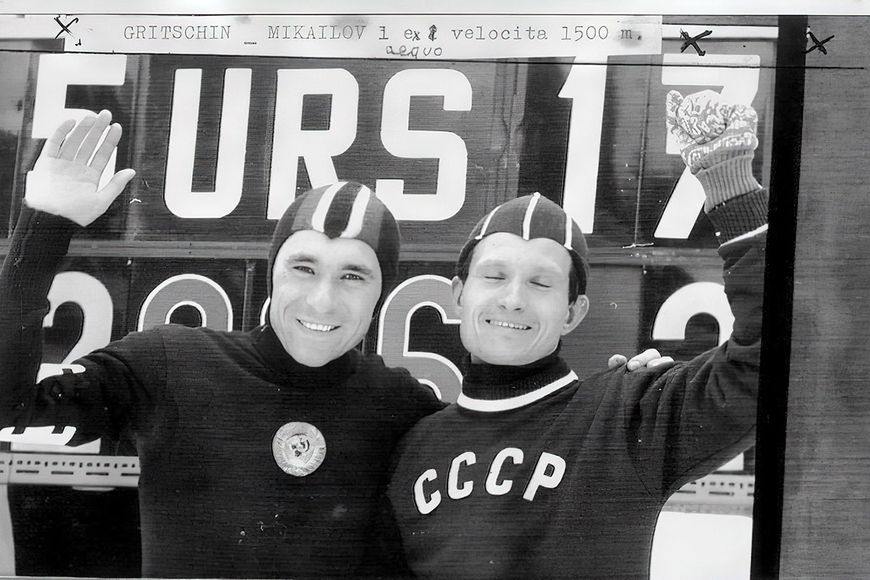
A true sensation at those competitions was caused by Soviet speed skater Yevgeny Grishin. First, in the 500m distance, he equaled his own world record, and then he broke the world record for the 1500m. Moreover, in the 1500m race, Yevgeny Grishin won the gold medal and rewrote the world’s best achievement together with his teammate Yuri Mikhaylov. World record holder Boris Shilkov, the winner of the 5000m race, finished his race with a new Olympic record and the second-best time in the history of speed skating.
The Soviet Union’s ice hockey team at the 1956 Olympics defeated the team from Canada, which at the time was considered invincible. Up to that point, Canadians had won six out of the seven Olympic tournaments held. The USSR national hockey team did not lose a single match and won the gold Olympic medals for the first time in history. It was then that the great history of Soviet hockey began.
It is worth noting that in 1956, Belarusian athletes did not compete in the Olympic Games. Belarusians made their debut at the Winter Olympics in 1964 in Innsbruck. But that is a completely different Olympic story.
Valeriya STETSKO,
photos from open sources,
BelTA