
MOGILEV, 12 December (BelTA) - The 7th Belarusian People's Congress will be held in Belarus very soon. Active preparations are now underway for this important national event. Delegates continue working on the draft Social ad Economic Development Program of Belarus for 2026-2030. Among the delegates from Mogilev Oblast is Liliya Melnikova, the director of the Mezhisetki Secondary School. In an interview with BelTA she talked about why small settlements are becoming increasingly attractive and comfortable places to live.
Liliya Melnikova has lived her entire life in the agro-town of Mezhisetki, Mogilev District. A comfortable and cozy settlement with well-developed infrastructure, including a kindergarten, a school, shops, close to the regional center, makes it a very attractive place to live.
“I was born in Mogilev, but my parents and I moved to Mezhisetki almost immediately. I finished secondary school here, and now I work here as its director,” she said. “You could say my career choice was predetermined: my parents were also teachers and worked at this school. I graduated from it, enrolled at Kuleshov Mogilev State University, and after receiving my diploma, I immediately returned to my hometown, my school, as an English language teacher.”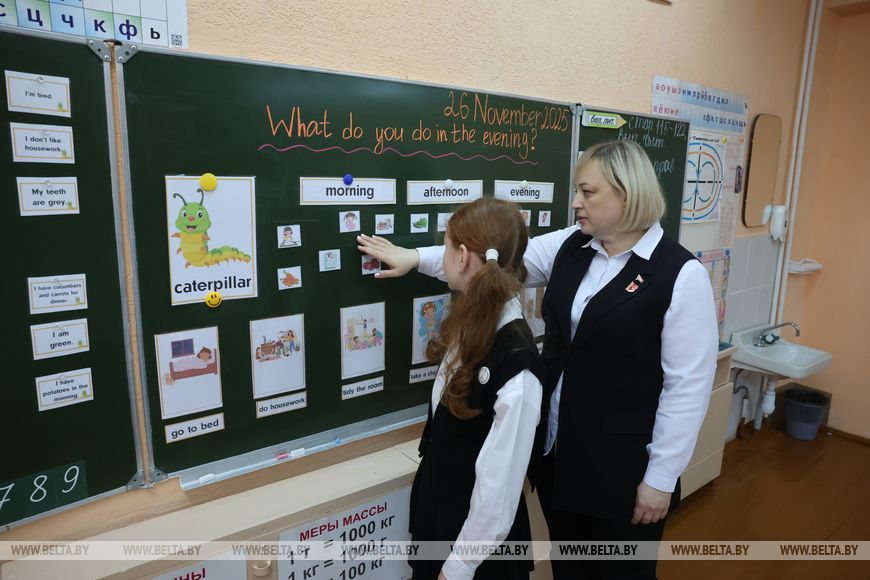
Liliya Melnikova has lived her entire life in the agro-town of Mezhisetki, Mogilev District. A comfortable and cozy settlement with well-developed infrastructure, including a kindergarten, a school, shops, close to the regional center, makes it a very attractive place to live.
“I was born in Mogilev, but my parents and I moved to Mezhisetki almost immediately. I finished secondary school here, and now I work here as its director,” she said. “You could say my career choice was predetermined: my parents were also teachers and worked at this school. I graduated from it, enrolled at Kuleshov Mogilev State University, and after receiving my diploma, I immediately returned to my hometown, my school, as an English language teacher.”
Not long after, Liliya Melnikova was asked to take on the role of deputy director for academic affairs. She served in that capacity for more than a decade before stepping into the position of director. Looking back, she has no regrets about choosing to remain in the agro-town.
“I've never been one for city life; the countryside suits me better,” she noted. “Knowing my parents taught at this same school certainly shaped my own wish to teach, to come back, and to build my life here. Mezhisetki is close enough to the city, and it's well-equipped for comfortable living. We have shops, a bank office and the school. I'm just not cut out for city rush.”
“I've never been one for city life; the countryside suits me better,” she noted. “Knowing my parents taught at this same school certainly shaped my own wish to teach, to come back, and to build my life here. Mezhisetki is close enough to the city, and it's well-equipped for comfortable living. We have shops, a bank office and the school. I'm just not cut out for city rush.”
According to Liliya Melnikova, Mezhisetki has grown significantly in its development. “I have lived here for over 40 years. And of course, a lot has changed during this time. We went from being a village to an agrotown. The infrastructure improved: there was one store, now there are five. The material and technical base of our school is on par with urban gymnasiums, and we have a comfortable, modern kindergarten. All this changed right before our eyes: we saw the community being beautified, expanded with roads, pedestrian pathways, small architectural forms, and children’s playgrounds. It might seem like a small thing, but it’s also very important for people,” she said. “Our Mezhisetki has blossomed.”
According to the school director, in terms of the development of agrotowns, Mezhisetki is not an exception to the rule but an example of systematic state policy to support small communities. “When I was little, my parents would take me into town for clubs and activities because there were none here. The bus ran only twice: in the morning and in the evening. Now, we have no problems getting to the city at any time, and children have everything they need to develop and realize their talents,” she said.
The sphere of education has also changed. “I have been in the profession for over 25 years. During these years, education has taken a very big step forward. We are equipped with all modern technologies: every classroom has computers, interactive boards, and projectors. This significantly improves the quality of lessons and the level of children’s engagement. It’s not just a blackboard and chalk, like when I started. We now have an excellent material and technical base, and all thanks to the policy of our state,” she said. “Curriculum and textbooks are being transformed. Education must always keep pace with the times.”
Education is not only about gaining knowledge. It encompasses many areas. One of them is the patriotic upbringing of the younger generation. “Children often spend far more time at school than at home: there are lessons, then extracurriculars and clubs. Our schedule is packed, even on Saturdays. We also hold many events with a patriotic focus, activities that allow children to discover their creative abilities and talents,” she explains. “Teachers go beyond teaching their academic disciplines. They cultivate universal values, a sense of patriotism, respect for others, and love for the place where they were born and raised.”
According to the school director, in terms of the development of agrotowns, Mezhisetki is not an exception to the rule but an example of systematic state policy to support small communities. “When I was little, my parents would take me into town for clubs and activities because there were none here. The bus ran only twice: in the morning and in the evening. Now, we have no problems getting to the city at any time, and children have everything they need to develop and realize their talents,” she said.
The sphere of education has also changed. “I have been in the profession for over 25 years. During these years, education has taken a very big step forward. We are equipped with all modern technologies: every classroom has computers, interactive boards, and projectors. This significantly improves the quality of lessons and the level of children’s engagement. It’s not just a blackboard and chalk, like when I started. We now have an excellent material and technical base, and all thanks to the policy of our state,” she said. “Curriculum and textbooks are being transformed. Education must always keep pace with the times.”
Education is not only about gaining knowledge. It encompasses many areas. One of them is the patriotic upbringing of the younger generation. “Children often spend far more time at school than at home: there are lessons, then extracurriculars and clubs. Our schedule is packed, even on Saturdays. We also hold many events with a patriotic focus, activities that allow children to discover their creative abilities and talents,” she explains. “Teachers go beyond teaching their academic disciplines. They cultivate universal values, a sense of patriotism, respect for others, and love for the place where they were born and raised.”
For Liliya Melnikova, participating in the Belarusian People’s Congress is a first-time experience. However, the school director is convinced that it is not only an honorable mission to represent her agrotown and her region but also a great responsibility: she will be meeting with various groups, explaining the chosen strategy, and answering questions.
“Any person, no matter where they are from, can contribute to the development of the state and be of benefit. I talk about this during meetings with people, with high school students,” she noted. “The state gives us a great deal, ensuring a high-quality and comfortable life and implementing our rights. And it is the duty of every person not to remain on the sidelines of such important events and to contribute through their local work to strengthening sovereignty and the economy.”
The director of the Mezhisetki Secondary School also shared her vision for Belarus’ future. “I appreciate that the key aspect of our state’s and our president’s policy is people, that we have a socially oriented economy. I have seen the draft program for 2026-2030, and I was very glad to see that we are not deviating from this. Significant funds are allocated for improving people’s quality of life and for the development of education and healthcare. The important approach is preserved: the economy works for the benefit of the people and is people-centric,” she noted. “I also greatly admire that in Belarus, the development of small settlements is never forgotten; the president always speaks about this. Living in a rural area, I want our villages to continue developing, for people to have a decent life, and for them not to have to move to the capital or large cities.”