
Image credit: pexels
News of the story
"On Point"
MINSK, 12 February (BelTA) – The loss of access to the satellite communication system Starlink will have little effect on the Russian army in the combat zone. Head of Russia’s center for studying military and political conflicts Andrei Klintsevich expressed the point of view in a recent episode of BelTA’s YouTube project On Point.
Speaking about Starlink, the expert noted its convenience and low cost. “With a small battery it can be deployed anywhere on the battlefield and a live feed to the command center can be organized. In other cases different algorithms are used: Wi-Fi bridges need to be set up and a broadband Internet access system needs to be organized,” he said.
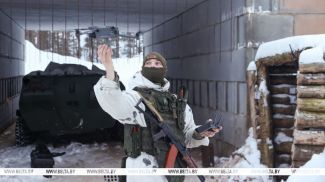
Andrei Klintsevich pointed out that, for instance, FPV drone operators could use Starlink to transmit imagery to the command center. Meanwhile, weapons like Geran drones and cruise missiles used other technologies and hit targets at predetermined coordinates.
“Geran drones, which hit and continue hitting, for example, railway trains, worked through the so-called mesh network. It is a communication system established between drones themselves. Certain repeaters were also used, which were set up by our intelligence officers in Ukraine’s territory,” the expert emphasized. “Of course, it’s easier and faster to do the same with Starlink. You set it up and it sometimes allows you to get faster access to the Internet. The enemy has always taken advantage of this. The so-called [Ukrainian drone] Baba Yaga made life difficult for our troops. These are optical guidance drones that are not susceptible to electronic warfare. They can only be destroyed physically, by shooting them down with small arms.”
Nevertheless, he stated that a number of Russian army units also used the Starlink system, but at the request of the Ukrainian Defense Ministry, Starlink disabled access for the Russian military. “We have to change our methods and the enemy is trying to take advantage of this. In the gray zone where the communication system relied on Starlink, they [the Ukrainian military] are trying to recapture various positions,” Andrei Klintsevich added.
At the same time, the expert believes that the communication system will not completely collapse. Units as large as a company and above are creating alternative channels. Apart from that, Russian satellite communication terminals are being shipped to the troops in large numbers. In particular, the Yamal satellite communication system can replace Starlink on the ground in a sense.
“But there is no proper replacement for Starlink on the move or on water. It is truly a unique product. We and China are now trying to launch satellites on a massive scale and I think that by 2027-2028 we will have some working systems,” Andrei Klintsevich assumed. “I think we will find some way to register [with the Starlink system]. In the end some corrupt Ukrainian army units will register Starlink systems themselves but we will use them. And it will be impossible to determine from the coordinates where their Starlink [terminal] is and where ours is.”