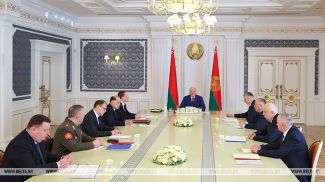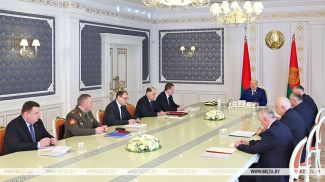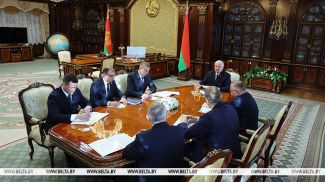
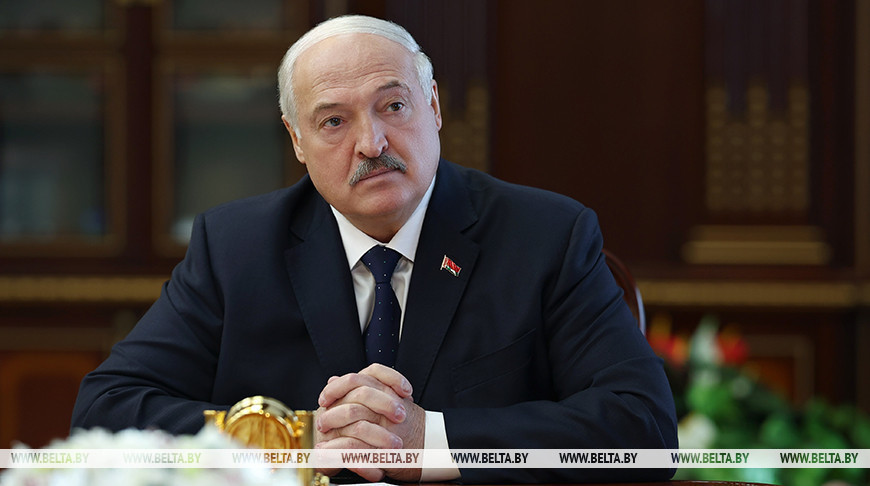
MINSK, 9 February (BelTA) - Belarusian President Aleksandr Lukashenko has generally supported the draft decree on improving scientific activity, but some of its provisions have been sent for revision, Chairman of the Presidium of the National Academy of Sciences of Belarus Vladimir Karanik told the media, BelTA has learned.
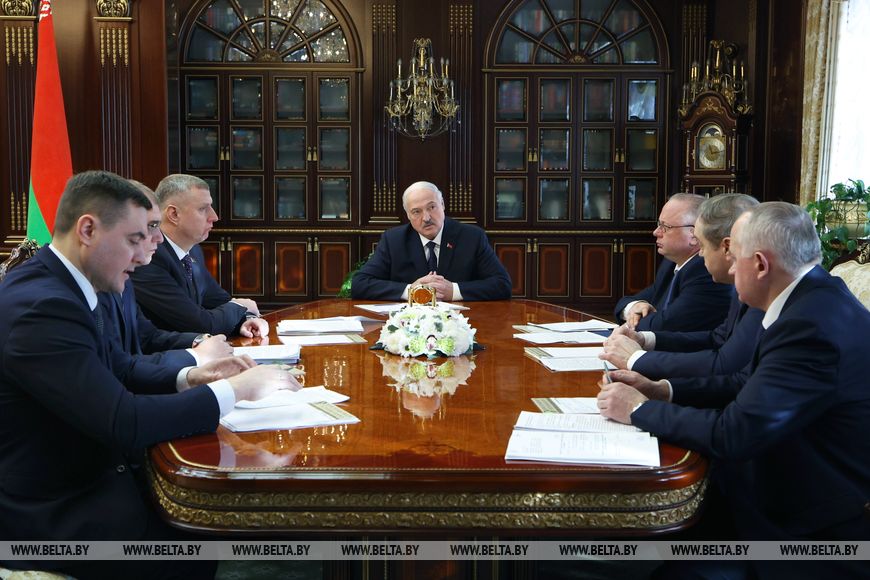
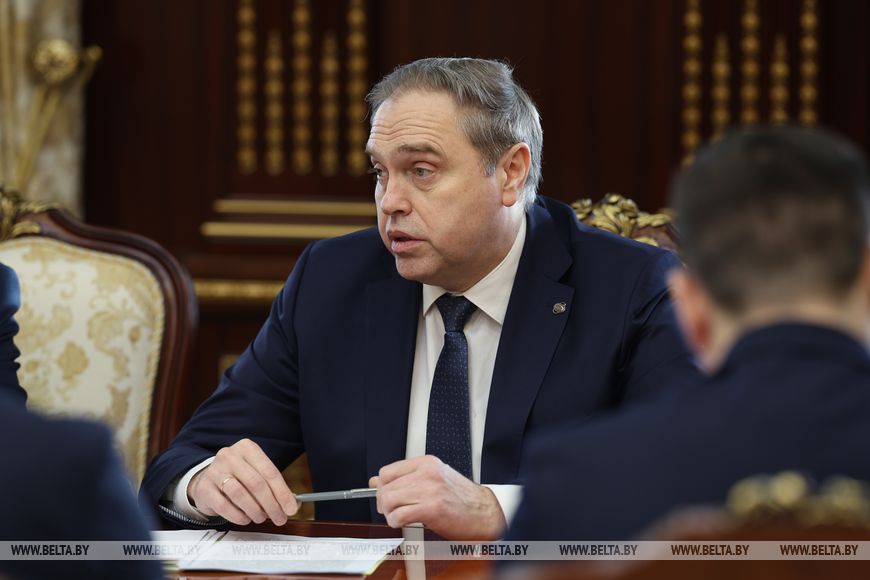
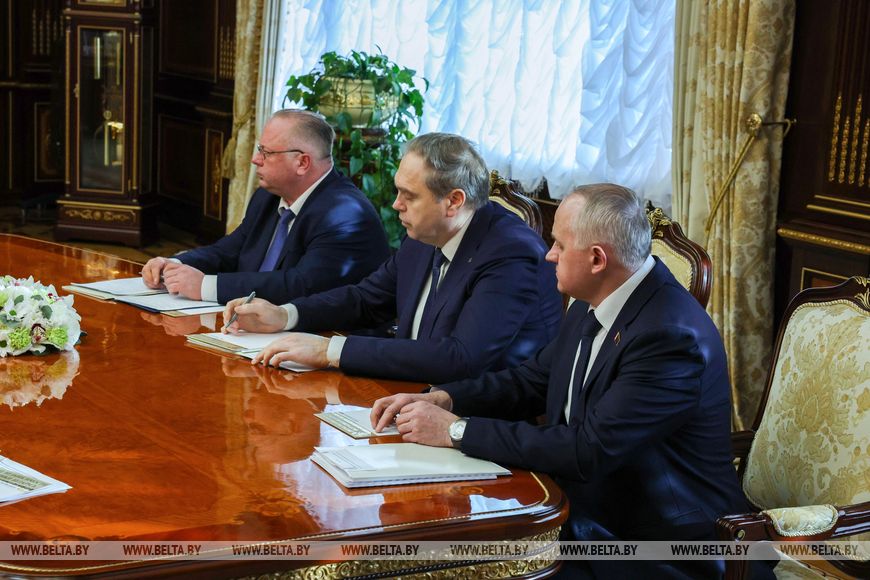
“In principle, the draft decree has been supported, some of its provisions have been sent for revision, including the issue of basic funding. Some parts have been approved such as optimizing the structure, the possibility of pedagogical activity, and the possibility of increasing additional payments for academic degrees in those fields that are priorities for our country,” Vladimir Karanik said.
He emphasized that the Academy of Sciences in Belarus is a unique organization operating on the principle of a research and production corporation. As a result, some legislative acts fail to account for the fact that the academy encompasses not only scientific but also production-related activities.
“Consequently, we face limitations in funding certain areas. The head of state has instructed us to convene with the Finance Ministry, the government, and the President Administration to determine how to enable the Academy of Sciences to develop more dynamically, both in terms of production and scientific pursuits,” the NASB head said.
However, he noted, the fundamental issue is not the funding of science, as it is. The question lies in increasing the efficiency of this process. “If we take the budget of the Academy of Sciences for 2026, compared to 2025, the increase is 23%. This is a significant figure. Moreover, the social and economic development program for the upcoming five-year period envisions an almost twofold increase in spending on scientific activities,” Vladimir Karanik said. He emphasized that these funds must be effective and yield concrete results, which was precisely the focus of the discussion during the meeting with the head of state.
“If budgets are separated, some might develop a dependent mindset: if funds are provided for operational expenses, perhaps there's no need to engage in scientific projects and other activities. The state is ready to pay for infrastructure, but within the framework of fulfilling state orders or contract-based activities, allocating a certain percentage toward infrastructure,” Vladimir Karanik explained.
At the same time, the NASB head noted that the president once again reiterated that no one will cut spending on science. The real sector of the economy will continue to be encouraged to turn to domestic science to solve scientific problems, rather than purchase ready-made imported technologies at global prices. “Here lies our task: not to disappoint the hopes of producers and to deliver high-quality scientific and technological products. If we succeed, scientific organizations will no longer face questions about where to find funds for maintenance and heating,” Vladimir Karanik added.
In his opinion, the decree on improving scientific activity will also help the structures of the Academy of Sciences to get rid of “ballast”. This refers to those components that do not contribute to gaining new knowledge or implementing new projects. Furthermore, the document will establish mechanisms that will allow for the funding of various areas, such as fundamental and applied sciences, as well as agricultural topics.
“When we optimize the structure and remove non-core assets, we will then return to the question of how to fund, within the budget estimates, what requires direct funding from the budget,” Vladimir Karanik believes. “But it must be understood that optimization is not aimed at reducing scientific research areas. Optimization is primarily intended to eliminate inefficient and cumbersome management structures. This does not concern research scientists. It concerns that part of the Academy of Sciences which does not generate new knowledge or address scientific questions.”