
Photo courtesy of the Council of the Republic of the National Assembly of Belarus
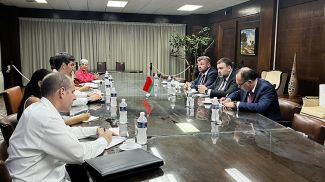
MINSK, 21 May (BelTA) – Belarus and Russia are strengthening their defense potential against the backdrop of the military-political situation in the West. Chairman of the Commission on International Affairs and National Security of the Council of the Republic of the National Assembly of Belarus Sergei Aleinik made the statement during a session of the Commission on Political Issues and International Cooperation of the CIS Interparliamentary Assembly, which is taking place in the Tauride Palace in St. Petersburg, BelTA has learned.
“I think no one has any doubt that the unstable geopolitical situation in the world and the crisis of international relations have a negative impact on international and regional security. There is an obvious trend toward a deterioration of the military-political situation on the western borders of the Union State of Belarus and Russia, which is related to the general course of the political elites of individual Western countries and the North Atlantic bloc (NATO) toward preparing for war with an alleged imaginary threat from the East,” Sergei Aleinik said.
The parliamentarian drew attention to the militarization of economies, the growth of military budgets, the deployment of NATO contingents, and large-scale military exercises near the borders of the Union State. He noted that the total military spending of the alliance member states surpassed $1 trillion long ago. In 2025 the combined military spending of Poland, Lithuania, and Latvia exceeded €52 billion, which is 25 times more than Belarus’ defense spending.
“All this cannot be ignored, and our countries are analyzing the situation and implementing exhaustive measures to strengthen their defense potential. Among them is the deployment of Russian tactical nuclear weapons and Russian missile systems Oreshnik [hazelnut] on the territory of Belarus,” the commission chairman said.
He emphasized that these steps are a purely defensive measure, provided for, among other things, by the Belarusian-Russian treaty on security guarantees within the framework of the Union State.
“But unlike our Western partners, Belarus and Russia demonstrate restraint and readiness to jointly seek solutions that could contribute to the gradual restoration of dialogue, reduction of the confrontation, and the development of solutions to build a regional security system based on the principle of its indivisibility as a key factor in the viability and durability of this system,” Sergei Aleinik noted.
The commission chairman noted that since the Organization for Security and Co-operation in Europe (OSCE) has virtually signed its own declaration of professional incompetence in finding solutions to conflicts, Belarus initiated the organization of the Minsk International Conference on Eurasian Security during its presidency in the CSTO in 2023. This platform has been searching for solutions for three years already to contribute to the creation of effective security mechanisms in Eurasia.
“It is in Eurasia where the principles of justice and equality are understood more deeply, the importance of the principle of indivisibility of security is fully realized, and international law is greatly respected as well as each other’s national, religious, and cultural peculiarities,” the parliamentarian remarked.
Sergei Aleinik pointed out that this is why the Belarusian side had launched the process of discussing the prospects of building a Eurasian security architecture. There are plans to hold the fourth Minsk conference this year, and Belarus expects even more Eurasian countries to participate in it.
Speaking about the initiative to develop the Eurasian Charter of Diversity and Multipolarity in the 21st Century, the parliamentarian emphasized that the idea of the charter had not been pulled out of thin air, but was one of the practical elements of the initiative to recognize the paths of progressive development as a value of human civilization, which was put forward by Belarus President Aleksandr Lukashenko at the 2005 UN Summit.
“The initiative is aimed at building in Eurasia a fair order based on the principles of indivisible security, equality, mutual respect, and cooperation. The charter could formulate the parameters and principles for the functioning of the security architecture in the Eurasian space as well as a strategic vision of multipolarity for an updated system of international relations,” Sergei Aleinik said.