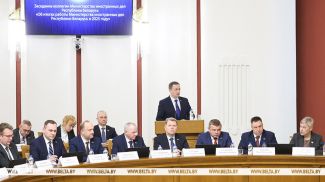
Photo courtesy of the Belarusian Ministry of Foreign Affairs
MINSK, 27 January (BelTA) - An international conference on Unilateral Coercive Measures: Contemporary Threats and Challenges was held in Brussels under the auspices of the Belarus’ Permanent Mission to the EU and members of the European Parliament, BelTA has learned.
The forum brought together about 100 guests from more than 25 countries. Participants included heads of diplomatic missions, MEPs, experts, lawyers, businesspeople, and representatives of the European Commission and other EU institutions.

The conference addressed the illegitimacy of sanctions, citing numerous examples of their negative impact on the rights and legitimate interests of ordinary citizens.
UN Special Rapporteur on the negative impact of unilateral coercive measures on human rights Alena Douhan highlighted that any sanctions may only be applied by a decision of the UN Security Council. All other restrictions are unilateral coercive measures, illegitimate from the standpoint of international law.
According to Alena Douhan, invocations of “lofty values”, “fighting for democracy”, and other “good intentions” do not bestow sanctions with legality, legitimacy, or justification. In essence, it is interference by certain states in the affairs of sovereign nations under the false guise of promoting “democracy” and human rights - rights that these very actions brutally trample.
Unilateral coercive measures have a devastating impact on a wide range of human rights, including the rights to food, work, healthcare, freedom of movement, and legal protection. They undermine the capacity of affected states to provide adequate social support and guarantee human rights due to the reduction of available resources.
These conclusions have been repeatedly confirmed by a multitude of evidence collected by UN Special Rapporteurs and are reflected in resolutions of the UN Human Rights Council. The issue of the harmful impact of UCMs on global food security has also been discussed repeatedly within other structures of the United Nations.
According to Belarus’ Permanent Mission to the EU, the problems of unilateral coercive measures are currently relevant not only for Belarus. Such illegitimate actions affect Russia, Iran, China, North Korea, Myanmar, Libya, Sudan, Somalia, Yemen, Burundi, the Central African Republic, the Republic of the Congo, Guinea, and other countries.
The European Union employs similar measures against more than 30 states worldwide. The combined population of these countries exceeds 2.2 billion people.
“The conference served as a call for a broad discussion among states, including on the platforms of the UN and other international organizations, on the need for workable humanitarian exemptions, or optimally, the complete elimination of the practice of applying unilateral coercive measures in contexts where the deterioration of citizens’ living standards becomes an objective of the foreign policy of certain countries, and hunger is used as a tool of coercion,” the Belarusian diplomatic mission stressed.