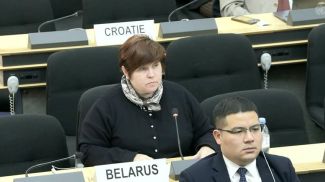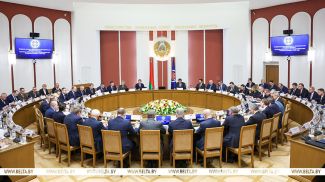

MINSK, 11 March (BelTA) – Belarus calls upon OSCE countries to refrain from confrontation and resume professional dialogue, especially in military matters. The statement was made by the Permanent Mission of Belarus to the OSCE at the Forum for Security Cooperation (FSC) in Vienna, BelTA has learned.
The Belarusian diplomatic mission recalled that at the last session of the forum the UK delegation called on Belarus to refrain from actions and rhetoric that militarize the OSCE region even more. In this regard, the representative of Belarus drew attention to the active militarization of the European continent and cited illustrative figures as an example.
For example, the North Atlantic Alliance intends to increase the level of military spending of its members to 5% of the GDP. The “roadmap for defense preparedness” agreed by the European Union envisages an injection of €800 billion into the defense sector by 2030. That means more than a threefold increase in spending on equipping the armed forces with combat aircraft, drones and heavy armored vehicles as well as further development of the military industry.
“The increase in military spending by the NATO member states that are neighbors of Belarus is indicative in this regard. In 2025 the combined military spending of Poland, Lithuania, and Latvia exceeded €52 billion. This is 25 times more than Belarus’ defense appropriations. As early as this year Belarus’ NATO neighbors intend to reach a new military spending level of 5% of the GDP. Meanwhile, Belarus spends just over 2% of its GDP on defense. It is obvious that compared to the inflated military budgets of our neighbors, Belarus’ defense spending looks very modest. Accusations of militarization against Minsk are, to put it mildly, inappropriate,” the Belarusian diplomat stressed.
The diplomat noted that Belarus is not getting involved in a reckless arms race by radically increasing military spending. In this matter the republic proceeds from the principle of reasonable sufficiency. However, when military-political tensions escalate, including in the immediate vicinity of the country’s borders, when there are no reliable security guarantees, when arms control mechanisms and confidence-building measures deteriorate, then the country is forced to take additional measures to ensure national security. These include the deployment of Russian tactical nuclear weapons and the Oreshnik [hazelnut] missile complex. All of Belarus’ actions are commensurate with the growing challenges and threats to national security and the level of escalation in the region. They are purely defensive in nature and are carried out in strict accordance with international law, including the Treaty on the Non-Proliferation of Nuclear Weapons,” the permanent mission said.
In its speech the British delegation called for using the OSCE Forum for Security Cooperation to restore practical mechanisms of risk reduction and incident prevention, ensure transparency and reopen channels of communication.
“All these measures should be based on professional and depoliticized dialogue, primarily in military matters. This is what Belarus has been insisting on within the framework of the Forum for Security Cooperation for the past four years. This is what our Western opponents stubbornly refuse to do. Is it possible that Western politicians simply do not trust military professionals in these matters, whose responsible communication may be guided by common sense? Excuses that such dialogue is hindered by Belarus’ tight cooperation with Russia do not stand up to any criticism,” the diplomatic mission said.
The reaction to Minsk’s invitation to participate in observing the joint Belarusian-Russian exercise Zapad 2025 and the refusal to engage in military contacts as a whole are telling examples. “Is there really such great concern about military activity in the territory of Belarus when for years Western countries have completely ignored the military-political instruments that would allow practically eliminating it? The Belarusian delegation once again calls on OSCE participating states to abandon the logic of confrontation and resume professional dialogue, especially about military affairs, in order to restore trust and create a space of equal and indivisible security on the European continent,” Belarus’ representative concluded.