
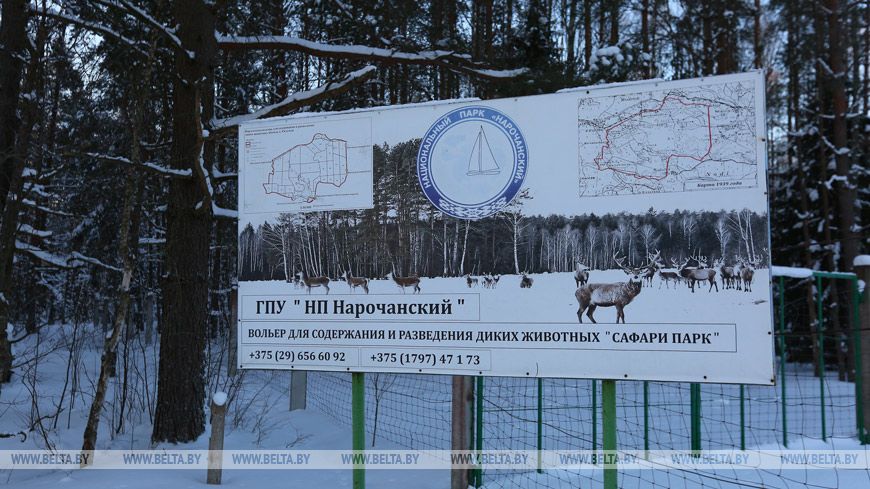
The Narochansky National Park operates a safari park, a unique place where visitors can observe red deer and European fallow deer from just a few meters away in their natural habitat. Without cages, fences, or the typical boundaries of a zoo. Why do tourists come here? BelTA’s correspondent found out.
The safari park covers an area of 1,753 hectares. It is home to about 400 red deer and 20–25 European fallow deer, which roam freely within a large, perimeter-fenced area. The tour program includes visits to feeding stations where wild animals gather and an introduction to the nature and history of the Naroch region.
Travel by specialized transport only
Early in the morning, those wishing to embark on a journey through this protected area gather at the entrance to the Hotel Naroch.
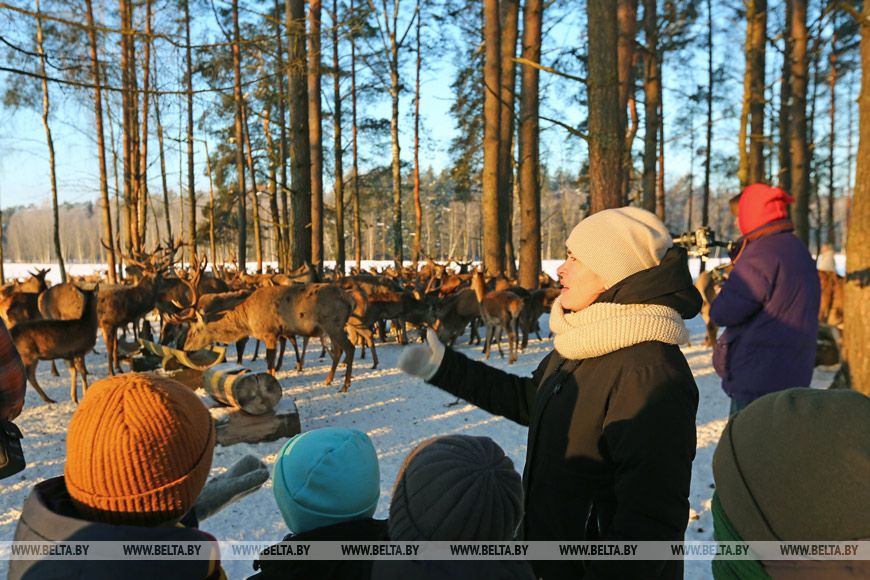
“Usually, tourists arrive the evening before and stay at the hotel. We depart for an excursion in the morning, using our National Park buses. Personal vehicles are not allowed to enter the protected area, to avoid introducing infectious diseases,” said Natalya Tal, a guide at the Narochansky National Park. She added that tours from Minsk are also organized and include round-trip transportation, a visit to the safari park, and lunch.
The excursion takes about 2–2.5 hours, travel time from the hotel Included. The trips begin in mid-September and last until mid-March, once a week on weekends. Visitors are introduced to the history of the Naroch region and learn about the physiological characteristics and habitats of wild animals.
“Tour groups mainly arrive during the feeding time of the park's inhabitants. After all, it's easier for humans to adapt to the deer's schedule, not the other way around,” Natalya Tal said. “The main goal of our safari park is not to feed the animals, but to create conditions in which they feel comfortable in their natural environment.”
The park began operating in 2009 as an enclosure for deer breeding and keeping, aimed at establishing a Belarusian population. Animals were brought to the Narochansky National Park from across the country, with some individuals sourced from CIS regions to refresh the gene pool of the existing herd.
Tourists have been visiting the safari park since 2014, and the number of visitors continues to grow with each season.
Deer harem
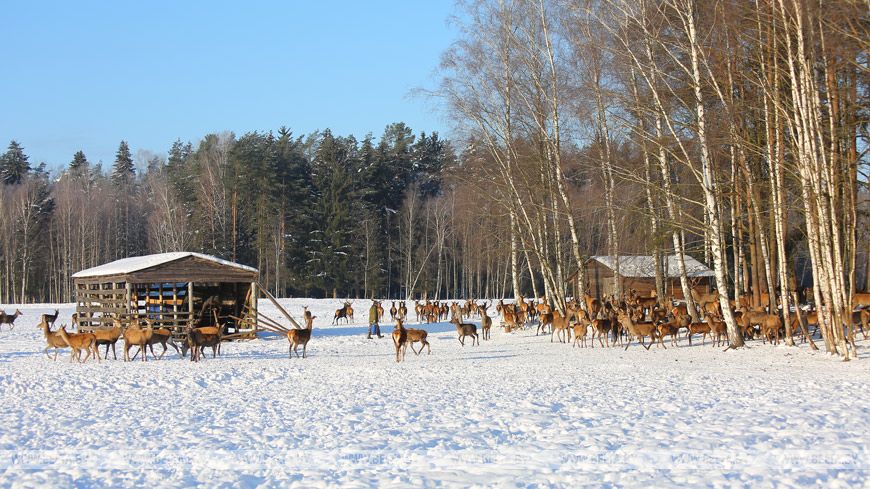
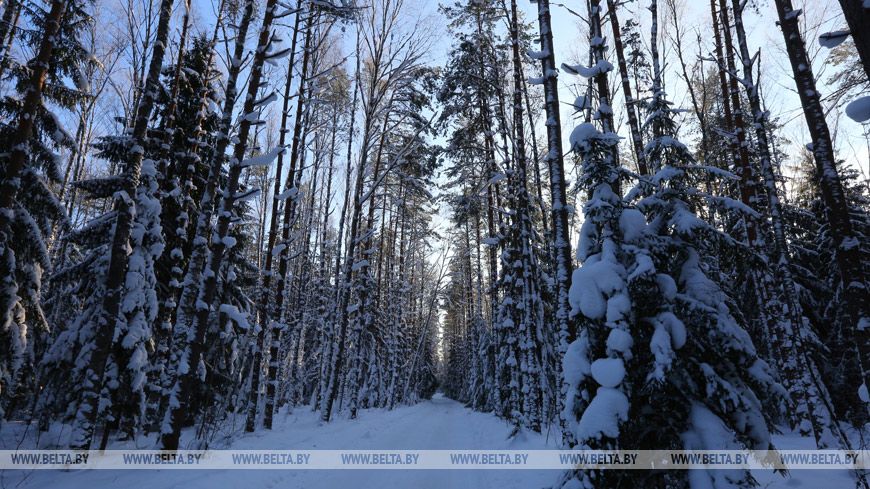
A true winter fairy tale began when our buses passed the village of Malaya Syrmezh: tall primeval forest covered in snow. Along a winding road, we approach the fenced area. This is where the safari park begins. A large field opens before us, surrounded on all sides by a ridge of treetops. From the forest area to a small grove where the feeding station is located, raising a column of snow shimmering in the morning sun rays behind them, runs a herd of red deer and roe deer.
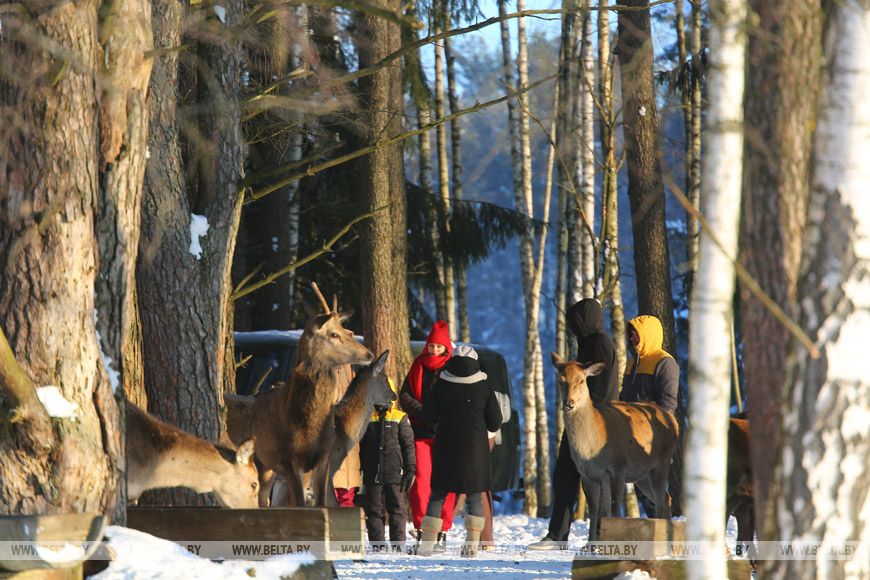
“Our park is home to about 400 red deer and 20-25 European roe deer. Their numbers are increasing every year,” Natalya Tal tells said to visitors, just a few meters from the feeders.
Some tourists try to approach the forest inhabitants closer, but they, hearing the slightest rustle or twig crunch under a visitor's foot, scatter in all directions. The deer stop at a safe distance from people, raise their muzzles, and only after making sure the danger has passed, return to eating.
“Each herd has its own groups and hierarchy. Females, fawns, and young stock make up the majority. Mature young males, “antlered ones”, stay in a group, and conflicts often arise between them. Older males aged 8-10 years, with magnificent antler crowns, gather a harem of females around themselves and guard it. The deer's lifespan in the wild is 15 years, but under such favorable conditions as here - up to 25,” the guide shared scientific facts with tourists.
And there are quite a few similarities between humans and animals! For example, deer have two more teeth than humans. The gestation period lasts 8-8.5 months. Usually females give birth to one fawn, rarely two.
“The excursion program is more educational than entertaining. National Park specialists present interesting facts in an easy and accessible form, understandable to both adults and children. I introduce the deer through its close connection to humans. I talk about the animal's symbolism as a patron of well-being, wealth, and prosperity. Even in fairy tales, deer often speak with a human voice and help lost travelers find their way out of the forest,” Natalya Tal said.
Over 30 excursions
Tourism in the Narochansky National Park is mainly focused on serving the hotel compound, guest cottages, and resort area. There are tourist campsites on 10 lakes for recreation. Hunting, fishing, educational, and excursion tours are actively developed.
“Our nature has always been in demand and attractive to visitors who can swim in clean lakes in summer, visit the rare plants park, and breathe fresh coniferous air,” said Lyudmila Kravchenok, head of the tourism department of the Narochansky National Park. “To vacationers in health resorts, we offer an overview excursion of the resort area or a trip along an ecological route to learn about local flora and fauna. Such educational tours are especially popular with people from other regions of the country or from abroad.”
Today the national park offers more than 30 different excursions both on its territory and across Belarus. Weekend tours tied to various holidays enjoy particular popularity.
During school holidays, various trips around the Narochansky region are organized for schoolchildren.
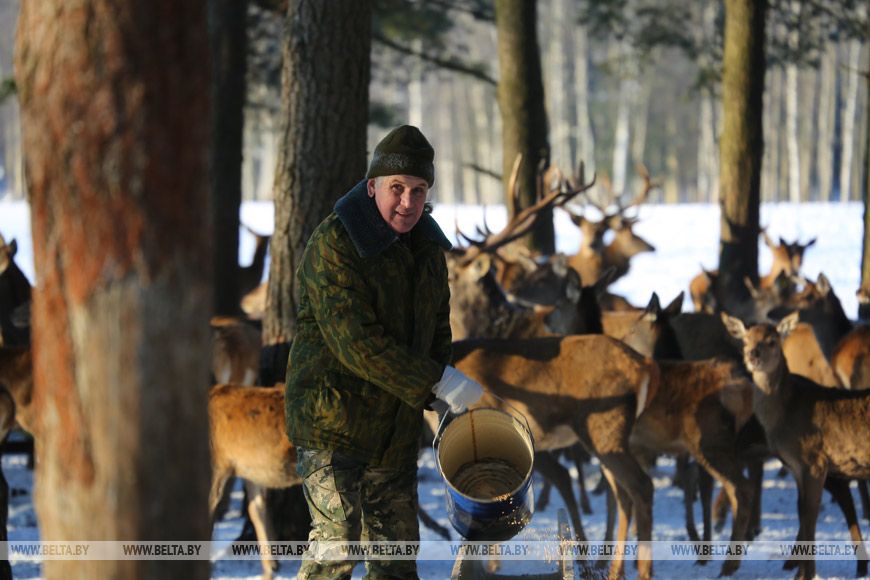
A snorting herd of deer is tended by rangers who carry grain from the shed near the grove and refill the feeders. The forest dining room for wild animals consists of several elongated troughs secured between trees or mounted on stands throughout the grove. The park has two feeding stations. One is filled with grain, which we visit first; the other, with hay and silage, is further along the route.
“Feeding follows a buffet system to avoid large gatherings of deer in one place,” explains Oleg Karpik, head of the safari park. “Many tourists ask guides before arriving: what should we bring to feed the animals? Nothing is needed! Our deer are not accustomed to carrots, crackers, or apples. After all, they cannot find this food in the wild. Therefore, we strictly monitor their diet so that at the feeding stations, the animals supplement the amount of food they couldn't obtain independently in the wild environment.”
After the story about the life of the park's inhabitants, tourists bombard the guide with questions: how much do the antlers cost, how to buy a deer, can you pet it? Not only children ask, but also adult men, whose eyes light up near wild animals too.
“The sight of a red deer impresses - its antlers, energy, and strength. Especially mesmerizing is how it runs, kicking up a column of snow behind it. It’s also great that you can get as close as possible to the animal. In those moments, you feel a unity with nature. Here it's not like in a zoo: there’s no fence or barriers between you and the deer. There’s no feeling that the animal is in captivity,” tourist Sergei shared his impressions, noting that a frosty sunny day adds even more vivid experiences.
Visitors take lots of photos and videos. By the way, some celebrate their birthdays here.
“Our group of 36 people, adults and children, came from Kolodishchy Secondary School No. 2. The kids are bursting with excitement. Even some dads were saying among themselves that in their whole lives they've never seen deer so close up and so many,” said Kristina, mother of the birthday boy.
Tourists are gradually boarding the buses to continue along the route. Ahead lies a visit to another feeding station, and a location with a beaver lodge and dam.
I ask Natalya Tal: why the name “safari park” when the excursion has nothing in common with wild hunting?
“Because you can't get around here on foot or just stroll around like in a zoo. A safari park is a place where a person is an observer of wild nature's life and comes into contact with its inhabitants in their natural environment,” the guide explained.
A few minutes after the buses left, the red deer and roe deer gathered into a herd and, led by a leader with large branched antlers, galloped into the forest, leaving behind snow dust settling on the snowdrifts.
In legends and fairy tales, the deer is a symbol of wealth, prosperity, and abundance.
Vadim Kondratyuk, 7 Dnei newspaper
The safari park covers an area of 1,753 hectares. It is home to about 400 red deer and 20–25 European fallow deer, which roam freely within a large, perimeter-fenced area. The tour program includes visits to feeding stations where wild animals gather and an introduction to the nature and history of the Naroch region.
Travel by specialized transport only
Early in the morning, those wishing to embark on a journey through this protected area gather at the entrance to the Hotel Naroch.
“Usually, tourists arrive the evening before and stay at the hotel. We depart for an excursion in the morning, using our National Park buses. Personal vehicles are not allowed to enter the protected area, to avoid introducing infectious diseases,” said Natalya Tal, a guide at the Narochansky National Park. She added that tours from Minsk are also organized and include round-trip transportation, a visit to the safari park, and lunch.
The excursion takes about 2–2.5 hours, travel time from the hotel Included. The trips begin in mid-September and last until mid-March, once a week on weekends. Visitors are introduced to the history of the Naroch region and learn about the physiological characteristics and habitats of wild animals.
“Tour groups mainly arrive during the feeding time of the park's inhabitants. After all, it's easier for humans to adapt to the deer's schedule, not the other way around,” Natalya Tal said. “The main goal of our safari park is not to feed the animals, but to create conditions in which they feel comfortable in their natural environment.”
The park began operating in 2009 as an enclosure for deer breeding and keeping, aimed at establishing a Belarusian population. Animals were brought to the Narochansky National Park from across the country, with some individuals sourced from CIS regions to refresh the gene pool of the existing herd.
Tourists have been visiting the safari park since 2014, and the number of visitors continues to grow with each season.
Deer harem
A true winter fairy tale began when our buses passed the village of Malaya Syrmezh: tall primeval forest covered in snow. Along a winding road, we approach the fenced area. This is where the safari park begins. A large field opens before us, surrounded on all sides by a ridge of treetops. From the forest area to a small grove where the feeding station is located, raising a column of snow shimmering in the morning sun rays behind them, runs a herd of red deer and roe deer.
“Our park is home to about 400 red deer and 20-25 European roe deer. Their numbers are increasing every year,” Natalya Tal tells said to visitors, just a few meters from the feeders.
Some tourists try to approach the forest inhabitants closer, but they, hearing the slightest rustle or twig crunch under a visitor's foot, scatter in all directions. The deer stop at a safe distance from people, raise their muzzles, and only after making sure the danger has passed, return to eating.
“Each herd has its own groups and hierarchy. Females, fawns, and young stock make up the majority. Mature young males, “antlered ones”, stay in a group, and conflicts often arise between them. Older males aged 8-10 years, with magnificent antler crowns, gather a harem of females around themselves and guard it. The deer's lifespan in the wild is 15 years, but under such favorable conditions as here - up to 25,” the guide shared scientific facts with tourists.
And there are quite a few similarities between humans and animals! For example, deer have two more teeth than humans. The gestation period lasts 8-8.5 months. Usually females give birth to one fawn, rarely two.
“The excursion program is more educational than entertaining. National Park specialists present interesting facts in an easy and accessible form, understandable to both adults and children. I introduce the deer through its close connection to humans. I talk about the animal's symbolism as a patron of well-being, wealth, and prosperity. Even in fairy tales, deer often speak with a human voice and help lost travelers find their way out of the forest,” Natalya Tal said.
Over 30 excursions
Tourism in the Narochansky National Park is mainly focused on serving the hotel compound, guest cottages, and resort area. There are tourist campsites on 10 lakes for recreation. Hunting, fishing, educational, and excursion tours are actively developed.
“Our nature has always been in demand and attractive to visitors who can swim in clean lakes in summer, visit the rare plants park, and breathe fresh coniferous air,” said Lyudmila Kravchenok, head of the tourism department of the Narochansky National Park. “To vacationers in health resorts, we offer an overview excursion of the resort area or a trip along an ecological route to learn about local flora and fauna. Such educational tours are especially popular with people from other regions of the country or from abroad.”
Today the national park offers more than 30 different excursions both on its territory and across Belarus. Weekend tours tied to various holidays enjoy particular popularity.
During school holidays, various trips around the Narochansky region are organized for schoolchildren.
“We try to offer different types of recreation year-round. Everyone will find leisure options to their taste: from active and educational tourism to quiet time in forest areas far from civilization, depending on the season. Thanks to the development of tourist infrastructure in the Narochansky National Park, the number of visitors grows every season. Over 60,000 people vacation here annually,” Lyudmila Kravchenok noted.
Buffet for animals
Buffet for animals
A snorting herd of deer is tended by rangers who carry grain from the shed near the grove and refill the feeders. The forest dining room for wild animals consists of several elongated troughs secured between trees or mounted on stands throughout the grove. The park has two feeding stations. One is filled with grain, which we visit first; the other, with hay and silage, is further along the route.
“Feeding follows a buffet system to avoid large gatherings of deer in one place,” explains Oleg Karpik, head of the safari park. “Many tourists ask guides before arriving: what should we bring to feed the animals? Nothing is needed! Our deer are not accustomed to carrots, crackers, or apples. After all, they cannot find this food in the wild. Therefore, we strictly monitor their diet so that at the feeding stations, the animals supplement the amount of food they couldn't obtain independently in the wild environment.”
Additionally, rangers lay out feed in several locations: on forest edges and meadow areas, so that different groups of deer, into which the large herd has split, have access to supplemental feeding.
Sense of unity
Sense of unity
After the story about the life of the park's inhabitants, tourists bombard the guide with questions: how much do the antlers cost, how to buy a deer, can you pet it? Not only children ask, but also adult men, whose eyes light up near wild animals too.
“The sight of a red deer impresses - its antlers, energy, and strength. Especially mesmerizing is how it runs, kicking up a column of snow behind it. It’s also great that you can get as close as possible to the animal. In those moments, you feel a unity with nature. Here it's not like in a zoo: there’s no fence or barriers between you and the deer. There’s no feeling that the animal is in captivity,” tourist Sergei shared his impressions, noting that a frosty sunny day adds even more vivid experiences.
Visitors take lots of photos and videos. By the way, some celebrate their birthdays here.
“Our group of 36 people, adults and children, came from Kolodishchy Secondary School No. 2. The kids are bursting with excitement. Even some dads were saying among themselves that in their whole lives they've never seen deer so close up and so many,” said Kristina, mother of the birthday boy.
Tourists are gradually boarding the buses to continue along the route. Ahead lies a visit to another feeding station, and a location with a beaver lodge and dam.
I ask Natalya Tal: why the name “safari park” when the excursion has nothing in common with wild hunting?
“Because you can't get around here on foot or just stroll around like in a zoo. A safari park is a place where a person is an observer of wild nature's life and comes into contact with its inhabitants in their natural environment,” the guide explained.
A few minutes after the buses left, the red deer and roe deer gathered into a herd and, led by a leader with large branched antlers, galloped into the forest, leaving behind snow dust settling on the snowdrifts.
In legends and fairy tales, the deer is a symbol of wealth, prosperity, and abundance.
Vadim Kondratyuk, 7 Dnei newspaper
Photos by the author