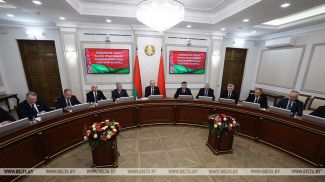

Screenshot of the video of the House of Representatives of the National Assembly of the Republic of Belarus
MOSCOW, 9 December (BelTA) - In 2027-2029, the Union State of Belarus and Russia will focus on the manufacturing industry, transport, and technological sovereignty, Chairman of the House of Representatives of the National Assembly of Belarus Igor Sergeyenko said as he spoke at the session of the Union State Parliamentary Assembly in Moscow on 9 December, BelTA has learned.
Igor Sergeyenko noted that in 2024-2026, integration programs have been implemented at 40%. “Work has begun on developing an action plan for the new three-year period, 2027-2029. The emphasis will be placed on such areas as industrial policy, technological sovereignty, food security, transport, energy, and tourism. And we need to promptly engage in this work,” he said, addressing the Union State parliamentarians.
“It has long been necessary to pay more attention to the implementation of roadmaps for cooperation in microelectronics, machine tool building, aviation, and elevator construction. The activities of specialized commissions directly on the ground and contacts with the leadership of the regions of Belarus and Russia must also be of a practical nature,” the speaker emphasized.
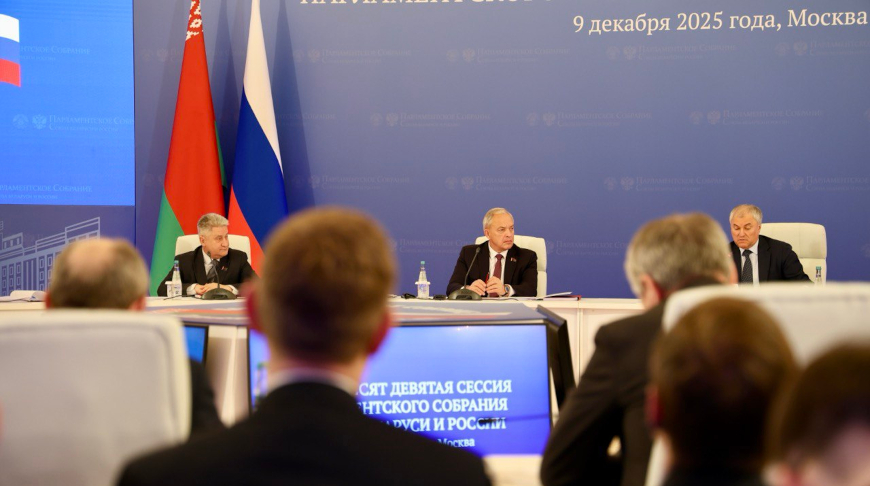
He recalled that this year a number of measures demanded by citizens of both countries were adopted to ensure equality of rights in the areas of education, healthcare, employment, support for the older generation, and cross-border transport. “For example, the initiative to create a unified system of compulsory civil liability insurance for vehicle owners in the Union State has been successfully implemented, and about 70,000 contracts have already been signed. But there is still work to be done. In particular, this concerns the harmonization of legislation on enforcement proceedings,” the speaker noted.
“In general, we have already achieved certain results in ensuring equal rights for citizens. But, as many deputies rightly point out, our voters' awareness of the new opportunities available to them leaves much to be desired. We understand that in the context of hybrid warfare, a lack of reliable information can lead to various speculations about Union State issues and public discontent. Therefore, parliamentarians must pursue a proactive information policy to address this issue,” Igor Sergeyenko stressed.
Igor Sergeyenko noted that in 2024-2026, integration programs have been implemented at 40%. “Work has begun on developing an action plan for the new three-year period, 2027-2029. The emphasis will be placed on such areas as industrial policy, technological sovereignty, food security, transport, energy, and tourism. And we need to promptly engage in this work,” he said, addressing the Union State parliamentarians.
“It has long been necessary to pay more attention to the implementation of roadmaps for cooperation in microelectronics, machine tool building, aviation, and elevator construction. The activities of specialized commissions directly on the ground and contacts with the leadership of the regions of Belarus and Russia must also be of a practical nature,” the speaker emphasized.
He recalled that this year a number of measures demanded by citizens of both countries were adopted to ensure equality of rights in the areas of education, healthcare, employment, support for the older generation, and cross-border transport. “For example, the initiative to create a unified system of compulsory civil liability insurance for vehicle owners in the Union State has been successfully implemented, and about 70,000 contracts have already been signed. But there is still work to be done. In particular, this concerns the harmonization of legislation on enforcement proceedings,” the speaker noted.
“In general, we have already achieved certain results in ensuring equal rights for citizens. But, as many deputies rightly point out, our voters' awareness of the new opportunities available to them leaves much to be desired. We understand that in the context of hybrid warfare, a lack of reliable information can lead to various speculations about Union State issues and public discontent. Therefore, parliamentarians must pursue a proactive information policy to address this issue,” Igor Sergeyenko stressed.