
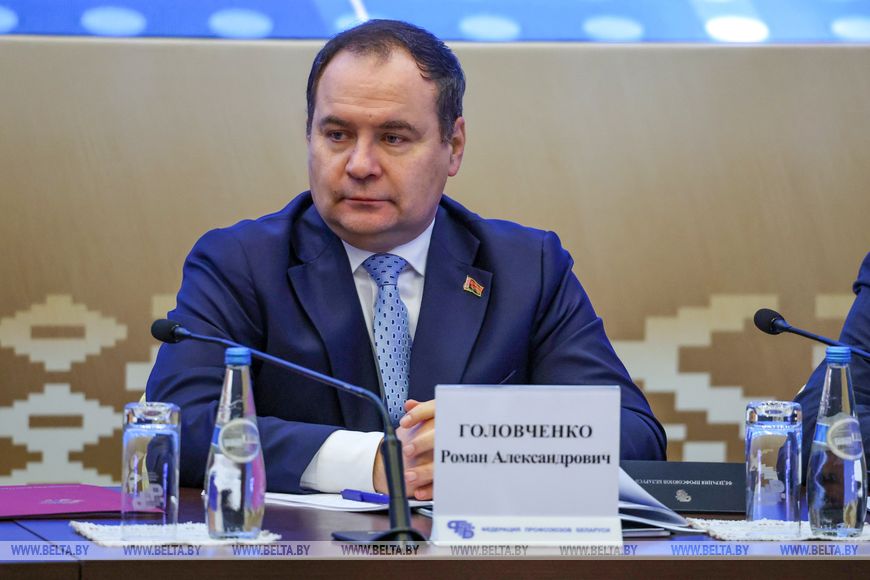
MINSK, 12 December (BelTA) - Head of the Belarus President Administration Dmitry Krutoi outlined the priorities for the 2026-2030 social and economic development program at a meeting of the 11th Extraordinary Congress of the Federation of Trade Unions of Belarus (FTUB), BelTA has learned.
Dmitry Krutoi noted that Belarusian People's Congress delegates had submitted over 1,000 proposals regarding the social and economic development program. “The proposals are grouped into thematic blocks, and government members and MPs are working on them today. Possibly, we will revise some of the points following the Belarusian People's Congress,” he added.
"Our people are very concerned about jobs. Among the main questions is whether the 'One District, One Project' initiative will continue. Over 150 projects have already been implemented, and about another hundred are in various stages of development,” Dmitry Krutoi said. “I believe special emphasis will be placed on additional benefits, incentives, and preferences to stimulate industrial jobs outside large settlements.”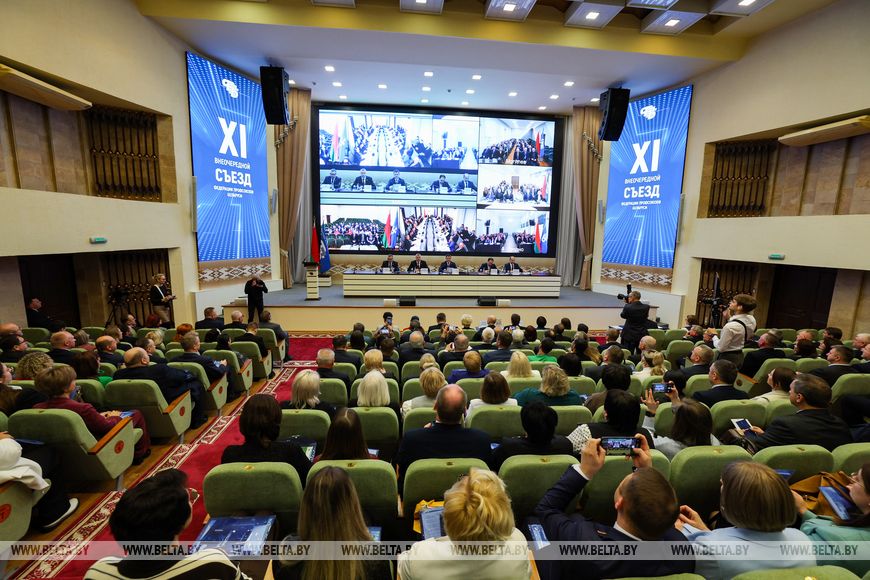
Dmitry Krutoi noted that Belarusian People's Congress delegates had submitted over 1,000 proposals regarding the social and economic development program. “The proposals are grouped into thematic blocks, and government members and MPs are working on them today. Possibly, we will revise some of the points following the Belarusian People's Congress,” he added.
"Our people are very concerned about jobs. Among the main questions is whether the 'One District, One Project' initiative will continue. Over 150 projects have already been implemented, and about another hundred are in various stages of development,” Dmitry Krutoi said. “I believe special emphasis will be placed on additional benefits, incentives, and preferences to stimulate industrial jobs outside large settlements.”
According to Dmitry Krutoi, the country's technological sovereignty and import substitution are the guiding principles running through the entire program. “The industrial foundation of our country must be preserved. Industry is our crucial point of effort. The situation is also challenging. The situation in export markets (both our traditional ones and those in the ‘far arc’ countries) is difficult. But we must fight for every market. Therefore, our products must first and foremost be competitively priced and meet all quality standards. It is impossible to break into a new market today without a comprehensive solution and full-service support. This will be a serious challenge for us, and the 'Export' section of the program for the next five-year period suggests increasing the share of the 'far arc' markets, which currently stands at approximately 20-22%, by 10%,” Dmitry Krutoi emphasized.
“Competition in a number of sectors has intensified significantly. Therefore, technological sovereignty, establishing new industrial enterprises in small settlements, and thereby advancing the concept of strong regions are priorities of the social and economic program,” Dmitry Krutoi noted.
The head of the Belarus President Administration emphasized that the export targets and the plans for real incomes of the population set for the current five-year period have been fulfilled. “We have a record low unemployment, and by and large, it is a job seeker's market, not an employer's market. The job bank currently lists approximately 170,000 vacancies that need to be filled immediately. Nearly all our enterprises are facing a significant labor shortage. This is precisely why a system for attracting skilled foreign workers was established. Around 35,000 individuals without permanent residency in Belarus are currently employed at our enterprises. This number is small and does not solve the overall labor shortage, but maintaining a balance here is crucial,” he said.
Dmitry Krutoi added that the share of wages in the total cost structure has reached 25-30%. “This can significantly increase the cost of goods. This salary race and the competition among our enterprises for specialists, primarily in blue-collar professions, must be under the constant supervision of the government. We must not allow any imbalances because labor productivity is also one of the priorities of the program,” he emphasized.
“In terms of labor productivity, Belarus ranks 67th out of approximately 160 countries participating in this global index. Therefore, we have the potential to at least double our labor productivity. It is on this healthy foundation that we can increase wages. Currently, the average wage in the country has reached approximately Br 2,700-2,800. This is the average, but we must also examine the regional and sectoral breakdowns and address this issue within that context,” Dmitry Krutoi said.
Dmitry Krutoi was elected delegate to the Belarusian People's Congress from the Federation of Trade Unions of Belarus.
The head of the Belarus President Administration emphasized that the export targets and the plans for real incomes of the population set for the current five-year period have been fulfilled. “We have a record low unemployment, and by and large, it is a job seeker's market, not an employer's market. The job bank currently lists approximately 170,000 vacancies that need to be filled immediately. Nearly all our enterprises are facing a significant labor shortage. This is precisely why a system for attracting skilled foreign workers was established. Around 35,000 individuals without permanent residency in Belarus are currently employed at our enterprises. This number is small and does not solve the overall labor shortage, but maintaining a balance here is crucial,” he said.
Dmitry Krutoi added that the share of wages in the total cost structure has reached 25-30%. “This can significantly increase the cost of goods. This salary race and the competition among our enterprises for specialists, primarily in blue-collar professions, must be under the constant supervision of the government. We must not allow any imbalances because labor productivity is also one of the priorities of the program,” he emphasized.
“In terms of labor productivity, Belarus ranks 67th out of approximately 160 countries participating in this global index. Therefore, we have the potential to at least double our labor productivity. It is on this healthy foundation that we can increase wages. Currently, the average wage in the country has reached approximately Br 2,700-2,800. This is the average, but we must also examine the regional and sectoral breakdowns and address this issue within that context,” Dmitry Krutoi said.
Dmitry Krutoi was elected delegate to the Belarusian People's Congress from the Federation of Trade Unions of Belarus.