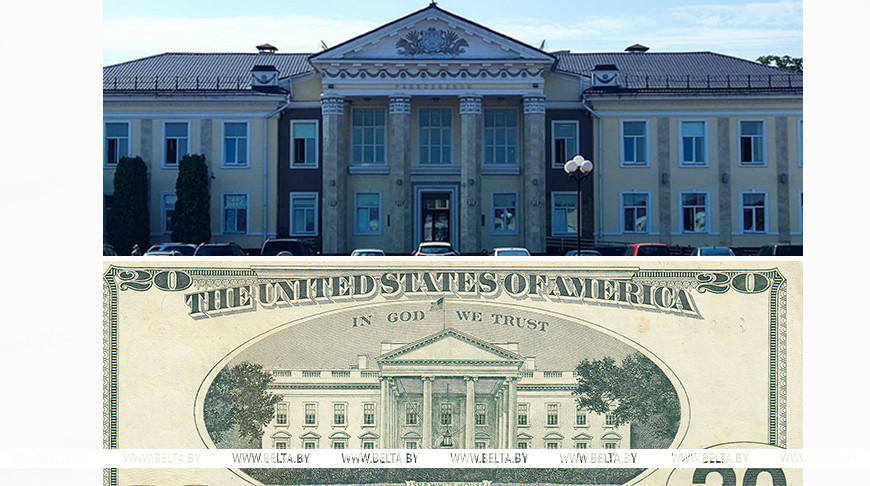
GOMEL, 1 December (BelTA) - How long has the building of the Zhlobin District Executive Committee been ‘featured’ on American currency, and why has collective attention only been drawn to this now? The ONT TV channel compared the “images” from different angles. Sergei Pogrebetsky, a historian, head of the Department of Ideological Work and Youth Affairs at the Zhlobin District Executive Committee, talked to BelTA to comment on the media hype regarding the similarity between the building of the local administration and the image of the White House on the reverse side of the $20 bill.
The striking resemblance between the two buildings (which, in yet another coincidence, both house government bodies) is more than just surprising; it has deeply astonished observant Belarusians. The discussion of this topic has literally gone viral across social media, generating hundreds of thousands of comments. Is it a trick of the imagination or a Belarusian nod to the U.S.currency? The curiosity it has sparked is even stronger than the interest in the exchange rate of the currency basket.
The striking resemblance between the two buildings (which, in yet another coincidence, both house government bodies) is more than just surprising; it has deeply astonished observant Belarusians. The discussion of this topic has literally gone viral across social media, generating hundreds of thousands of comments. Is it a trick of the imagination or a Belarusian nod to the U.S.currency? The curiosity it has sparked is even stronger than the interest in the exchange rate of the currency basket.
The strict symmetry of its lines, the pediment, the columns, and the fenestration of the two-story building are practically identical to the residences in Zhlobin and America. Against the broader architectural context and heated public discourse, the differences in roof details and bas-reliefs seem almost imperceptible to the collective consciousness.
Sergei Pogrebetsky is a native of Zhlobin District. He knows the history and architecture of his homeland not only from archives but from having personally witnessed how his beloved city has transformed over decades.
The ‘twin’ building of the White House in the district center was erected in 1954 and has housed government institutions ever since. An annex was added in the 1960s, after which the Soviet-era architecture saw no further intervention. However, in the 2000s, in preparation for the Dazhynki national harvest festival, the facade was renovated. During this work, the shape of the entrance columns was slightly altered from rounded to polygonal. The White House itself was built in 1800. The facts thus show a difference of a century and a half.
Local residents, as well as employees of the district executive committee, view the situation with a sense of humor. “Does Zhlobin have its own White House? There is a resemblance, but ours is prettier,” the civil servants say with a smile. People who have worked in this building for many years or are just beginning their professional careers do not tire of expressing their affection for the building’s exterior and interior. They particularly note the columns at the entrance, which are over three meters tall.
As it happens, architectural projects realized on different sides of the ocean have, at one point, “met” on an U.S. dollar banknote.
The U.S. banknote featuring the residence has been printed since 1928. Numismatists and collectors point out that the “Zhlobin façade” appeared on the banknote relatively recently. “Previously, the U.S. Federal Reserve printed notes depicting a different façade of the White House. After 2000, they decided to make changes and use an image of the building from a different angle. The $10 and $20 bills are the most popular and widely circulated in the USA, their print runs are enormous,” Valery Kravchenko, a member of the Board of the Belarusian Collectors’ Society, explained.
Both buildings were constructed at different times but are executed in a similar vein. The White House was built by an Irish architect in the so-called Palladian style. The Zhlobin District Executive Committee building, however, is executed in the spirit of Soviet Neoclassicism or Stalinist Empire style, which succinctly incorporates the richness of various architectural trends.
“The architect who designed the White House building drew inspiration from Ireland, which had borrowed heavily from Italian colleagues. We, of course, incorporated all the best elements that had been developed in the world - those that came from Italy, Ireland and America. This is why it ended up looking so similar,” explained Viktor Feshchenok, former chief architect of Zhlobin (1988-2002).
However, some experts in Belarusian architecture have gone further, noting similarities between the American and Zhlobin residences and the building of the Zhitkovichi District Executive Committee.
In addition, there is more than one architectural parallel drawn in the city of metallurgists. We are talking about an educational institution: if you look closely, Secondary School No. 5 in Zhlobin has similar features. To emphasize its historical significance, a park of 20th-century sculptures was created on its grounds. “We are ready to continue this tradition. If anyone has any sculptures that have been preserved, we would be happy to accept them and restore them, adding them to our collection of outdoor art,” Sergei Pogrebetsky said. He also added to the list of “White Houses” of the Soviet period in Zhlobin, including the building of Secondary School No. 6 and the Rodina cinema, which were built in the 1950s.
Local history expert Lyudmila Petrovskaya pointed out: “This should not come as a surprise, as many buildings during the Soviet era were constructed using standardized designs. As for district executive committees, similar buildings can be seen in a number of cities and towns. The only difference might be in the exterior finish or color schemes.”
“Our district boasts numerous buildings of remarkable architectural interest. While stories can be told about them, they are best experienced firsthand by seeing them up close and stepping inside. These include remarkable old manors and splendid sports facilities. Also, the largest metallurgical production site in the country is located in our area, so we are keen to offer all kinds of tourism: from historical to sports and industrial,” Sergei Pogrebetsky said
The staff of the Zhlobin Local History Museum view this situation as a kind of gift for the district center. The town of metallurgists takes delight in the curiosity of visitors and stands eager to welcome them, unveiling its historical secrets and unique architectural gems. The museum is also ready to go beyond the curiosity sparked by the U.S. $20 bill and offer a deeper look into much more significant historical facts.