

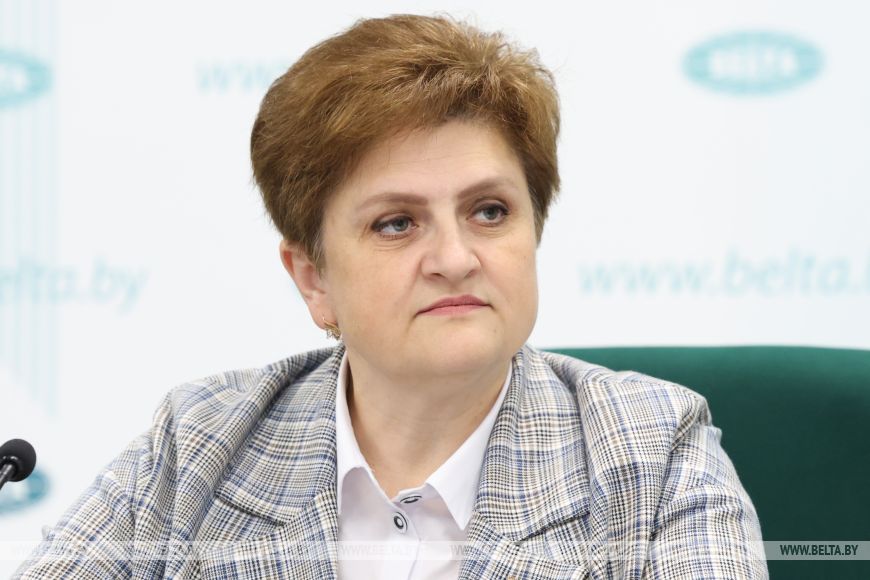
MINSK, 13 June (BelTA) – Yelena Zelenko, Head of the Department for Social Integration of Persons with Disabilities at the Belarusian Ministry of Labor and Social Protection, spoke at the BelTA press center about the solutions being implemented in Belarus for people with disabilities.
According to her, work to ensure barrier-free access to social infrastructure facilities is carried out through state programs. In addition, the Ministry of Labor and Social Protection closely cooperates with public associations: the Belarusian Society of the Disabled, the Belarusian Society of the Deaf, the Belarusian Association of the Visually Impaired, and the National Association of Wheelchair Users.
A key role in this area is played by the Law “On the Rights of Persons with Disabilities and Their Social Integration”, which established a systemic approach to creating an accessible environment. “The provisions of the law are aimed at organizing the surrounding space so that people with disabilities can have unobstructed access to services, facilities, information, and move freely along their chosen route,” she noted.
The country has mandatory construction standards titled “Living Environment for Physically Weakened Persons”. “This means that a building cannot be constructed if the project documentation does not take into account the requirements for comprehensive accessibility,” Yelena Zelenko emphasized. “And if it is impossible to fully equip a facility in line with accessibility requirements, the owners must take all possible measures, coordinated with public associations, to ensure access for persons with disabilities to the place where services are provided.”
“Today, people with disabilities have broad access to public information through television and print media, official websites of state bodies and organizations, using sign-language interpreters, subtitles, Braille, tactile graphics, assistive devices and technologies, and adapted websites,” she added.
An ongoing inventory of existing technical regulatory legal acts is conducted. “In 2025, new state standards came into force, establishing requirements for the accessibility of the tourism industry, visual and tactile-visual signage, rehabilitation equipment, wheelchair-securement systems, and much more,” Yelena Zelenko said.
In addition, an automated information system for recording the accessibility of social infrastructure facilities has been introduced. State bodies and organizations providing services across the country are involved in its operation. The system is regularly updated with information about accessibility features installed at facilities. According to Yelena Zelenko, the system is closely integrated with the public cadastral map, allowing users to check the accessibility of a given location.
“The public cadastral map also provides a link to the social protection portal, where one can see what exactly is accessible at a facility: how the restroom is equipped, whether it is possible to reach the second floor, and much more. A person can plan their route in advance from home,” she explained.
According to her, more than 30,500 facilities in Belarus are fully accessible to people with disabilities. This number is expected to increase by 2030. “A state program ‘Society of Equal Opportunities’ for 2026-2030 has been adopted, setting ambitious goals in this area,” Yelena Zelenko added.
“Only by combining the efforts of the state and society can we achieve our goals and ensure maximum integration of people with disabilities into all spheres of life,” she concluded.
Photo by Vitaly Pivovarchik